Blog/Guides
What are the top 17 Lattice competitors and alternatives in 2026?
Discover the best alternatives to Lattice performance management in 2026. Compare 17 top performance management tools, including AI-driven platforms like Taito.ai, built for modern teams seeking automation, continuous feedback, and growth.
TL;DR
- Lattice is still strong for structured HR cycles, but many companies are now prioritizing AI-native, continuous performance enablement over review-heavy systems.
- The biggest shift in 2026 is toward automation and real-time feedback, with tools like Taito.ai and Mesh.ai embedding coaching and insights directly into daily workflows.
- Teams are choosing alternatives based on maturity and speed — startups want lightweight, Slack-first tools, while enterprises prioritize OKR alignment and configurability.
- Cost and complexity are common switching triggers, especially for fast-growing companies seeking faster onboarding and less administrative overhead.
- The best alternative depends on your operating model: AI-first enablement (Taito.ai), continuous engagement and eNPS (FeedbackPulse), engagement analytics (CultureAmp), structured OKRs (Leapsome), lightweight check-ins (15Five), or enterprise alignment (Betterworks).
Lattice remains a well-established performance management platform, but newer AI-native solutions like Taito.ai and Mesh.ai are redefining the space with automation, real-time feedback, and intelligent coaching support. This guide explores the top 17 Lattice alternatives for 2026 to help teams find the best platform for their size, structure, and performance needs.
Performance management and employee enablement platforms have evolved rapidly in recent years. While Lattice remains one of the best-known names in the space, many growing companies are now exploring more flexible, AI-powered alternatives that reduce manual admin and focus on real-time performance enablement.
In this guide, we break down the best alternatives to Lattice performance management, including newer solutions like Taito.ai, which bring automation and AI to the center of modern performance practices.
What is Lattice?
Lattice is a popular people management platform designed to help organizations manage performance reviews, goal tracking, engagement surveys, and career growth. It’s widely used by HR and People teams in mid-sized and enterprise organizations that need structured performance cycles and integrated engagement insights.
The platform is known for its breadth of features, but also its reliance on manual configuration and process-heavy workflows. Lattice helps centralize HR programs effectively, but it can feel complex for teams seeking fast setup and lightweight automation.
While Lattice continues to be a leader in HR tech, many organizations are now prioritizing AI-driven, continuous performance enablement over traditional review cycles.
Some common reasons companies look for alternatives include:
- Desire for lighter, faster onboarding and simpler workflows
- Need for AI-powered insights that support managers and employees in real time
- Cost and scalability: Lattice’s enterprise-oriented pricing can become heavy as teams grow
- Preference for tools built around continuous feedback, 1:1s, and personalized coaching rather than review cycles alone
As noted in Gartner’s 2025 predictions by Unleash, AI could become the foundation of performance management through the automation of performance workflows.
McKinsey’s HR Monitor 2025 shows that high-performing organizations are already using automation and generative AI to reduce manual HR workloads, for example, cutting HR-to-employee ratios dramatically.
Quick decision matrix
| Tool | Best For | Key Strength |
|---|---|---|
| Lattice | Enterprise HR teams | Comprehensive performance & engagement suite |
| Taito.ai | Modern, fast-growing companies | AI-driven performance enablement (expectations, feedback, 1:1s) |
| CultureAmp | Engagement-focused organizations | Deep analytics and benchmark data |
| Windmill | Tech-forward teams that live in Slack | Continuous feedback and AI-enabled performance reviews |
| FeedbackPulse | Growing teams priced out of per-module suites | Engagement, eNPS, and 360 reviews in one plan from $4 per employee |
| Small Improvements | Teams that want structure without bureaucracy | Lightweight performance management platform |
| Sprad | Teams driving performance with business impact | AI-powered business-linked performance analytics |
| Leapsome | All-in-one people enablement | Strong OKR and feedback features |
| 15Five | Growth-oriented teams | Recognition, goals, and check-ins |
| HiBob | Mid-sized companies with core HR needs | Combines HRIS and engagement |
| Betterworks | Enterprise OKR management | Goal alignment and progress tracking |
| Peoplebox | Startups scaling fast | OKR and performance automation |
| Zavvy | Learning and feedback integration | Development journeys & automation |
| Mirro | Mid-market companies | Recognition and continuous feedback |
| Mesh.ai | AI-first engagement tool | Personalized insights and feedback loops |
| PerformYard | Professional services teams | Flexible review workflows |
| Engagedly | Culture-focused teams | Recognition, surveys, and gamification |
| Synergita | Traditional HR teams upgrading to digital | Goal tracking and appraisal automation |
The top 17 Lattice competitors and alternatives in 2026
We assessed every tool across five key areas: automation depth, AI capabilities, integrations, scalability, and feedback quality. These criteria capture what forward-thinking HR and performance enablement teams prioritize most in 2026.
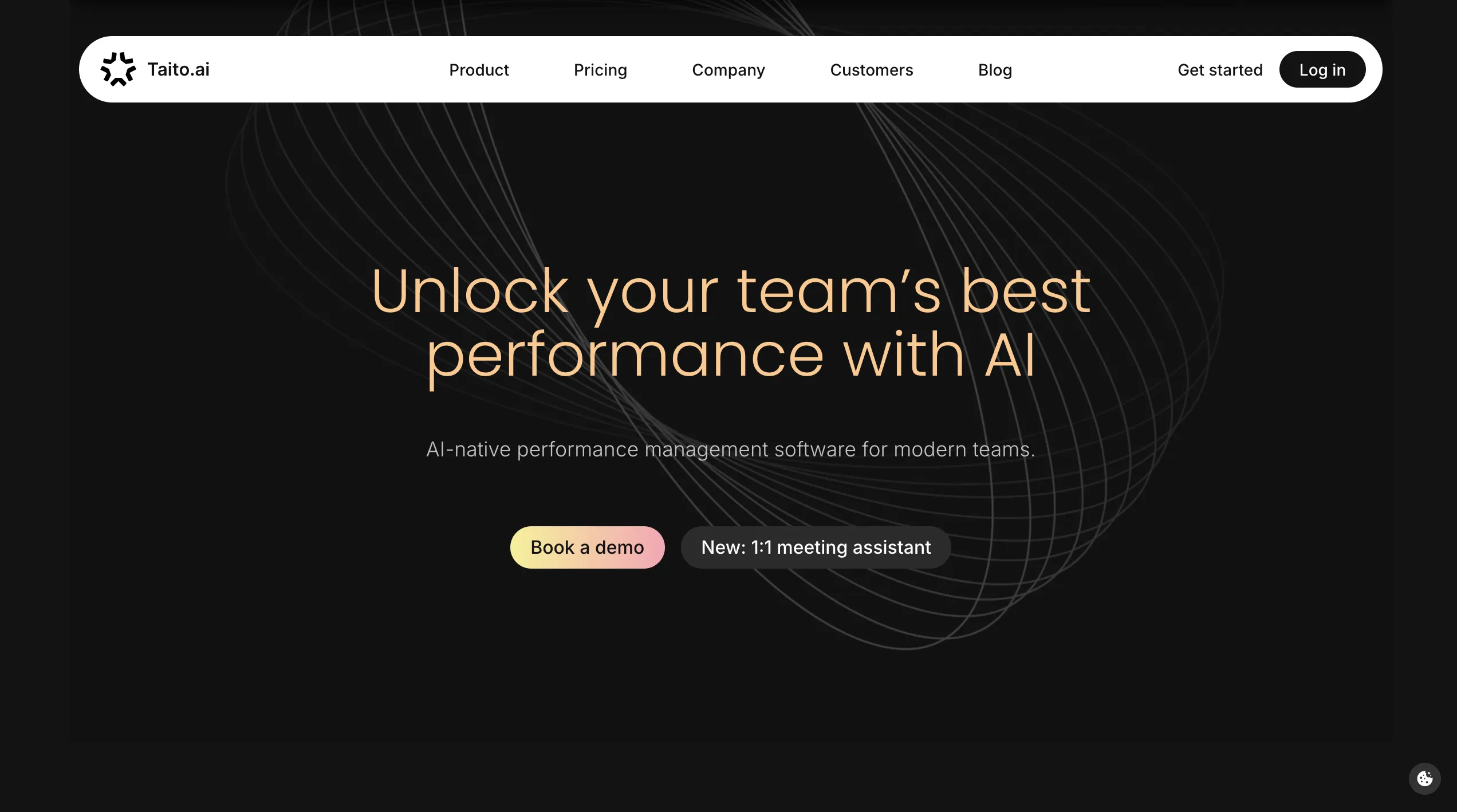
1. Taito.ai
Strengths:
- AI-generated role and expectations frameworks
- 1:1 meeting assistance and coaching prompts for managers
Limitations:
- Newer ecosystem, still expanding integrations and analytics depth
Integration & Onboarding: Integrates with Slack, Google Workspace, and leading HRIS tools; fast onboarding within days.
Pricing Range: Mid-range and scalable from startups to enterprise.
Best For: Teams looking for an AI-first alternative that automates growth and performance discussions.
2. Windmill
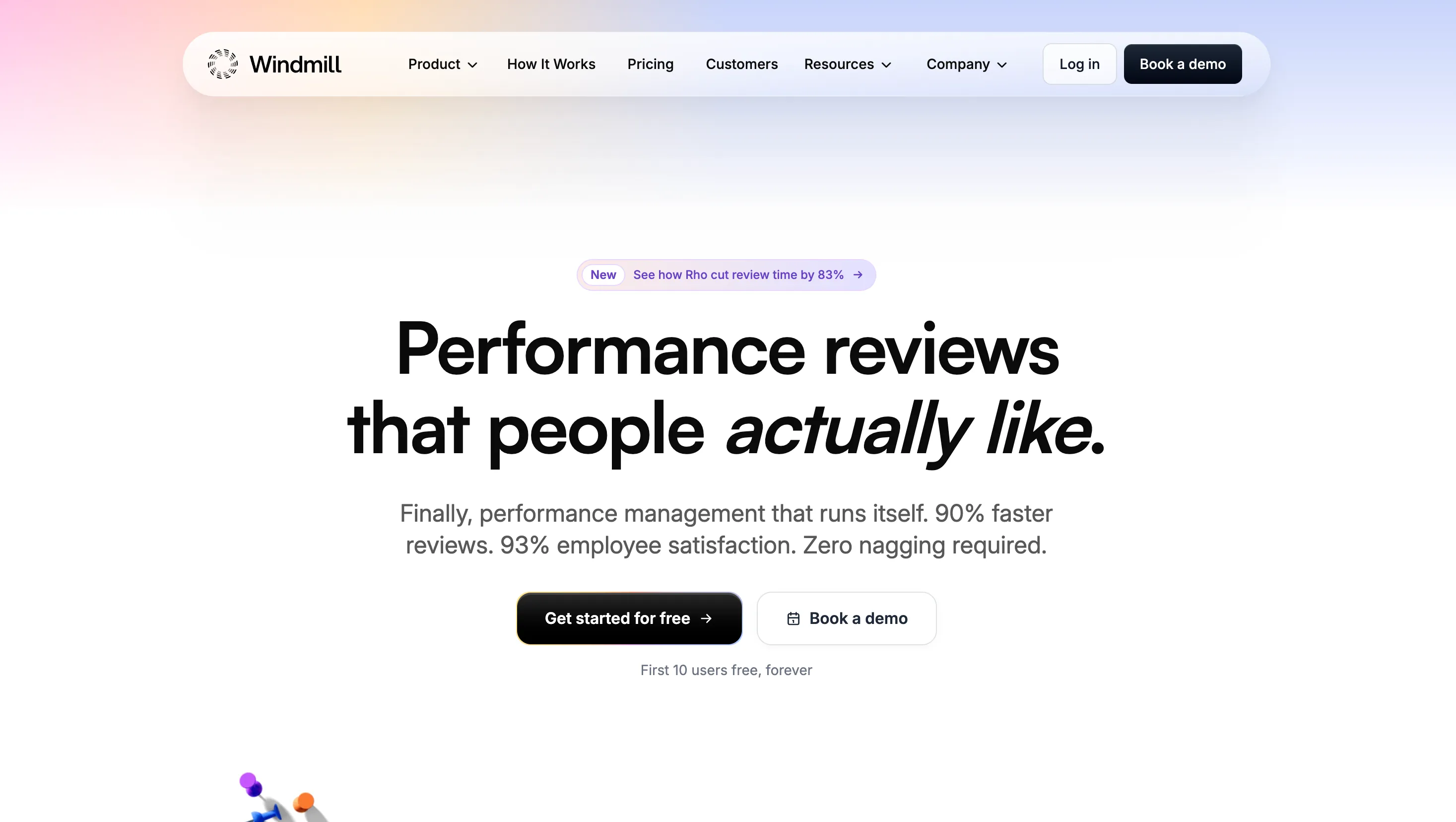
Overview: Windmill brings the manual slog of performance reviews into the modern age, with context-rich AI-generated drafts to cut down on hours of self-review time per employee, interactive calibration sessions backed by data to provide unbiased and fair ratings, and drag-and-drop functionality to save managers days when reviewing their employees.
Strengths: Windmill syncs with external business systems to understand what employees are working on in real-time, and enriches that data by pulling in qualitative, holistic data from 1:1 conversations, employees chatting with their AI agent Windy, and ad hoc meetings and surveys. By combining work data with human conversations and context, Windmill has a full picture of an organization and uses it to cut performance cycle time by over 90%.
Limitations: Newer tool, and currently has limited support for Microsoft customers.
Integration & Onboarding: Self-serve onboarding can be done in an hour. Create an account, connect your tools, and invite your team. A performance cycle can be set up and launched in minutes.
Pricing Range: Mid-range with free seats for startups, scalable through enterprise.
Best For: Tech-forward teams that live in Slack and want continuous feedback and AI-enabled performance reviews.
3. FeedbackPulse
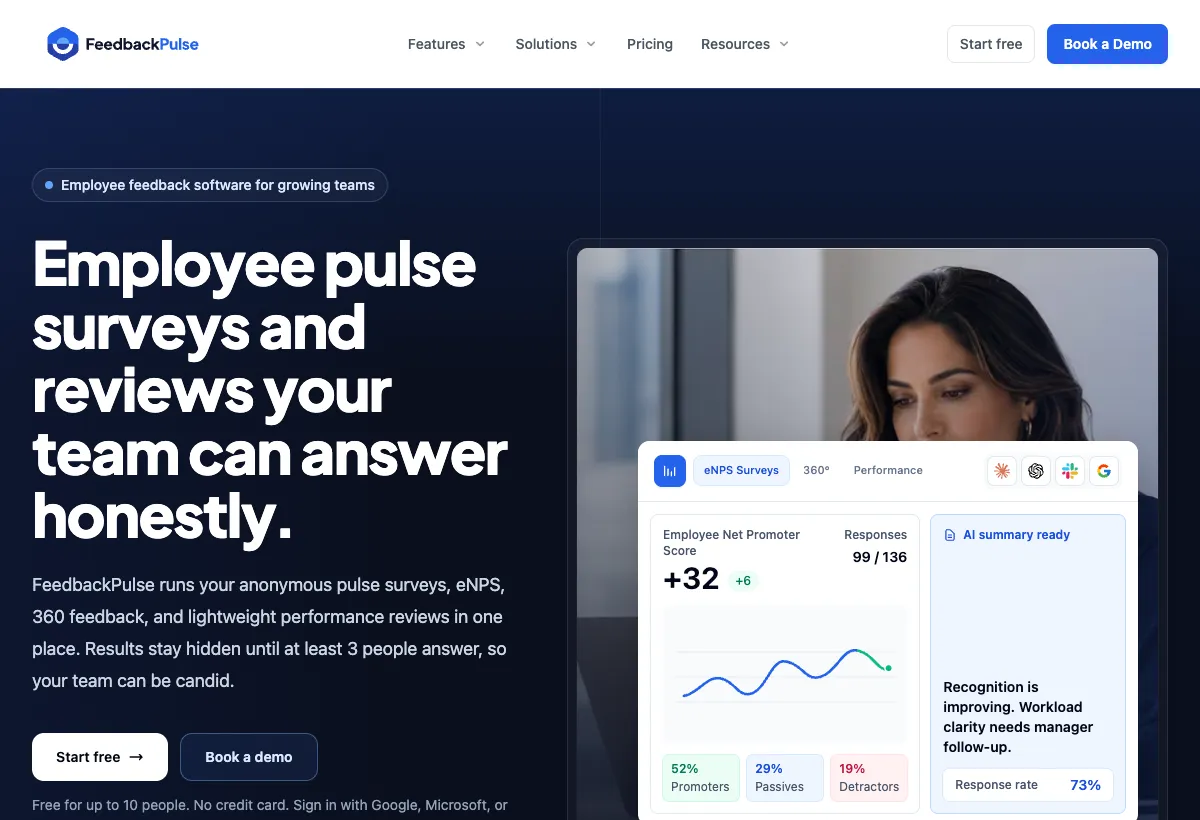
Overview: FeedbackPulse combines the two things Lattice charges separately for: engagement surveys and performance reviews. Teams get eNPS and pulse surveys, anonymous feedback, 360 peer reviews, and blind performance reviews in a single plan, priced for companies without a dedicated people analytics function.
Strengths:
- Engagement surveys, eNPS, 360 peer reviews, and performance reviews included in one plan, not sold as separate modules
- Blind performance reviews: results stay hidden until every party has submitted, which removes anchoring on the manager’s rating
- Recurring pulse cadence with automatic eNPS trend tracking, plus free published eNPS benchmarks by industry, size, and country
- Self-serve setup in minutes, and AI access over MCP for Claude, ChatGPT, and Copilot
Limitations:
- No OKR cascading, compensation tooling, or career-framework modules
- Not an HR system of record, so it pairs with a people ops platform rather than replacing one
Integration & Onboarding: Self-serve, no implementation project and no minimum seat count.
Pricing Range: Free forever up to 10 people, then $4 per employee per month billed annually.
Best For: Teams of 10 to 500 that found Lattice’s per-module pricing heavier than their actual review and engagement needs.
4. Small Improvements
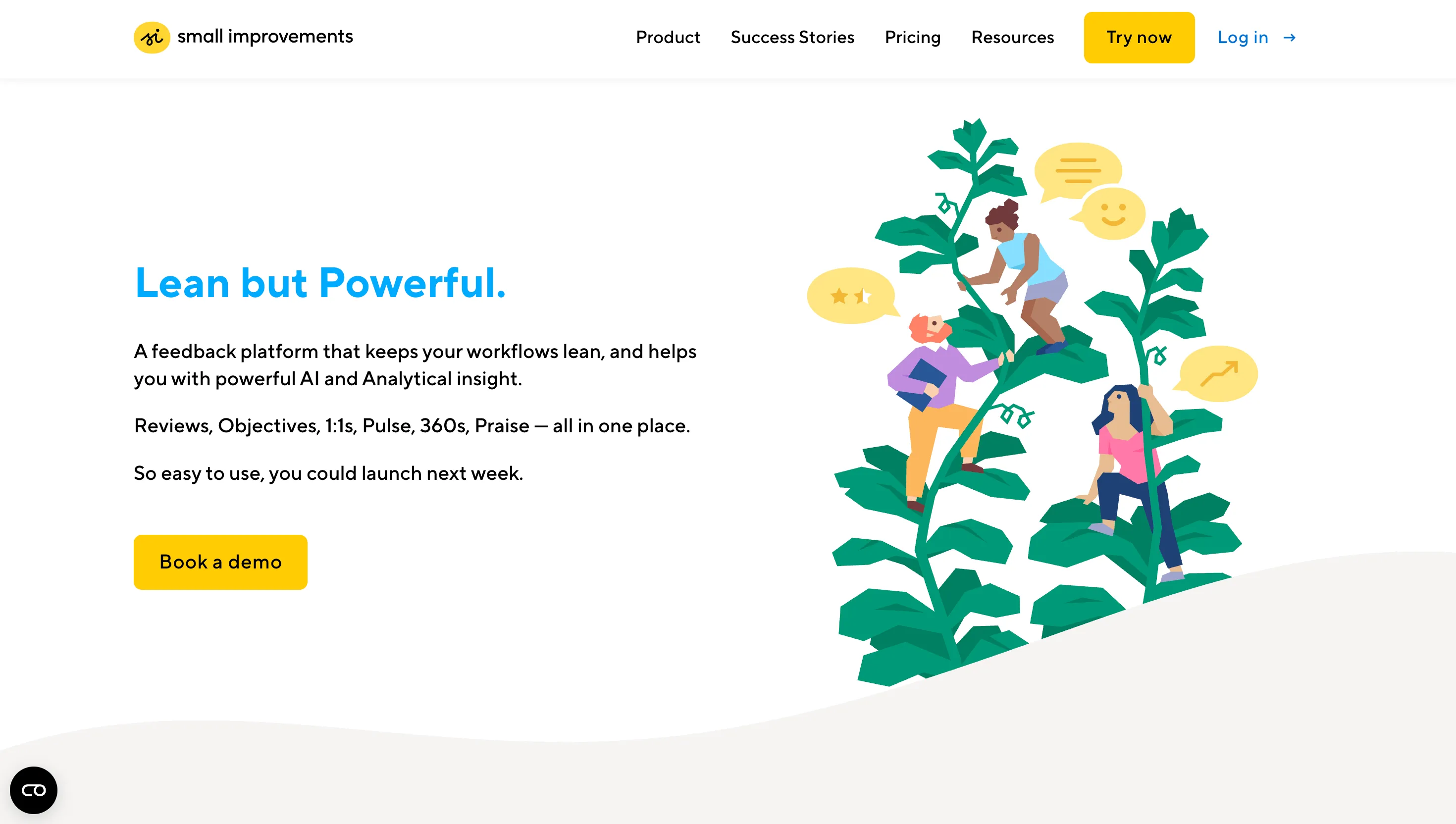
Overview: Small Improvements is a lightweight performance management platform combining reviews, 1:1s, continuous feedback, and praise — designed for teams that want a flexible, easy-to-adopt tool without enterprise overhead.
Strengths:
- Very easy to use, with little training required for both admins and employees
- A flexible set of features supports performance reviews, 1:1 meetings, continuous feedback, cascading objectives, and praise
- Continuous feedback and shared 1:1 agendas that support ongoing conversations
- New Manager Activation Scores and post-1:1 ratings help surface and support managers who may be struggling
Limitations:
- Analytics and reporting are more limited compared to enterprise-focused solutions
Integration & Onboarding: Integrates with common HRIS systems and tools like Slack and Google Workspace, with fast onboarding and no implementation overhead.
Pricing Range: Low-end pricing within the category, starting at $3 per user per month, with no seat minimums or implementation costs.
Best For: Smaller and mid-sized teams looking for a simple, affordable performance tool without sacrificing core review and feedback workflows.
5. CultureAmp
Overview: CultureAmp specializes in engagement surveys and performance management through analytics-driven insights.
Strengths:
- Robust reporting and culture insights
Limitations:
- Limited automation and AI-driven workflows
Integration & Onboarding: Integrates with most HRIS and communication tools; onboarding takes moderate setup time.
Pricing Range: Mid- to high-range, suited for mid-sized to enterprise organizations.
Best For: Companies focused on culture and engagement data.
6. Sprad
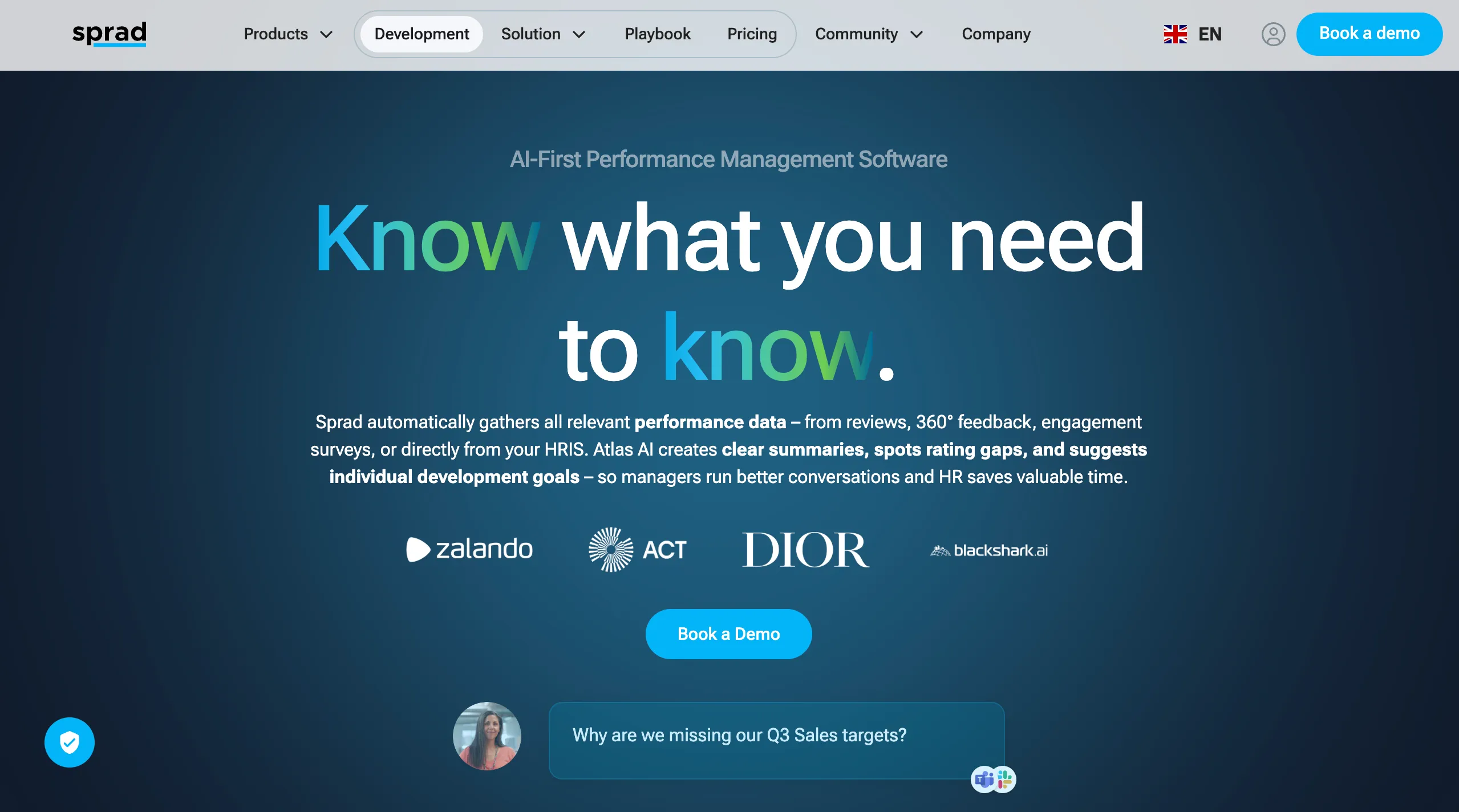
Overview: Sprad is an AI-first talent and performance management platform that connects skills, performance insights, and business outcomes to help teams make better talent decisions.
Strengths:
- Continuous, AI-assisted performance reviews and check-ins in the flow of work (e.g., Slack, Teams)
- Skill management and mapping tied to measurable business results
- Predictive insights flag retention risks and highlight internal mobility
- Atlas AI Agent supporting managers with actionable insights
Limitations: Focuses on performance and skill insights rather than offering a built-in traditional LMS with extensive curated learning content.
Integration & Onboarding: Works with popular collaboration and HR systems; guided onboarding supports fast adoption.
Pricing Range: Mid-range, scalable for growing teams and larger organizations.
Best For: Teams driving performance with business impact.
7. Leapsome
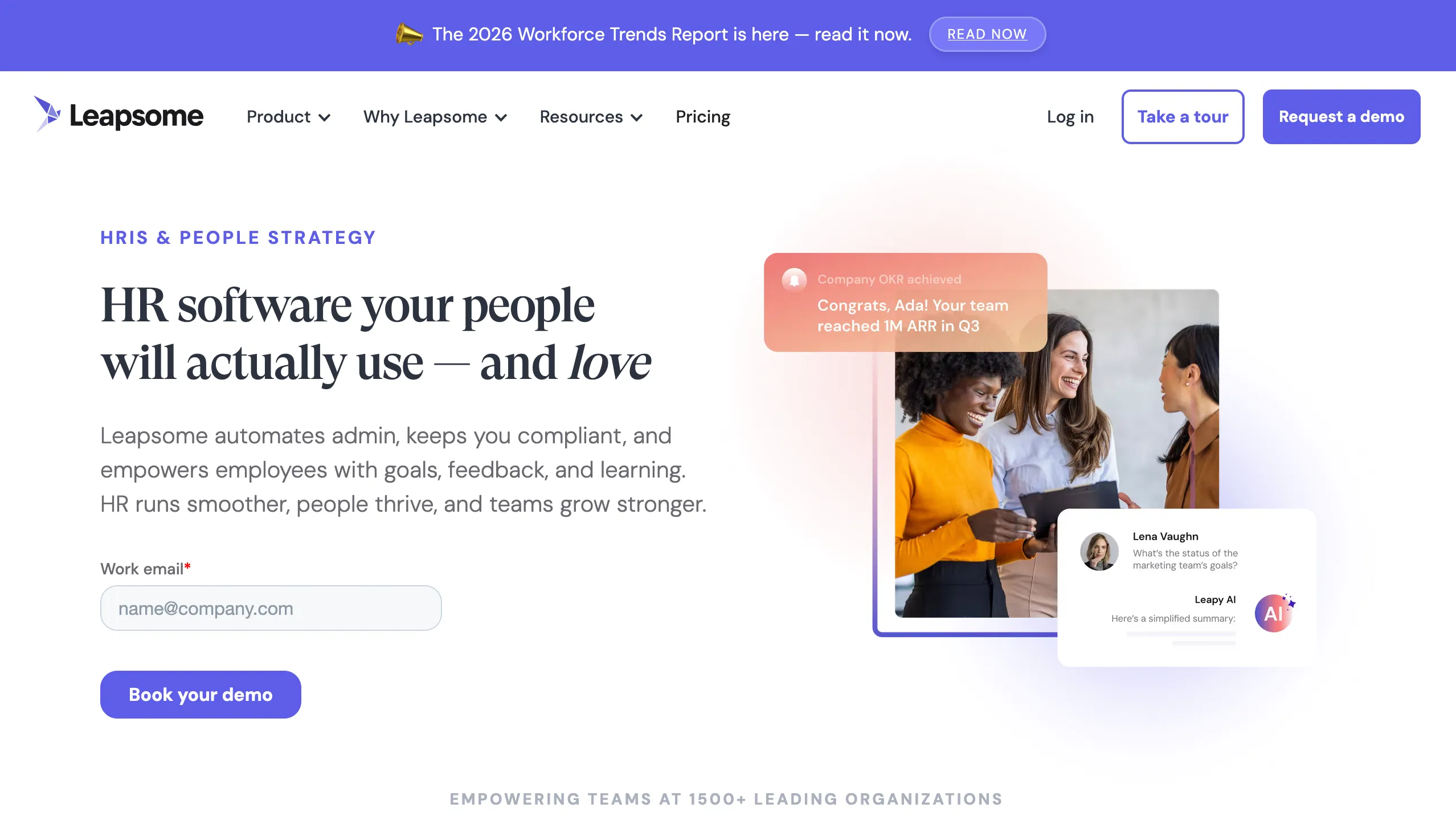
Overview: Leapsome combines OKRs, feedback, and learning in a unified people enablement platform.
Strengths:
- Strong goal-setting and competency frameworks
- Integrated learning modules
Limitations:
- Setup and customization can be time-intensive
Integration & Onboarding: Works with Slack, Jira, and HRIS systems; onboarding requires admin setup.
Pricing Range: Mid-range, with per-user licensing for growing teams.
Best For: Organizations seeking structured OKRs and growth frameworks.
8. 15Five
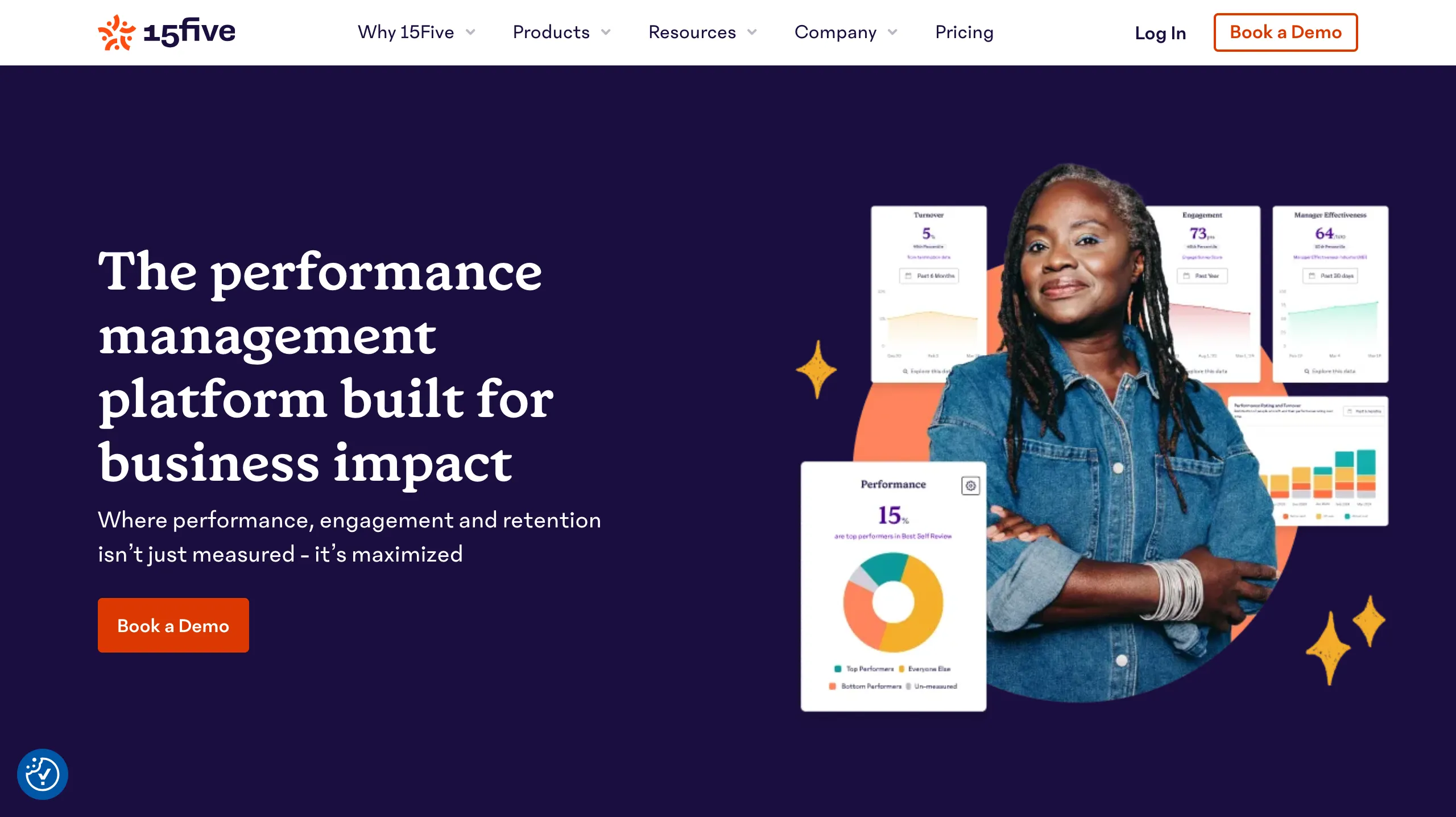
Overview: 15Five focuses on continuous performance, recognition, and engagement.
Strengths:
- Simple check-in system and lightweight reviews
- Great for remote and hybrid teams
Limitations:
- Limited analytics compared to larger platforms
- May lack advanced reporting for enterprise teams
Integration & Onboarding: Smooth onboarding and Slack integration; minimal setup required.
Pricing Range: Affordable for SMBs and growth-stage startups.
Best For: Companies seeking an easy-to-use check-in and recognition system.
9. HiBob
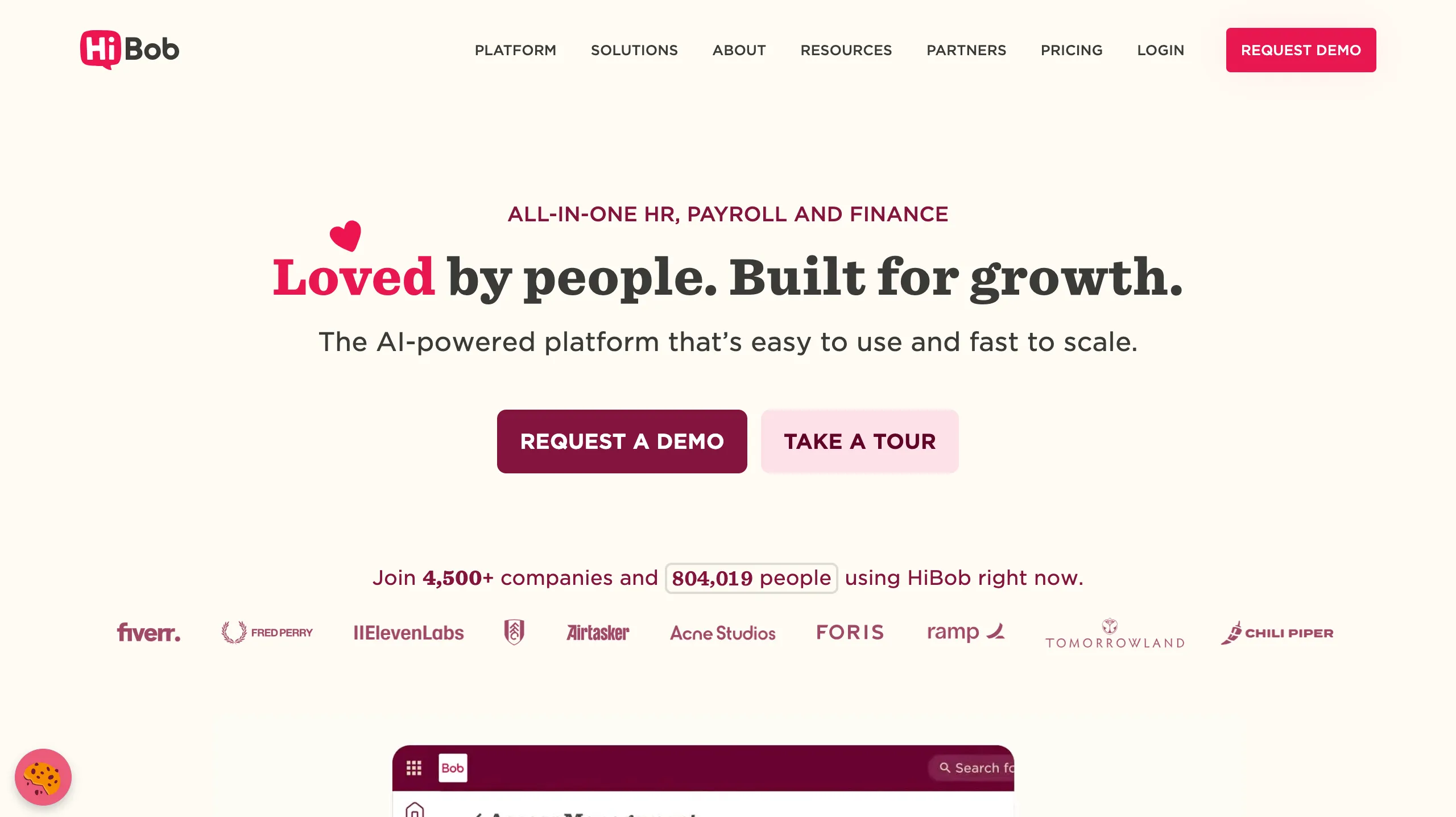
Overview: HiBob blends HRIS functionality with performance and engagement tools for growing organizations.
Strengths:
- HRIS + performance capabilities
- Intuitive design and employee experience focus
Limitations:
- Performance module less comprehensive than specialized platforms
- Reporting can feel limited for large-scale use
Integration & Onboarding: Works with HR systems like Greenhouse and Deel; onboarding time moderate.
Pricing Range: Mid-range HRIS pricing tier.
Best For: Mid-sized HR teams wanting one system for people operations and engagement.
10. Betterworks
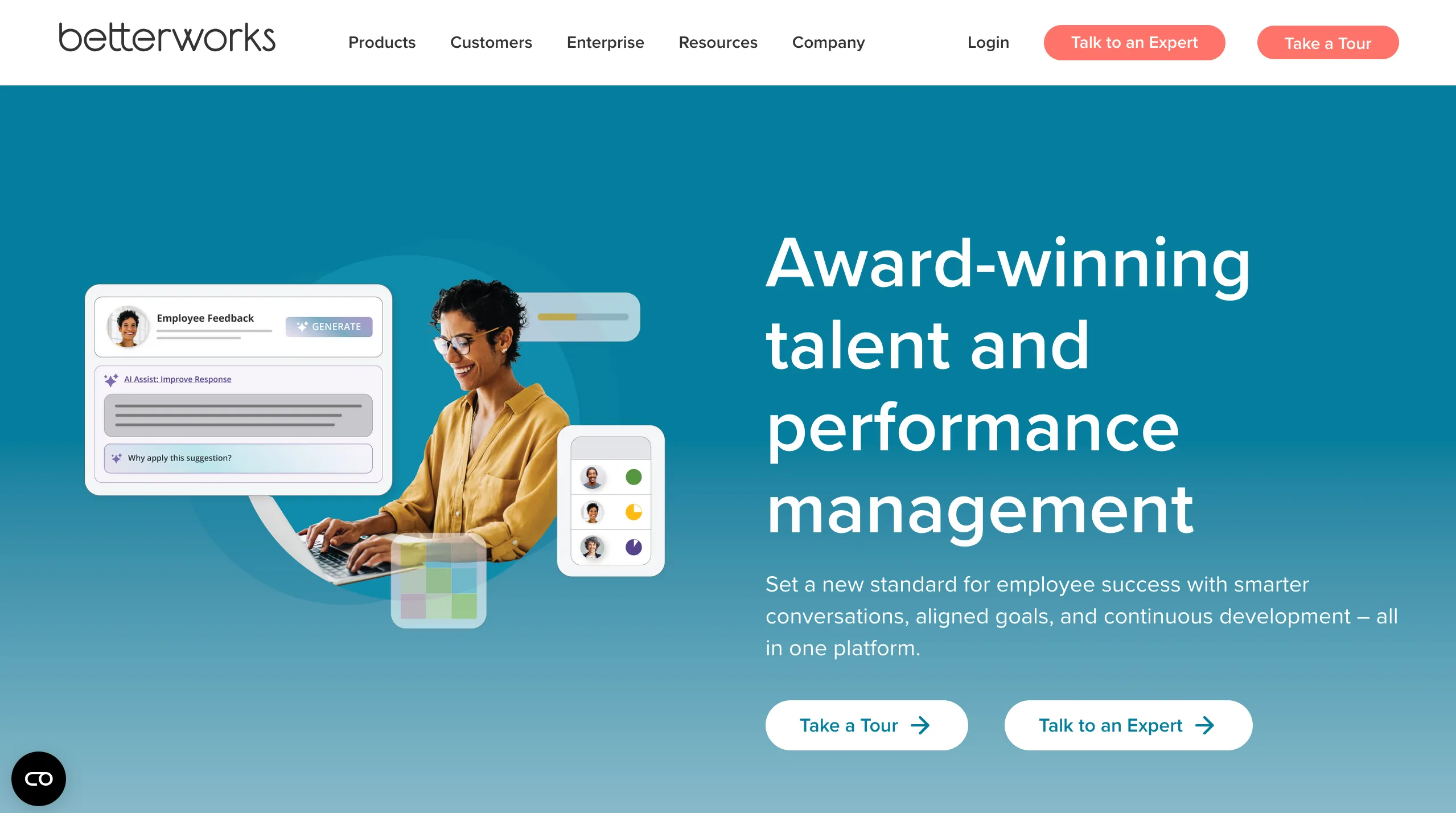
Overview: Enterprise-grade OKR and performance platform.
Strengths:
- Deep OKR alignment capabilities
Limitations:
- Complex for smaller organizations
- Implementation time can be lengthy
Integration & Onboarding: Integrates with MS Teams, Slack, and major HRIS; onboarding may take several weeks.
Pricing Range: Enterprise-level.
Best For: Large organizations driving strategic goal alignment.
11. Peoplebox
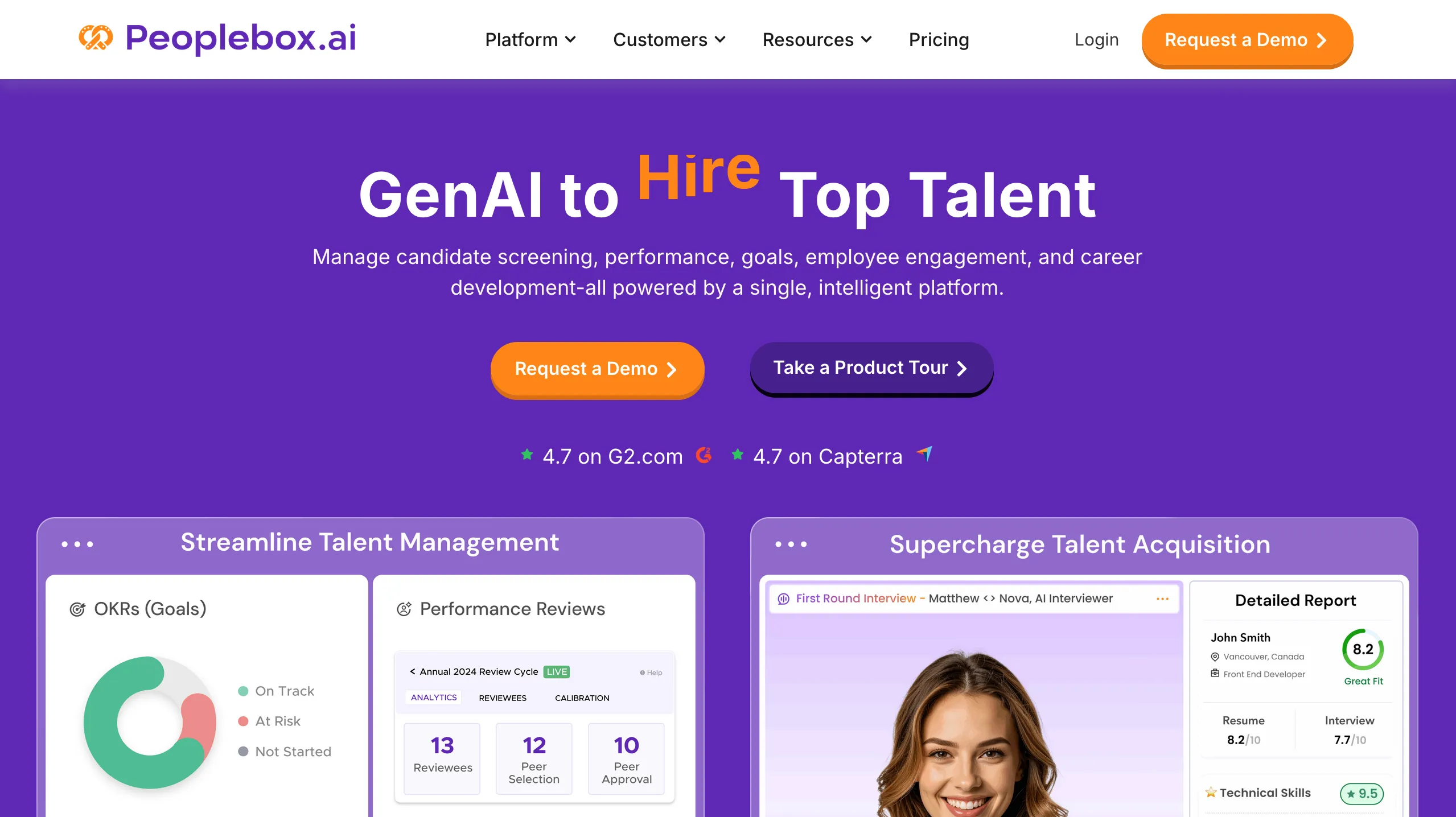
Overview: AI-assisted OKR and performance management tool built for startups and scaleups.
Strengths:
- Simple goal management and AI-driven insights
- Affordable and flexible
Limitations:
- Narrower feature set than larger HR platforms
- Limited analytics capabilities
Integration & Onboarding: Connects easily to Slack and Jira; setup in days, not weeks.
Pricing Range: Affordable, startup-friendly pricing.
Best For: Fast-growing startups scaling performance practices.
12. Zavvy
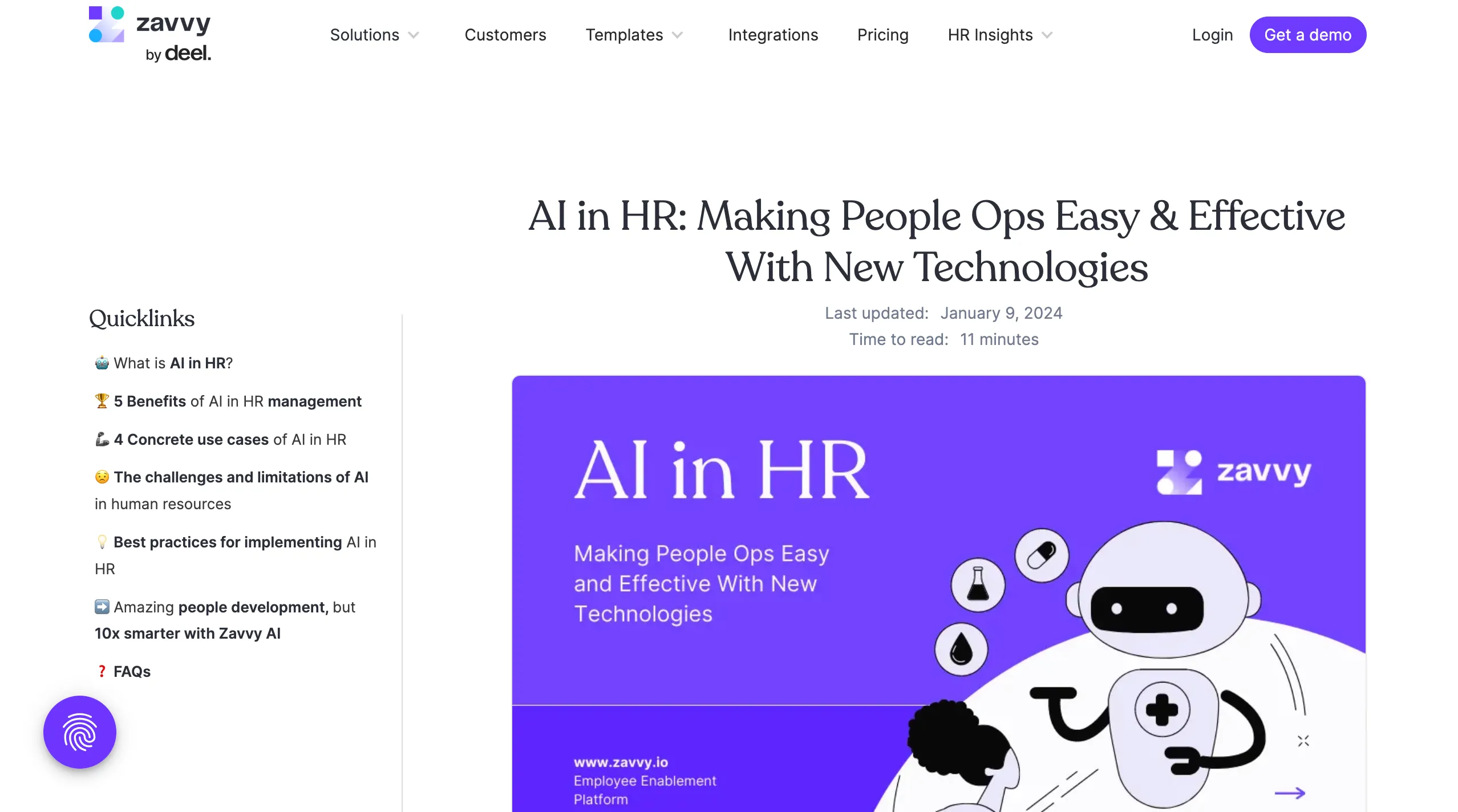
Overview: Zavvy links performance, feedback, and learning into structured employee growth journeys.
Strengths:
- Unique learning-based performance loops
Limitations:
- Smaller customer ecosystem
- Limited benchmarking analytics
Integration & Onboarding: Works with Google Workspace and Slack; guided onboarding flow.
Pricing Range: Mid-range, depending on modules activated.
Best For: Teams combining performance with continuous learning.
13. Mirro
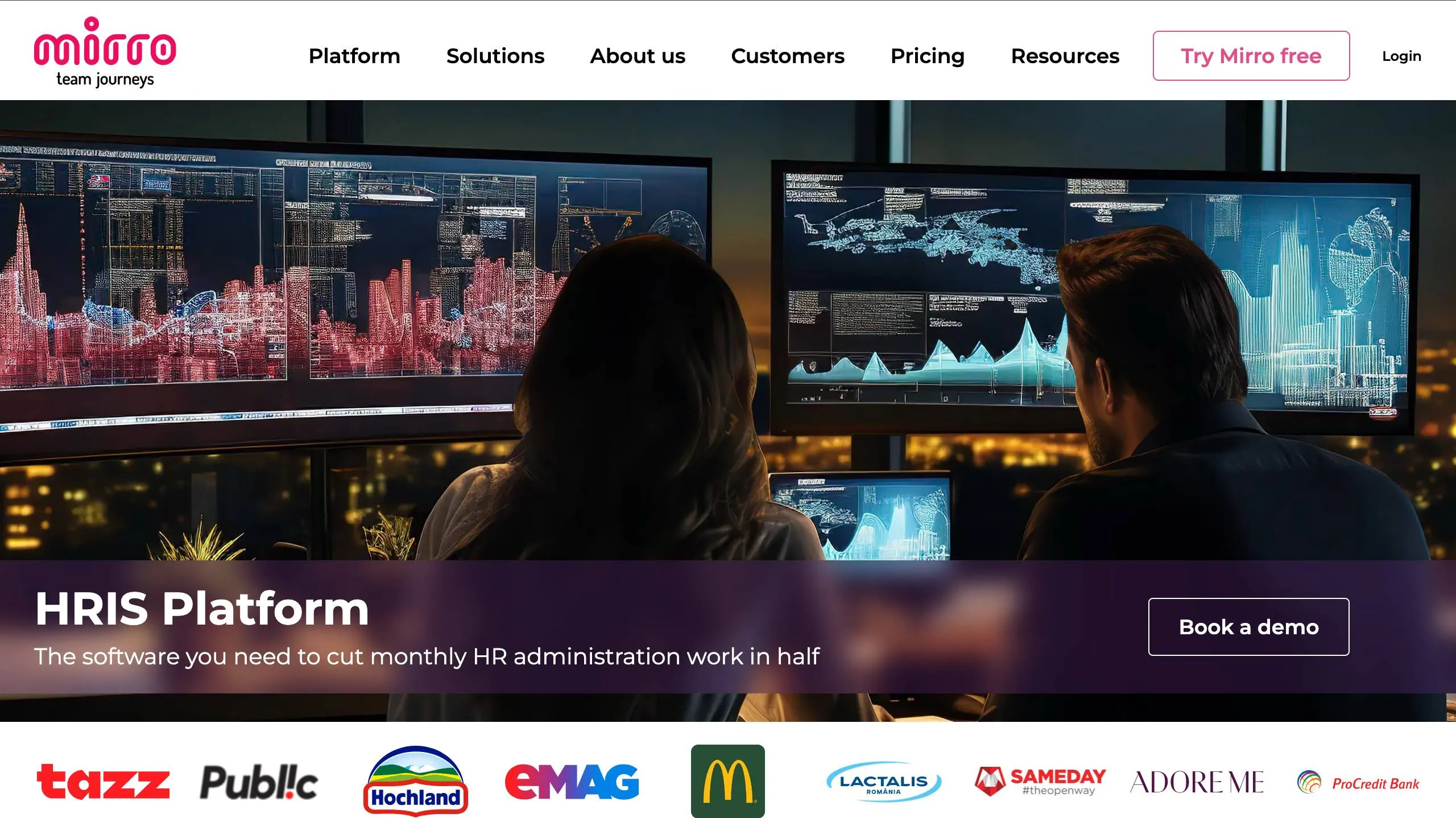
Overview: Mirro is a people enablement platform focused on recognition and feedback.
Strengths:
- Encourages frequent recognition and engagement
Limitations:
- Lacks advanced OKR and evaluation tools
- Not ideal for complex review cycles
Integration & Onboarding: Standard HRIS and Slack integrations; guided onboarding.
Pricing Range: Affordable, SMB-friendly.
Best For: Mid-market companies prioritizing recognition and transparent feedback.
14. Mesh.ai
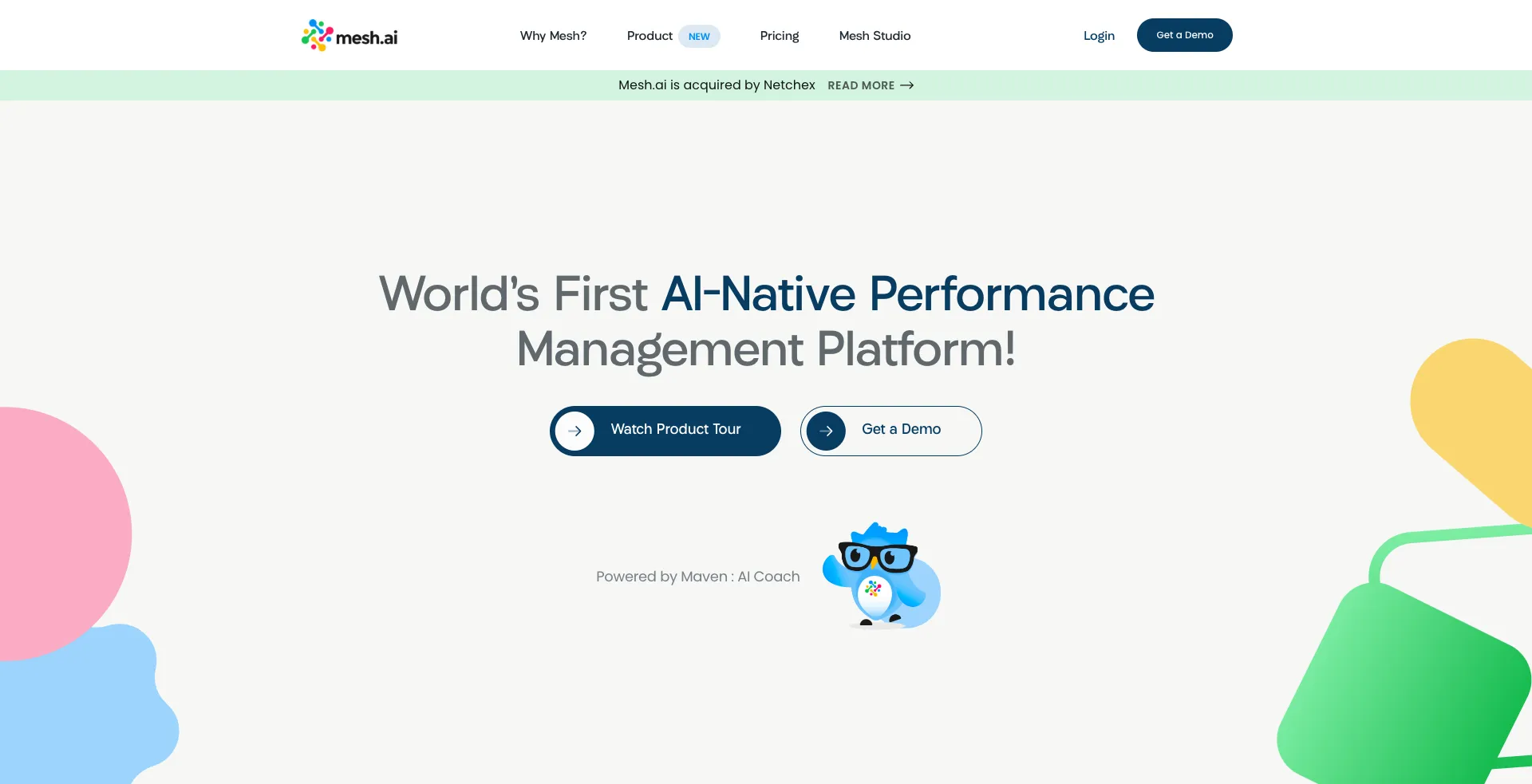
Overview: An AI-powered performance and engagement platform built for real-time insights.
Strengths:
- Personalized recommendations for employees and managers
- Feedback automation and insight generation
Integration & Onboarding: Easy setup via Slack and HRIS systems; quick implementation.
Pricing Range: Mid-range pricing tier.
Best For: Tech-driven companies prioritizing AI in HR processes.
15. PerformYard
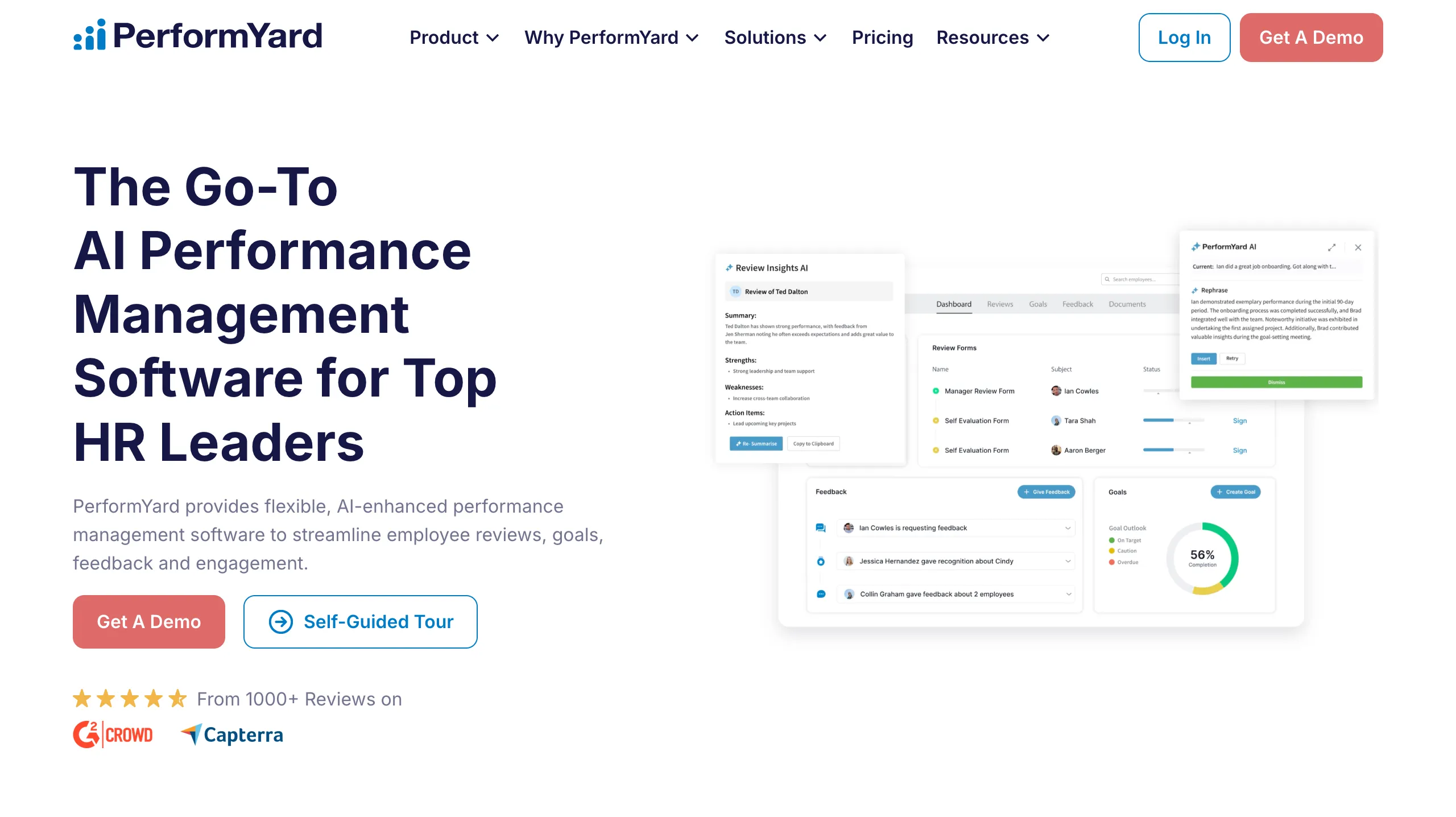
Overview: Customizable performance review software suited for professional services and mid-sized companies.
Strengths:
- Flexible review templates and cycles
- Easy reporting for HR teams
Limitations:
- No built-in feedback automation
- Lacks engagement tools
Integration & Onboarding: Integrates with core HR systems; guided onboarding process.
Pricing Range: Mid-range pricing.
Best For: Teams seeking configurable review cycles.
16. Engagedly
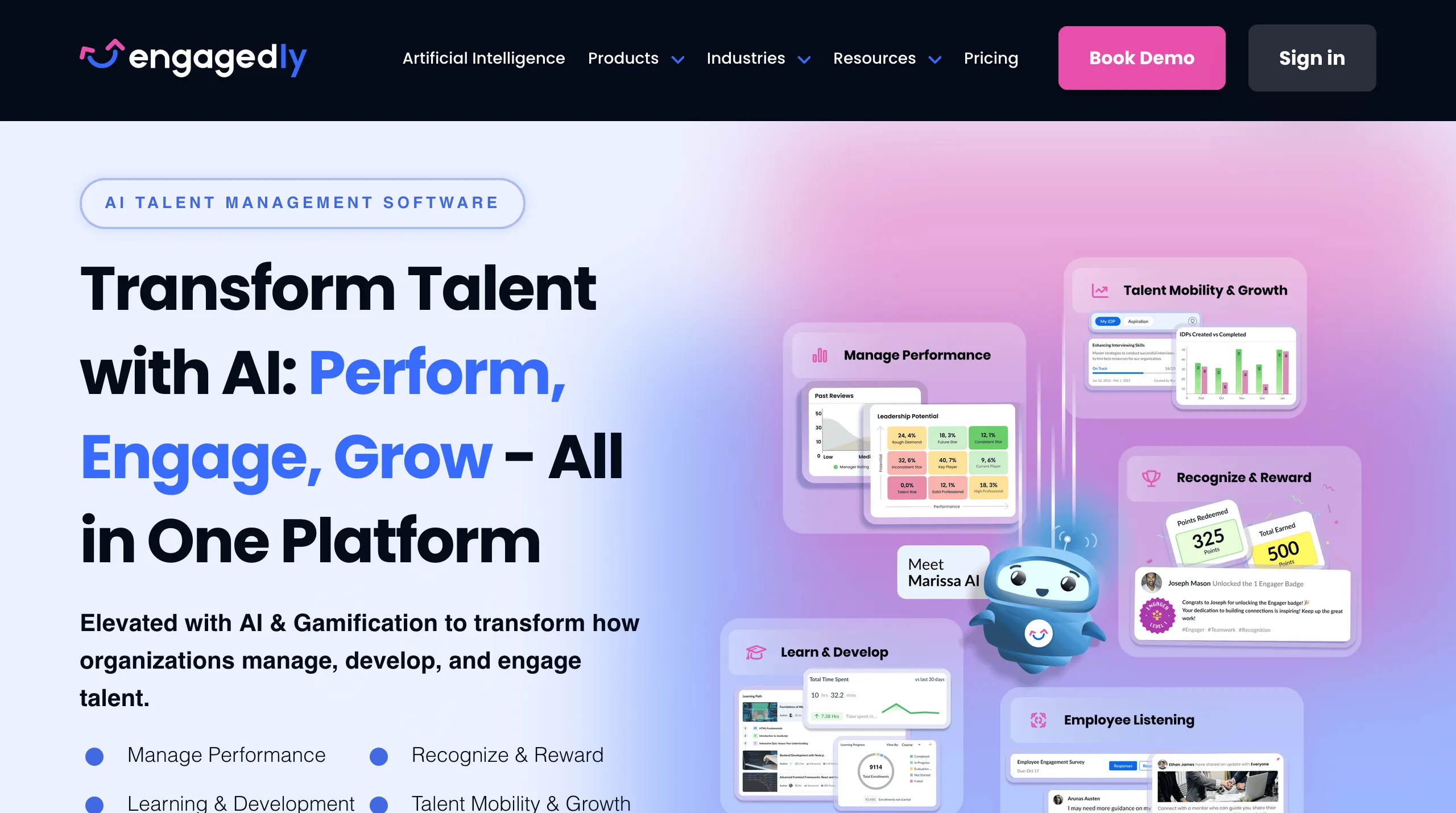
Overview: Comprehensive platform for engagement, recognition, and learning.
Strengths:
- Gamified features encourage participation
- Combines engagement and performance tools
Limitations:
- Interface can feel heavy for smaller teams
- Requires training to configure workflows
Integration & Onboarding: Connects with Teams, Slack, and learning tools; onboarding guided by customer success.
Pricing Range: Mid-range, suitable for mid-sized to large organizations.
Best For: Organizations emphasizing engagement and motivation.
17. Synergita
Overview: Cloud-based performance management platform with strong analytics.
Strengths:
- Goal tracking and competency frameworks
- Useful automation for performance appraisals
Limitations:
- UI less modern than newer tools
- Reporting flexibility can be limited
Integration & Onboarding: Standard HRIS integrations; moderate onboarding process.
Pricing Range: Affordable to mid-tier pricing.
Best For: Traditional HR teams upgrading to digital systems.
Recap: what is the best solution for us?
Choosing the right alternative depends on your company’s size, maturity, and the role performance management plays in your culture. Here’s a summary of the platforms that stand out in key categories:
- Best AI-native platform: Taito.ai
- Best for engagement insights: CultureAmp
- Best for engagement and 360 reviews on an SMB budget: FeedbackPulse
- Best for structured OKRs: Leapsome
- Best for lightweight check-ins: 15Five
- Best for HR-suite integration: HiBob
- Best for large enterprises: Betterworks
Closing summary
The performance management landscape is shifting fast. Traditional review-heavy systems are giving way to continuous, AI-enabled performance enablement, where growth happens weekly, not yearly.
Whether your company is exploring automation, real-time feedback, or scalable performance practices, there’s now a wide range of tools to choose from.
Taito.ai stands out as the new-generation solution built for this shift — helping teams define clear expectations, collect meaningful feedback, and coach continuously with the help of AI.
FAQs
1. What’s the best alternative to Lattice for startups? Taito.ai and Peoplebox offer lightweight, AI-supported systems ideal for fast-scaling startups.
2. Which alternatives focus on AI and automation? Taito.ai and Mesh.ai lead in automation and intelligent feedback recommendations.
3. Which Lattice competitors are easiest to implement? 15Five, Mirro, and Taito.ai all offer fast setup with minimal admin.
4. What tools combine OKRs and feedback in one system? Leapsome, Betterworks, and Taito.ai connect goals and continuous feedback seamlessly.
5. Which platforms fit hybrid or remote teams best? FeedbackPulse, 15Five, and Taito.ai all support distributed feedback and check-ins. FeedbackPulse runs anonymous pulse surveys and eNPS on a recurring cadence, which is how most distributed teams keep a read on sentiment between review cycles.