Events
12.1.2026
Kristo Ovaska
What does performance look like at Linear in the age of AI?
A founder-led conversation on what performance really means in the age of AI, drawing lessons from Linear’s approach to hiring, leadership, remote work, and accountability.
TL;DR
- Performance in the age of AI is still fundamentally about people and judgment, not tools or automation.
- Hiring slowly and deliberately compounds quality and culture over time.
- Small teams with clear standards tend to outperform large, process-heavy organizations.
- AI increases leverage and execution speed, but accountability remains human.
- The best performance systems reduce friction rather than add management theater.
What does performance mean in the age of AI?
Performance in the age of AI means achieving what truly matters with the people you have, while using technology to amplify execution rather than replace responsibility.
This definition framed the entire discussion. Despite the rapid pace of AI adoption, neither the goals of performance nor the conditions for achieving it have fundamentally changed.
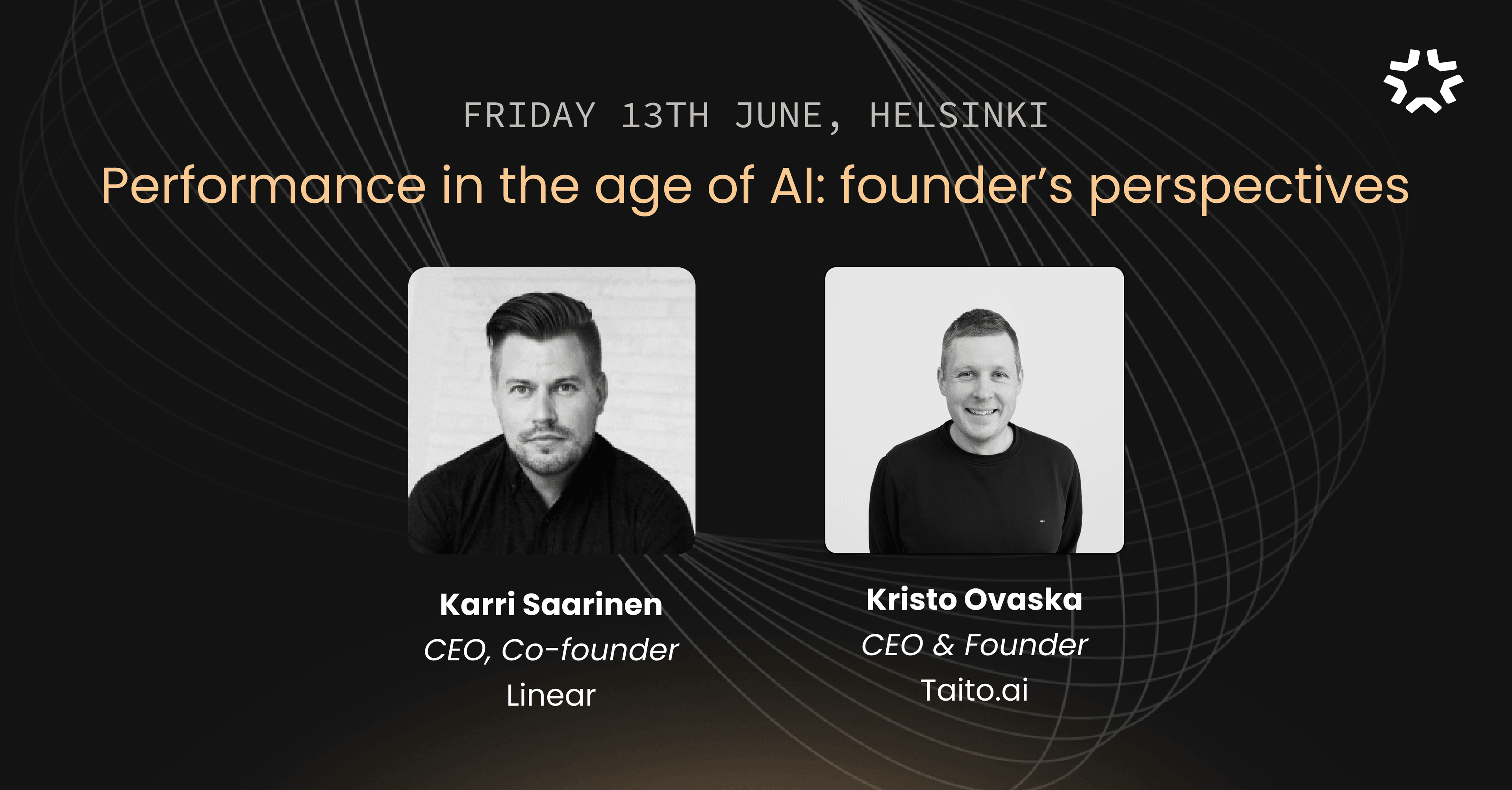
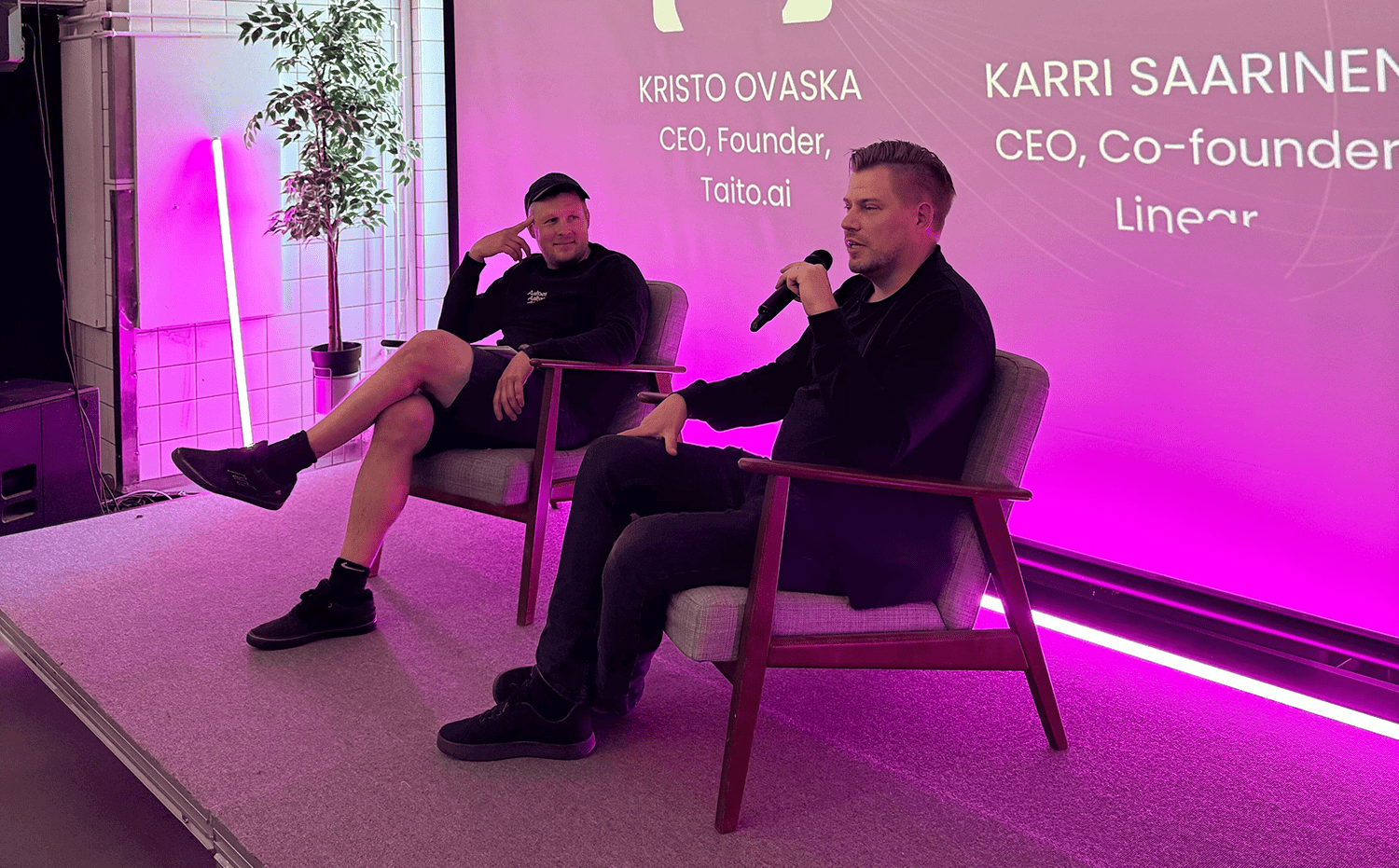
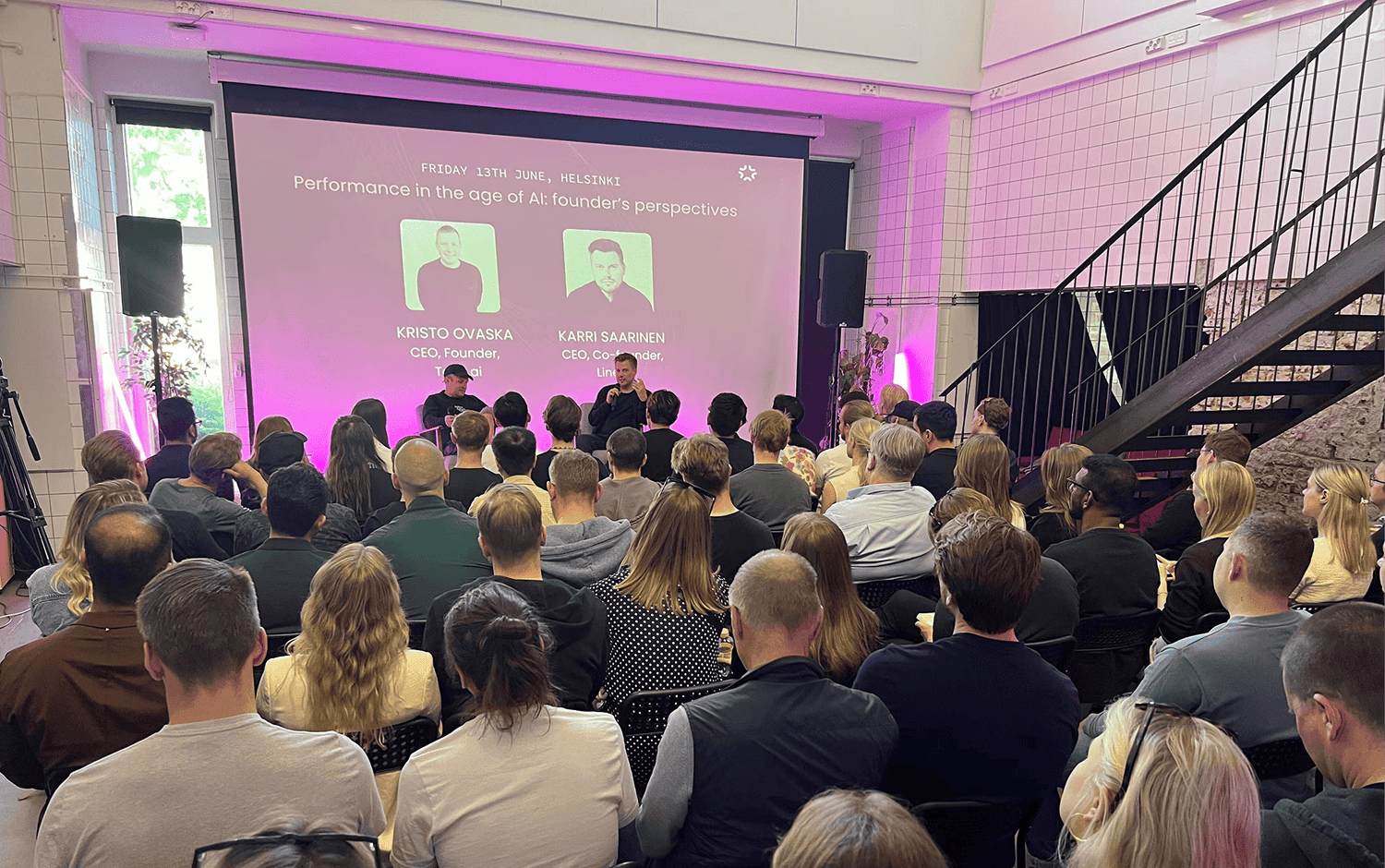
On June 13th in Helsinki, at Maria01, Taito hosted a founder conversation titled "Performance in the age of AI: founders’ perspectives" that focused on this exact question. Kristo Ovaska, founder and CEO of Taito.ai, sat down with Karri Saarinen, co-founder and CEO of Linear, to discuss how high-performing companies are actually built today.
What stood out immediately was how Karri explained complex organizational ideas using simple, well-understood metaphors. Rather than abstract frameworks, he relied on concrete comparisons that made performance, leadership, and scale easier to reason about.
Why does performance look different now?
Performance looks different today because AI changes how work gets done, even though it does not change what good work looks like.
Many companies are focused on automating workflows, introducing new tools, and instrumenting performance more aggressively. Karri made a clear distinction early on between activity and outcomes.
"In the end, companies are just groups of people working on something. Performance is about whether we’re achieving what actually matters with the people we have."
At Linear, what matters has remained consistent from the beginning. The company optimizes for quality across decisions, product experience, and execution, rather than raw speed or output volume.
This focus helps explain why Linear has scaled to a multi-billion-dollar valuation with a relatively small team. Performance, in this model, is driven by clarity and judgment rather than layers of management.
Why is hiring slowly a performance strategy?
Hiring slowly protects standards, and standards compound through people.
Karri’s perspective is shaped by direct experience at companies that scaled extremely quickly, including Coinbase and Airbnb. He described how rapid hiring introduces coordination costs that are easy to underestimate.
"You end up with a majority of people being new. Everyone’s trying to figure out what they’re supposed to do. There’s a lot of waste."
Beyond execution drag, fast hiring dilutes culture and lowers the bar for decision-making. Over time, performance becomes dependent on process rather than judgment.
At Linear, every new role is treated as a first hire. The assumption is that early decisions in each function will shape how that function operates for years.
"The first engineer sets the engineering standard. The first salesperson sets the sales standard. This repeats every time."
This is one reason Linear relies more on referrals and sourcing than inbound applications. As Karri noted, many of the strongest candidates are not actively applying for roles.
Why do work trials outperform interviews?
Work trials reveal how people actually work, not just how they present themselves.
Linear uses paid work trials for every role, designed to simulate real work in a limited time window. The approach was influenced by Karri’s experience during a work trial when joining Coinbase.
"We’re trying to understand how someone actually works. How do they scope problems? How do they ask for help? How do they make decisions?"
The goal is not perfect output. The goal is to observe judgment under constraints, including how candidates handle ambiguity and incomplete information. If someone needs weeks to get something done, it’s probably not the right fit, because startups run on days.
Work trials also benefit candidates by exposing them to Linear’s remote culture and collaboration style. This mutual evaluation has contributed to unusually low attrition over several years.
Can remote work support high performance?
Remote work can support high performance, but only when it is designed intentionally.
Linear decided to operate as a fully remote company in 2019, before the pandemic forced many organizations to adapt. The decision was rooted in long-term sustainability rather than short-term convenience.
"If this company works, it’s going to be 10 to 15 years of your life. We didn’t want that to mean being in San Francisco forever."
Karri emphasized that remote work is not inherently easier. It requires different systems, clearer direction, and more explicit communication. He says it’s like switching from basketball to soccer mid-game, but keeping the same rules and players.
At Linear, remote performance depends on trust, stable priorities, small autonomous teams, and strong written communication. Leadership, in this context, becomes more about clarity than oversight.
Why does Linear favor teams over hierarchies?
Hierarchies tend to distance leaders from the work, which eventually hurts quality.
Linear operates with very few formal managers and no layered executive structure. Most leaders begin as individual contributors and remain close to execution.
"At Linear, we almost never hire managers. We hire leads who start by doing the work."
Leadership is defined less by people management and more by craft mastery, directional clarity, and the ability to resolve ambiguity. Leaders are expected to manage up, sideways, and down.
Karri contrasted this with what he observed in large organizations, where management roles gradually drifted away from the work itself. In these organization managers became more like union leaders. Everyone stopped thinking about the work.
How does Linear approach performance management?
Performance management works best when it is lightweight, infrequent, and grounded in real work.
Karri described long and complex review cycles at Airbnb that consumed significant managerial time without necessarily improving outcomes. The review cycle would take five or six months. By the time it ended, the next one started.
At Linear, performance reviews happen once a year and focus on role effectiveness, impact, and potential. Calibration happens across leads and founders, without heavy process overhead.
"We want performance to stay meaningful, not ritualized."
Because Linear is profitable, revenue targets function as signals rather than existential constraints. This reduces pressure to over-instrument performance.
Does AI change accountability?
AI increases leverage, but it does not remove responsibility.
Audience questions frequently returned to whether AI reduces the need for people, particularly at junior levels. Karri’s answer was direct.
"AI can’t be accountable. Someone still has to own the result."
AI raises the baseline of execution and makes it easier to move faster. It does not eliminate the need for judgment, taste, and ownership.
How does Linear avoid enterprise complexity creep?
Enterprise needs are addressed without sacrificing everyday usability.
As Linear serves larger organizations, feature requests naturally increase. Karri explained how the team evaluates complexity based on its impact on the majority of users.
Custom fields were a clear example of a feature that can degrade experience when overused.
"If you add 40 fields to every issue, people stop using the tool."
Linear prefers opinionated solutions that solve specific problems while keeping core workflows simple. Complexity is allowed only when it can be contained.
Summary: how Linear approaches performance differently
The table below summarizes how Linear’s performance practices differ from more conventional approaches.
Why does this conversation matter now?
Performance systems are increasingly misaligned with how work actually happens in AI-enabled environments.
Hosted in Helsinki at Maria01, where Taito is headquartered, this conversation reflected a broader shift across modern technology companies. High performance is becoming less about control and more about clarity.
It depends on clear standards, small capable teams, and systems that enable action. This perspective sits at the core of Taito’s performance enablement philosophy.
What to read next
- What is a skills & competencies framework and how to build one for my team?
- How to increase employee performance with goals, feedback, and 1-1 meetings?
- What is performance enablement, and how does it differ from traditional performance management?
FAQ
Q1: What does performance mean in the age of AI?
It means achieving what matters with small teams using clear judgment, while AI amplifies execution.
Q2: Why does Linear hire so slowly?
Because early hires compound quality, culture, and decision-making for years.
Q3: Are performance reviews still relevant?
Yes, when they are lightweight, infrequent, and grounded in real work.
Q4: Does AI reduce the need for people?
No. AI increases leverage, but ownership and accountability remain human.
Q5: Can remote teams outperform in-person teams?
Yes, when remote work is designed intentionally rather than adopted by default.