Events
27.1.2026
Miikka Kataja
How Lovable and ŌURA scale performance in the AI era
A practical exploration of how engineering and marketing leaders enable performance in fast-moving AI-native companies, based on insights from Lovable and ŌURA.
TL;DR
- Performance in AI-native teams comes from clarity, not control.
- High-growth teams align on direction even when priorities shift weekly.
- AI increases leverage only when expectations are already clear.
- Performance enablement helps people do work they did not think possible.
How do Lovable and ŌURA enable performance in the AI era?
They enable performance by making direction, expectations, and feedback explicit while keeping execution flexible.
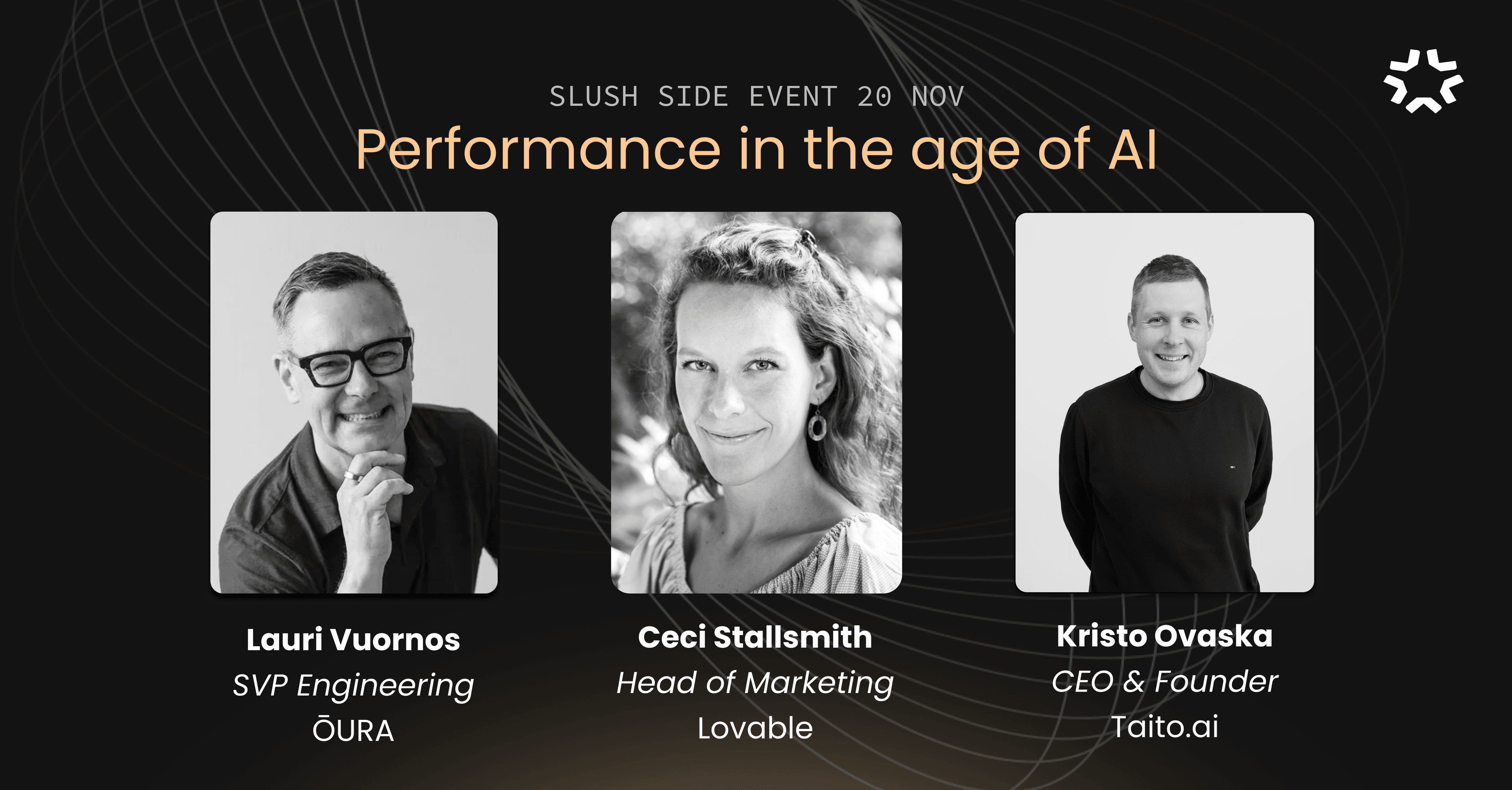
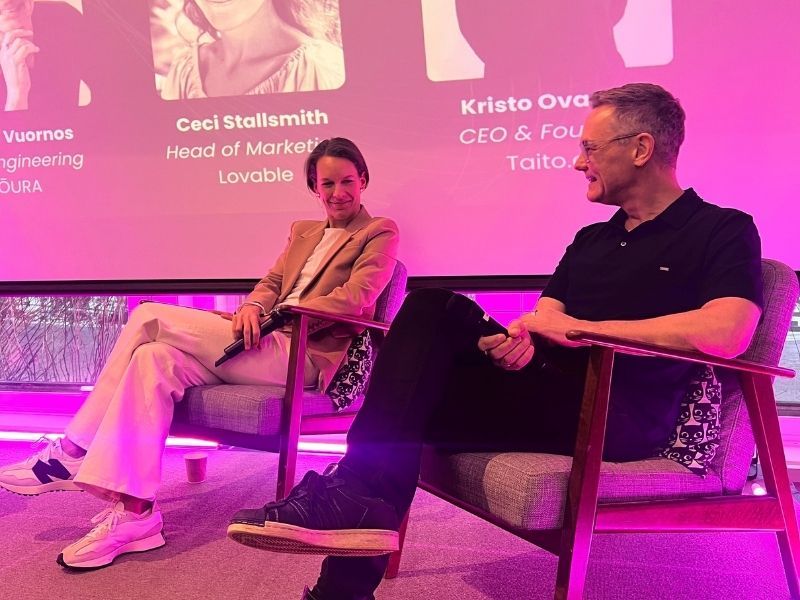
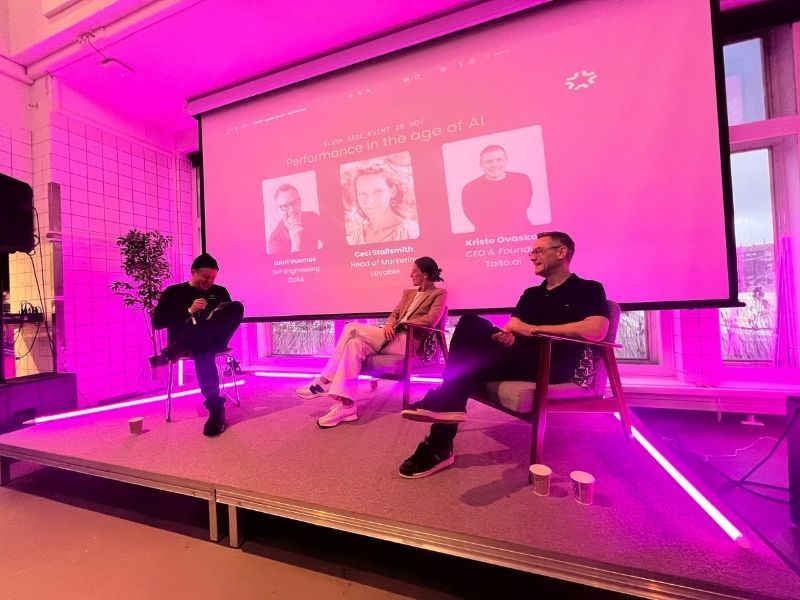
This conversation took place during Performance in the age of AI – A Slush side event featuring Lovable and ŌURA, held alongside Slush 2025 at Maria01. While the context was a live event, the themes were not event-specific. They reflected a broader shift in how functional leaders approach performance in AI-native environments.
As Kristo put it early in the discussion:
"It’s a must to perform well yourself. But as a leader, that’s not enough. You need to enable other people and build teams."
The discussion was fundamentally about how leaders scale performance without scaling friction, especially when speed, tooling, and expectations are constantly changing.
Who was part of the conversation, and why did it matter?
The conversation brought together leaders operating under very different conditions, yet facing the same core performance challenges.
Kristo Ovaska framed the discussion through the lens of performance enablement and systems of action.
Cecilia Stallsmith - Head of Marketing at Lovable, shared how Lovable approaches performance as it grows at unprecedented speed with a small team.
Lauri Vuornos, SVP of Engineering at Oura explained how ŌURA builds high-performing engineering teams with clear expectations, feedback, and psychological safety.
Ceci captured the shared tension well:
"What you see going on in these AI companies now is insane. The growth is crazy, and it’s very hard to have clear goals that stay stable."
Together, their perspectives showed how performance challenges converge across functions when AI compresses time and scale.
What does individual performance look like in AI-native work?
Individual performance starts with habits and clarity, not constant intensity.
Cecilia described performance as something that naturally fluctuates with life and energy. Her focus was on building practices that support long-term consistency rather than chasing daily peak output.
"Everything comes down to your daily habits. Atomic habits really do work and have changed my life."
Lauri approached individual performance through two time horizons. Long-term direction provides meaning. Short-term focus creates execution discipline.
"On Monday mornings, I claim the three most important things I want to get done that week and share them with my team."
In both cases, performance was treated as something designed through structure, not forced through pressure.
How do functional leaders keep teams aligned when everything moves fast?
They over-communicate direction and simplify what matters.
"ARR is such a lagging indicator. It’s not the goal. It’s a side effect of us achieving what we’re trying to achieve."
She described using simple visual metaphors to show alignment when growth creates chaos. The point was not precision, but shared movement.
Lauri reinforced this from an engineering perspective:
"Having a shared context and shared goals makes all the difference."
Alignment becomes the stabilizer when priorities shift faster than documentation can keep up.
Is hiring the right people enough to sustain performance?
No. Hiring sets the ceiling, but environment determines outcomes.
Cecilia emphasized hiring for deep craft and high drive, especially in leadership roles. But she was clear that hiring alone does not scale performance.
"It is actually critical to be setting vision at this moment as a leader. It’s less about telling people what to do and more about saying we’re going to scale that mountain together."
Lauri added that teams need both predictability and learning.
"You need people you can trust to get things done with minimal instructions, but you also need systems where learning is possible."
Performance emerges when capable people operate inside environments designed for learning and trust.
What does performance enablement mean in practice?
It means helping people become their best selves, not ranking them.
Lauri described the goal clearly:
"The key thing needs to be how to help all of us to be our best selves, and to encourage us to do something we didn’t know we were able to do."
For Cecilia, performance enablement is constrained by reality. Hypergrowth limits coaching time, even when ambition is high.
"I would love to deeply coach each person, but frankly, I don’t have enough bandwidth right now."
Enablement, in this sense, is about building systems that support growth even when leaders cannot be everywhere.
How has AI changed expectations for functional leaders?
AI has not changed what good leadership looks like, but it has raised the stakes.
Lauri highlighted outcome thinking as essential
"Always think about the outcome. Not the deliverable, but the impact you’re after."
He also emphasized curiosity as a leadership skill that matters more now than before.
"Leaders need to be curious about new technologies and challenge the status quo."
Cecilia connected AI-native work to leverage and team size:
"We’re doing things with under 100 people that used to require hundreds or thousands."
AI amplifies performance only when leaders provide clarity and judgment.
How do these approaches compare across engineering and marketing?
Despite differences in craft, the performance patterns were remarkably similar.
Here is a practical comparison drawn directly from the discussion:
As Cecilia summed it up:
"It’s a different world. People are shipping on day three. The system has to support that."
What is the role of systems of action in performance?
Systems of action connect intent to execution.
Both Cecilia and Lauri described environments where autonomy works because it is supported by structure. Goals, feedback loops, and rituals create alignment without micromanagement.
Kristo connected this directly to leadership responsibility:
"Performance stops depending on individual effort or memory when it’s built into the system."
AI strengthens these systems by reducing friction, not by replacing judgment.
What is the deeper takeaway for functional leaders?
Performance in the AI era is designed, not demanded.
Functional leaders are closest to execution. They feel misalignment first and benefit most from clear systems. This conversation showed that clarity, learning, and alignment matter more than control, especially as AI compresses time and scale.
As Cecilia put it simply:
"This is an opportunity to do the best work of our lives."
What should you read next?
- How to structure effective 1-on-1 meetings
- What are the top 8 AI native skills needed in any organization?
- How to increase employee performance with goals, feedback, and 1-1 meetings?
FAQ
Q1: How often should functional leaders revisit goals in fast-moving teams?
As often as reality changes. Direction should remain stable, but priorities may need to be adjusted weekly.
Q2: Does continuous feedback replace formal performance reviews?
No. Continuous feedback improves daily execution, while reviews provide calibration and long-term alignment.
Q3: How does AI help leaders without removing human judgment?
AI reduces manual work and surfaces patterns. Leaders still decide, coach, and contextualize.
Q4: Can small teams benefit from performance enablement systems?
Yes. Smaller teams often see faster impact because habits form quickly.
Q5: What is the biggest risk when scaling performance in AI-native companies?
Assuming speed creates alignment. Without clarity, speed amplifies confusion.