Insights
20.3.2026
Miikka Kataja
What are the top 9 AI tools for HR teams in 2026?
AI-powered HR tool comparison for EU startups: ATS, performance management, and engagement platforms with pricing, G2 reviews, and GDPR compliance data.
TL;DR:
- Talent acquisition (ATS): Tellent Recruitee offers EU-native GDPR automation ($269-$451/month), Ashby provides best-in-class analytics for data-driven teams ($5-$8/employee/month), and Dover is completely free forever with unlimited jobs/users—choose based on budget vs. sophistication needs.
- Performance management: Taito.ai embeds AI-driven continuous feedback in Slack/Jira workflows at flat €10/employee/month (14-day trial), Effy AI delivers AI-assisted 360 reviews with Slack-native experience at $2.50-$6/employee/month (GDPR-ready, free tier for 5 people), and Small Improvements offers lightweight feedback without enterprise bloat (€5-€10/employee/month).
- Employee engagement: Leapsome combines engagement surveys with OKRs, reviews, and learning in one German platform (€8-€18/employee/month, 8-12 week setup), Teamspective uses Finnish-built Organizational Network Analysis to identify isolated employees and bottlenecks (€6-€10/employee/month estimated), and Friday Pulse provides privacy-first Norwegian surveys for remote teams (€5-€12/employee/month).
- Strategic decision: Most 50-250 person teams face a build-vs-buy inflection point where lightweight internal workflows (spreadsheets, Notion) start to fray as promotion/compensation decisions scale—this guide focuses on systems of action (hiring, performance, engagement) that shape execution today, not systems of record (HRIS, payroll) that document decisions later.
- Key selection criteria: EU-first presence with GDPR compliance, startup-native design (2015+ founding preferred), implementation speed measured in weeks not months, native Slack/Google Workspace integration, and transparent pricing—validated through G2 reviews (40+ minimum), Reddit practitioner discussions, and vendor documentation with bias toward newer EU platforms over US incumbents.
What are the top 9 AI tools for HR teams in 2026?
The top AI tools for HR teams in 2026 are platforms that help teams hire better, continuously manage performance, and understand employee engagement without adding process overhead. This guide compares eight modern, AI-forward HR tools used by European tech companies today, focusing on solutions that support growing teams of 50–250 people.
These tools are designed to work within modern SaaS stacks, integrate naturally with Slack and Google Workspace, and operate in line with EU and GDPR requirements. As HR teams move away from annual cycles and fragmented tooling, AI is increasingly used to reduce manual work, surface patterns over time, and support better human judgment, not replace it. This comparison helps founders, People leaders, and functional managers understand which tools fit which stage of growth and where AI meaningfully improves hiring, performance, and engagement in practice.
How do these HR categories fit together, and what is intentionally left out?
For companies at this stage, talent acquisition, performance management, and employee engagement function as one interconnected system rather than three isolated categories. Hiring decisions shape performance expectations, performance signals influence engagement, and engagement data feeds back into retention and hiring quality. That’s why this guide evaluates these categories separately, but treats them as a single system of action around people.
Other HR categories play a different role and are intentionally excluded. HR OSs, payroll, benefits, and employers of record are systems of record: compliance-focused, highly country-specific, and optimized for storing static employee data. In practice, these tools increasingly act as structured data layers rather than active workflows. With modern stacks and configurable tools like Lovable, much of this functionality is easier to embed or interlink than to manage as standalone decision-making systems.
Learning and development are also excluded. At 50–250 people, formal reskilling platforms are rarely the bottleneck. Learning happens primarily through the work itself: clear expectations, frequent feedback, strong 1:1s, and real projects. The constraint is not access to courses, but the quality of performance enablement. For fast-moving AI-native teams, improving how people perform today matters more than abstract future reskilling.
What strategic decisions are HR teams actually making at 50–250 people?
Before comparing vendors, most HR teams at this stage are deciding how much to build themselves and where to introduce dedicated tools. In practice, this decision usually falls into one of three paths, each with clear trade-offs.
The first option is to build lightweight workflows internally and keep things lean.
Teams often use a combination of Lovable, ChatGPT, spreadsheets, and internal documents to design their own hiring, feedback, and performance processes. The benefit is speed and control. You can tailor workflows to how your team actually works, avoid heavy software early, and evolve processes organically. The risk is durability. As the company grows, knowledge spreads across too many places, managers interpret things differently, and performance data becomes harder to trust. What works well with 20–30 people often frays once promotion, compensation, or exit decisions become more frequent.
The second option is starting with systems of action before systems of record.
Historically, the first HR tool introduced to around 50 people was an HRIS, mainly for contracts, payroll, and compliance. These are systems of record: static data, historical truth, and regulatory safety. In fast-moving AI-native environments, that order is increasingly inverted. Teams feel pain first in who they hire, how performance is managed, how feedback flows, and how managers make decisions week to week. These are systems of action. They shape how work happens today, not just how it is documented later. As a result, many teams now adopt tools for talent acquisition, performance management, and engagement before or alongside a full HRIS.
The third option is trying to build everything yourself long-term.
Some teams attempt to replace both systems of action and systems of record with fully custom internal tooling. In practice, this is rarely sustainable. Reliability, security, auditability, and manager usability quickly become a distraction from the core business. Most teams eventually reintroduce specialized tools once the hidden cost becomes visible.
This is where the comparison comes in. The tools covered in this guide sit squarely in the systems-of-action layer: hiring, performance, and engagement. These are the levers that most directly affect execution, retention, and growth for companies of 50–250 people, and the hardest to “just wing” once the company starts moving fast.
How was this research done?
This research evaluates nine modern HR tools used by European AI and SaaS companies with 50–250 employees. The focus is on tools that shape day-to-day execution around people, not on compliance infrastructure or legacy HR suites.
The analysis deliberately prioritizes newer, startup-native platforms over incumbents. Evidence is drawn from G2 reviews, practitioner discussions on Reddit, and publicly available vendor documentation, with an emphasis on how these tools are actually used in fast-moving, AI-native environments rather than how they are marketed.
How were the tools selected?
Tools were selected based on constraints that consistently arise at this stage of the company's growth. The goal was to reflect real-world buying decisions, not theoretical feature comparisons.
Selection criteria included:
- EU-first or strong European presence, including GDPR compliance and cross-border support
- Startup-native design built for scaling teams rather than enterprise bureaucracy
- Fast implementation measured in weeks, not months
- Native integration with Slack, Google Workspace, and modern SaaS stacks
- Clear signals around pricing, security posture, and operational maturity
What categories are covered in this comparison?
This guide focuses on three categories that together form the system of action around people:
- Talent acquisition (ATS): tools that define who you hire and how consistently you do it
- Performance management: systems that turn expectations, feedback, and goals into a weekly operating rhythm
- Employee engagement: lightweight tools to understand sentiment, energy, and collaboration before issues escalate
Foundational systems such as HRIS, payroll, benefits, and employers of record are intentionally excluded, as they are highly country-specific and rarely the limiting factor for performance at this stage. Formal learning and development platforms are also out of scope, since most companies of this size benefit more from strong performance enablement and learning through work than from standalone reskilling tools.
This comparison is designed to help teams make clearer choices about the people and systems that actually shape execution as they scale.
Quick decision matrix
This matrix maps your primary constraint or goal to the best-fit tool in each category. Use it as a starting filter before reading the detailed analysis.
| Your Priority | Best Tool | Why |
|---|---|---|
| Budget-conscious ATS (pre-Series A) | Dover | 100% free forever, unlimited jobs/users |
| EU-first hiring + GDPR automation | Tellent Recruitee | Amsterdam-based, automated GDPR compliance, career site builder |
| Data-driven recruitment analytics | Ashby | Best-in-class reporting, worth the premium for 100+ hires/year |
| AI-native performance (Slack/Jira teams) | Taito.ai | Continuous feedback embedded in workflows, zero G2 reviews but strong customer case studies |
| AI-assisted 360 reviews (budget-friendly) | Effy AI | Slack-native 360 reviews with AI summaries, $2.50-$6/user/month, GDPR-ready |
| Lightweight continuous feedback | Small Improvements | Simple setup, focused on feedback loops without enterprise bloat |
| All-in-one engagement + performance (EU) | Leapsome | German platform, engagement surveys + OKRs + reviews + learning integrated |
| Network analysis for engagement risks | Teamspective | Finnish ONA tool, identifies isolated employees and bottlenecks |
| Remote-first engagement (privacy focus) | Friday Pulse | Norwegian, GDPR-transparent, EU data centers |
How do the 9 tools compare at a glance?
This table shows G2 ratings, positioning, and the single strongest "for" and "against" theme from actual user reviews for each tool.
| Category | Tool | Why it Fits EU 50-250 AI/SaaS |
|---|---|---|
| Talent Acquisition | Tellent Recruitee | Amsterdam-based, EU-native with automated GDPR compliance; strong career site builder and collaboration tools for growing teams |
| Talent Acquisition | Ashby | Analytics-first ATS for data-driven startups; scales 50-250; strong EU tech adoption |
| Talent Acquisition | Dover | Free ATS with unlimited users; fast implementation; startup-friendly with EU data compliance |
| Performance Management | Taito.ai | AI-native, Slack/Jira/Linear embedded; continuous feedback for product/engineering teams |
| Performance Management | Effy AI | AI-first 360 reviews with Slack-native workflows; GDPR-ready AWS Frankfurt hosting for EU SMBs |
| Performance Management | Small Improvements | EU-friendly continuous feedback; lightweight alternative to US platforms |
| Employee Engagement | Leapsome | German origin, GDPR-first; all-in-one combining engagement surveys, OKRs, reviews, and learning |
| Employee Engagement | Teamspective | Finnish-built, EU-native; unique Organizational Network Analysis for targeted interventions |
| Employee Engagement | Friday Pulse | Newer Norwegian tool; designed for remote-first EU startups; privacy-focused |
What does each tool actually cost?
Verified pricing from vendor websites and G2 data as of February 2026. Always confirm directly with vendors, as pricing can change.
Talent Acquisition - ATS
| Tool | Price/Seat (Lowest Tier) | Price/Seat (Highest Tier) | Free Trial |
|---|---|---|---|
| Dover | $0 (unlimited forever) | $0 (unlimited forever) | Free forever |
| Tellent Recruitee | ~$269-$354/month total (5-10 job slots) | ~$451-$1,664+/month (unlimited jobs, enterprise features) | 18 days |
| Ashby | $300-$400/month total (1-10 employees) OR ~$5-$8/employee/month | Custom enterprise pricing | Contact sales |
Performance Management
| Tool | Price/Seat (Lowest Tier) | Price/Seat (Highest Tier) | Free Trial |
|---|---|---|---|
| Taito.ai | €10/employee/month (flat rate) | €10/employee/month (flat rate) | 14 days |
| Effy AI | $2.50-$3/employee/month (or free for up to 5 people) | ~$6/employee/month | Free tier + free trial |
| Small Improvements | ~€5-€8/employee/month | ~€8-€10/employee/month | 14-30 days |
Employee Engagement
| Tool | Price/Seat (Lowest Tier) | Price/Seat (Highest Tier) | Free Trial |
|---|---|---|---|
| Leapsome | ~€8-€12/employee/month (surveys + performance) | ~€15-€18/employee/month (all modules: surveys, OKRs, reviews, learning) | Demo + trial |
| Teamspective | Contact for pricing (estimated €6-€10/employee/month) | Contact for pricing | Demo available |
| Friday Pulse | ~€5-€8/employee/month | ~€10-€12/employee/month | 14-30 days |
Pricing verified from vendor websites, G2 data, and third-party sources as of February 2026. Always confirm directly with vendors.
Category deep-dives
Here are detailed deepdives for each category.
Talent acquisition (ATS) - What this category is for:
For AI/SaaS companies scaling from 50 to 250 employees, an ATS is the foundation of hiring infrastructure. It centralizes job postings, candidate pipelines, interview scheduling, and team collaboration—replacing spreadsheets and email chaos with structured workflows. In distributed EU teams, the ATS must handle multi-country job distribution, GDPR-compliant candidate data management, and seamless integrations with Slack/Google Workspace to maintain high hiring velocity without adding headcount to People Ops.
Tool 1: Tellent Recruitee
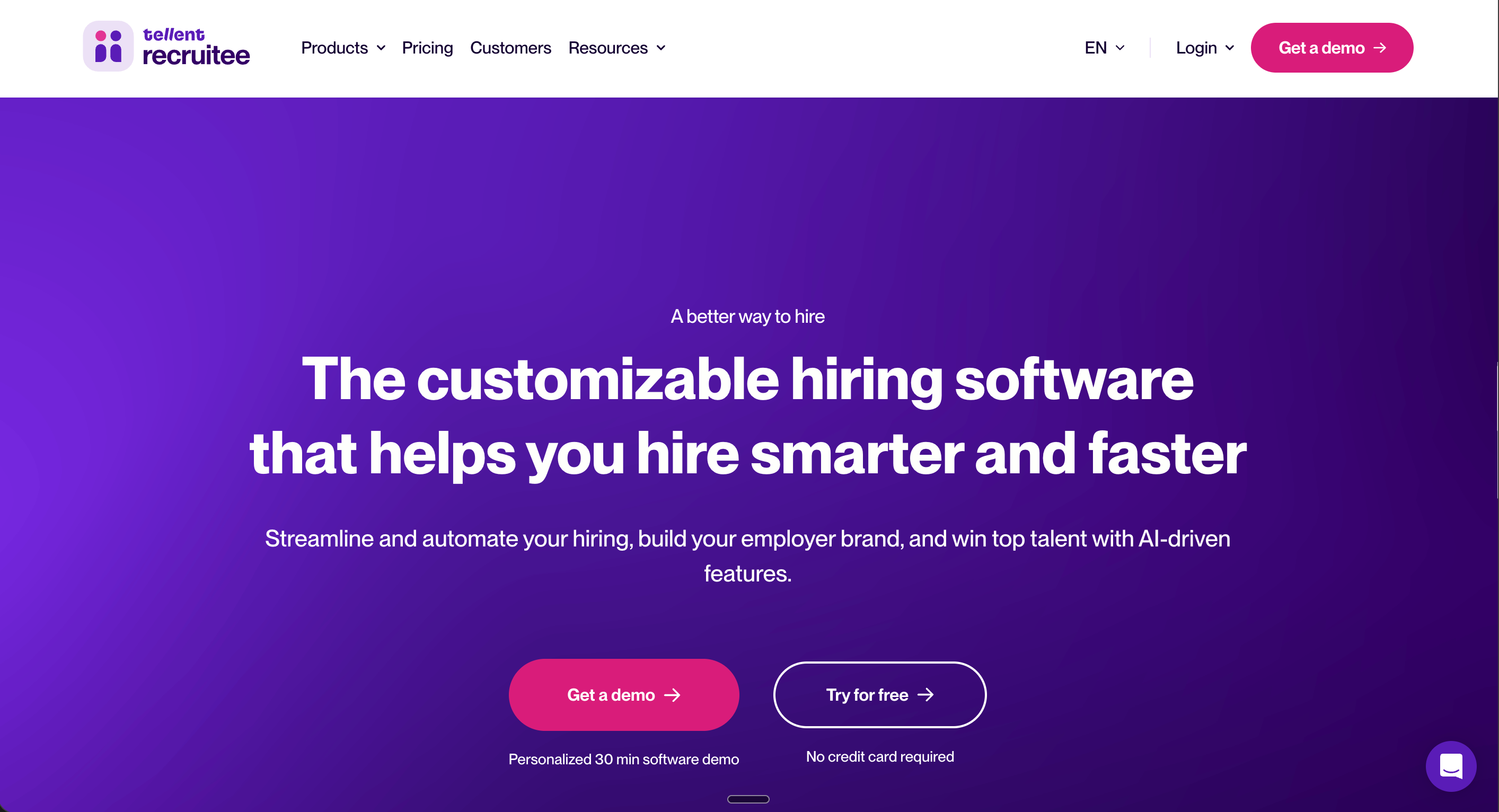
Best for: EU-based startups (50-250) needing GDPR-automated hiring workflows with strong collaboration tools and a career site builder at mid-market pricing.
Key Strengths:
- Amsterdam-based, EU-native GDPR automation: Data hosted in EU data centers; automated retention/deletion rules, consent management, and DSAR support built into core workflows. DPA is provided as standard. Explicitly positions itself as a data processor with the customer as the controller.
- Ease of use for non-technical teams: G2 rates it 9.3/10. Hiring managers can self-serve pipeline views, leave scorecards, and schedule interviews without HR hand-holding. Intuitive drag-and-drop pipeline, fast onboarding ("dive right in").
- Collaboration-first design: Centralized feedback per candidate keeps recruiters and hiring managers aligned. Role-based access lets managers review/comment without full admin rights. Saves time vs. email-based coordination.
- Career site builder (CareersHub): No-code, branded careers pages hosted by Recruitee. Many SMEs use it as a primary careers hub. Strong employer branding at this price point.
Watch-outs:
- Pricing behavior concerns: Multiple G2 reviews report prices doubling for existing customers without notice; data lock-in makes switching costly. Advanced features (SSO, automation, reporting) are gated behind higher tiers, causing costs to spike as you scale.
- UX rough edges and missing features: Some bugs in job description editing. No Kanban-style dashboard view (only pipeline). Limited ability to "file" candidates outside pipelines. Access control granularity is lower than that of enterprise ATSs.
Integrations:
- API, webhooks, 120+ integrations including Slack, Outlook, Google Workspace
- HRIS: Factorial, Personio, BambooHR, Rippling, HiBob (via API)
- E-signature tools, background check vendors, job boards (Indeed, Glassdoor, etc.)
- Calendar sync, productivity tools
- Gap: Less developer-centric than Ashby; fewer advanced automation options
Pricing Signal:
- Slot-based pricing (linked to active jobs and company size), not per-recruiter
- Start plan: ~$269-$354/month for 5-10 job slots
- Advance: ~$451/month (unlimited jobs/users, more automation/reporting)
- Optimize (enterprise): $1,664+/month (full automation, advanced analytics, SSO, custom reporting)
- 18-day free trial (capped at 5 published jobs)
- Realistic range for 50-250 SaaS hiring 10-20 roles/year: $300-$500/month base, more for enterprise features
- Annual discounts available; pricing scales with growth
- G2
- Vendor Website
- GDPR comparison
- AvaHR comparison: (pricing details, late 2025)
Tool 2: Ashby
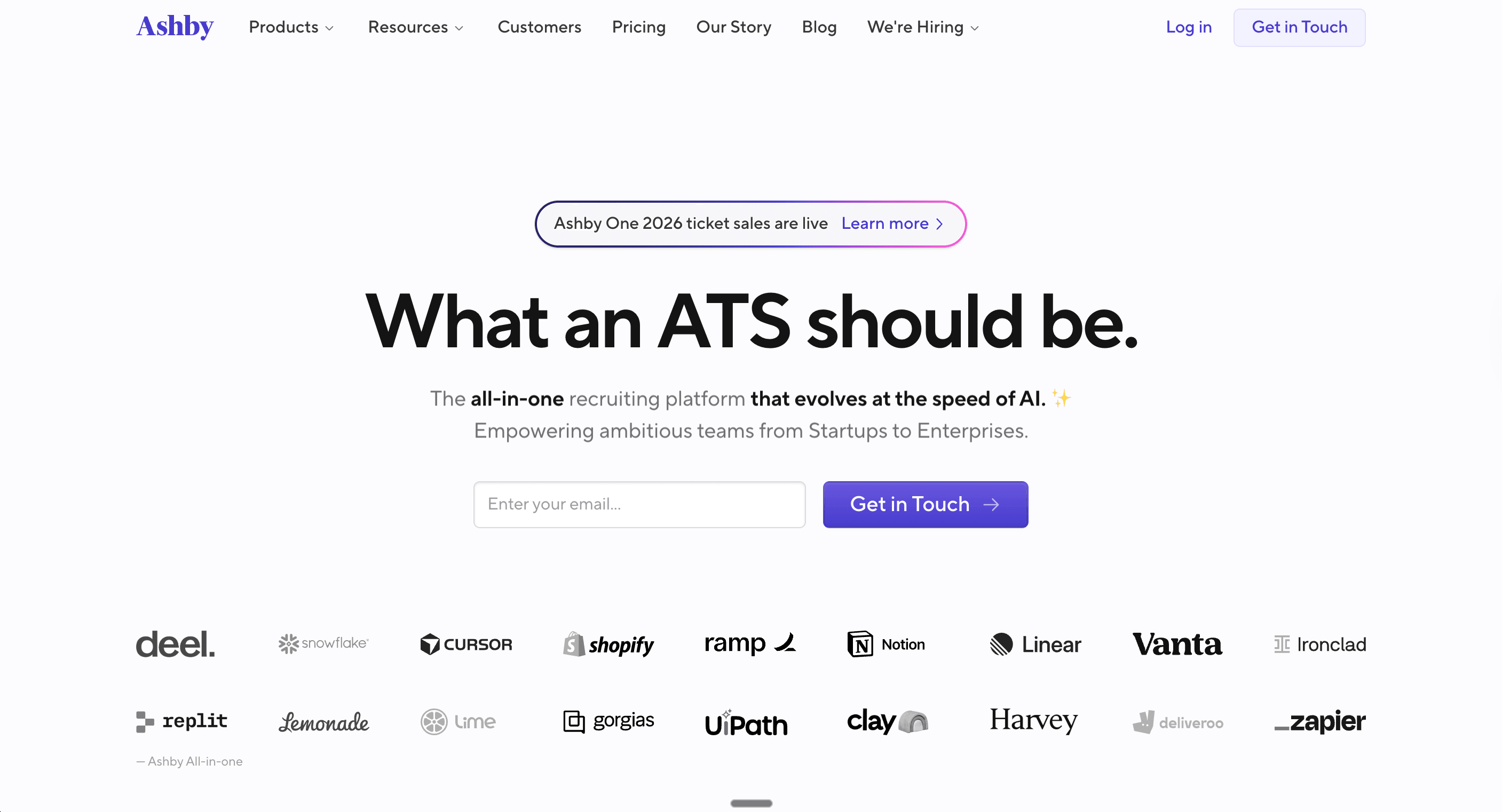
Best for: Data-driven EU startups (50-200) that want best-in-class analytics and are willing to pay premium pricing.
Key Strengths:
- Analytics powerhouse: BI-level reporting is native in the platform. Track funnel conversion, source quality, interviewer performance, DEI metrics—no external tools needed.
- Modern, fast UX: Designed by ex-Google engineers; rapid implementation (weeks, not months). Continuous product updates.
- All-in-one consolidation: ATS + CRM + scheduling + analytics reduce tool sprawl and context switching.
Watch-outs:
- Premium pricing: $10,000-$15,000/year minimum (small teams); can reach $25K-$40K for 100-200 employees. 2-3x costlier than budget options.
- Learning curve: Power requires investment. Multiple reviews mention "steep but worth it" onboarding.
Integrations:
- Slack, Google Calendar (instant sync), Gmail, major job boards
- HRIS: BambooHR, Workday, Rippling, Personio
- API + webhooks for custom builds
- Gap: Some niche EU payroll/HRIS integrations require middleware
Pricing Signal:
- Foundations: ~$300-$400/month (1-10 employees)
- Plus/Enterprise: Custom quotes (typically $10K+ annually)
- 10% discount for annual payment
- Transparent tiers on website; sales-assisted for 100+ employees
Sources:
Tool 3: Dover
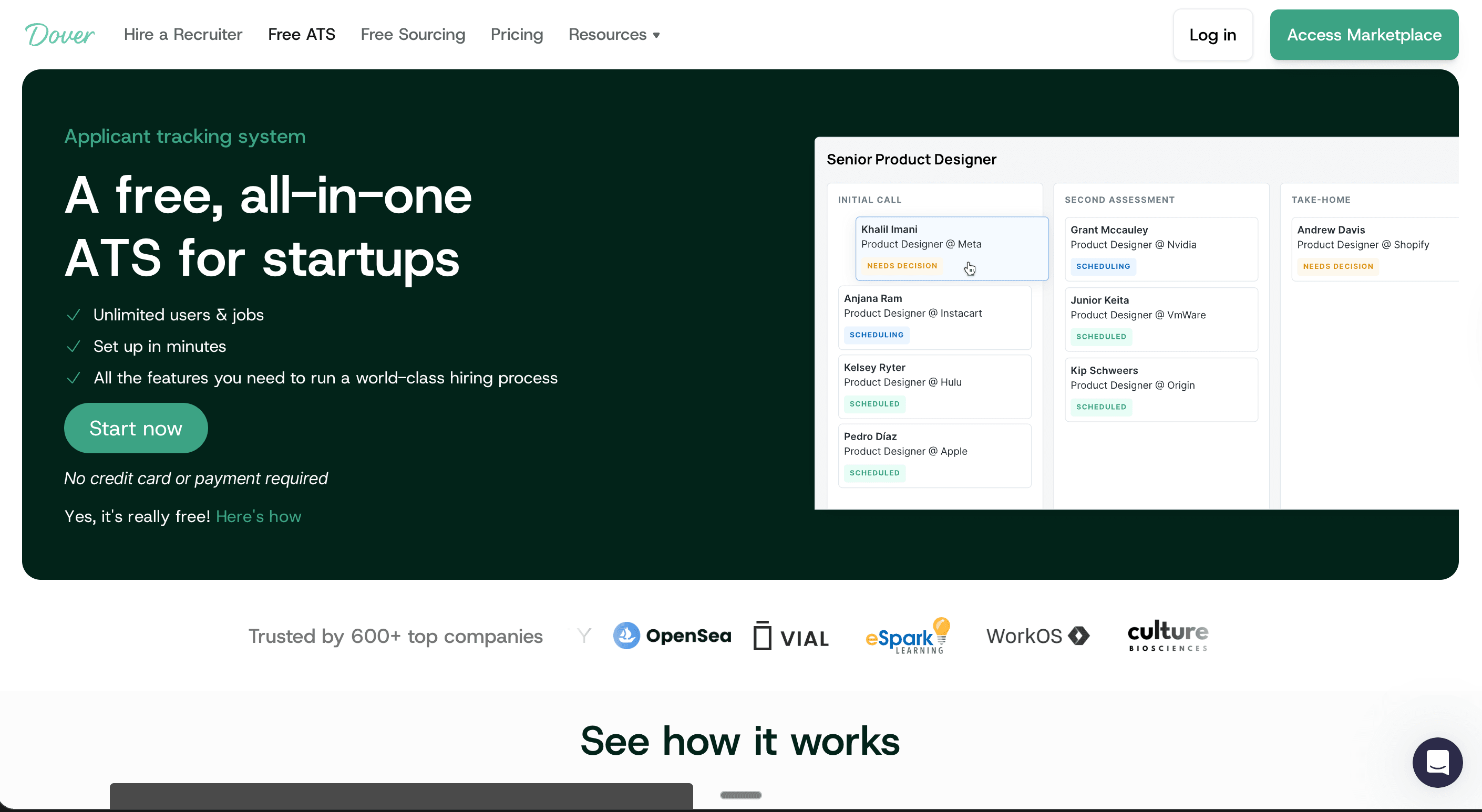
Best for: Pre-Series A / bootstrapped EU startups (10-50 employees) needing zero-cost ATS with the option to scale into a recruiter marketplace.
Key Strengths:
- 100% free, forever: Unlimited jobs, users, candidates. No hidden costs, no feature gates. Removes budget barrier for early-stage teams.
- Fast setup: Designed for founders/solo recruiters. Live in <1 hour with minimal configuration.
- Recruiter marketplace upsell: When hiring scales, spin up fractional recruiters without migrating to the platform. Transparent cost-per-hire data.
Watch-outs:
- Limited G2 validation: Newer product; fewer enterprise customers mean less review depth.
- Feature gaps vs. paid tools: No native employee referral module; resume parsing is English-only; reporting is basic.
Integrations:
- Google Workspace (calendar, Gmail) is required for scheduling
- Slack for notifications
- 75+ job boards (LinkedIn, Indeed, etc.)
- Gap: No Zapier/webhook support; fewer HRIS connectors
Pricing Signal:
- ATS: $0 forever (unlimited)
- Recruiter marketplace: Variable per-hire fees; cost-per-hire data published on site for transparency
- No upsell pressure; explicit "free forever" commitment
Sources:
- Vendor website
- Third-party: (June 2025)
- Third-party: (Q1 2026)
Practitioner Synthesis of ATS's:
- Greenhouse vs. newer tools: Greenhouse dominates the mid-market but is seen as overkill for companies with <100 employees. Recruitee and Ashby are cited as "modern alternatives" with better value/UX.
- Free tier skepticism: Dover's free model gets praise but also caution: "works until 20-30 hires, then you need real reporting." Some note English-only parsing limits EU utility.
- GDPR automation matters: EU startups prioritize ATS with built-in GDPR workflows (retention, deletion, consent). Recruitee specifically praised for automated compliance vs. manual processes in US-first tools.
- Implementation pain: Users warn: most ATS vendors underestimate setup time. "Weeks, not months," claims often stretch to 6-8 weeks in practice. Ashby exception: genuinely fast.
- Hidden costs: Job board integrations often have per-post fees. LinkedIn integration costs can exceed the ATS subscription. Practitioners advise budgeting separately.
- Pricing transparency valued: "Contact sales" model widespread frustration. Recruitee gets mixed reviews: more transparent than Greenhouse, but concerns about price hikes for existing customers.
- "Good enough" positioning: Reddit threads frame Recruitee as a solid mid-tier option: cheaper/simpler than Greenhouse, more automated than basic tools, but not aspirational at scale.
Implications for EU 50-250 AI/SaaS:
- Buying decision: If budget-constrained (<€5K/year), start with Dover or Recruitee. If analytics-critical (engineering hiring), Ashby ROI justifies a premium. Recruitee fits teams wanting GDPR automation without enterprise complexity.
- Implementation: Expect 4-6 weeks to full productivity, even with "fast" tools. Block calendar time for People Ops lead.
- Integration priority: Slack + Google Workspace non-negotiable. HRIS integration is a nice-to-have for <100, critical at 100+.
What are the key feature differences between these ATS tools?
This table compares the most relevant features for 50-250-person EU AI/SaaS companies. Learning curve estimates combine G2 reviews, Reddit discussions, vendor claims, and logical reasoning.
| Feature Category | Tellent Recruitee | Ashby | Dover |
|---|---|---|---|
| Employer Branding | CareersHub career site builder; no-code, branded pages; many SMEs use as primary careers hub | Good career pages; job posting customization; focus on analytics over branding | Basic career page generation; functional but not design-focused |
| Analytics & Reporting | Standard pipeline metrics; time-to-hire, source effectiveness; advanced reporting in higher tiers (Optimize/Lead) | Best-in-class: BI-level custom dashboards, funnel analysis, interviewer performance, DEI metrics, time-to-hire by source | Basic metrics; pipeline visibility; limited advanced reporting |
| GDPR & EU Compliance | Amsterdam-based; automated retention/deletion rules, consent management, DSAR support; EU data centers; DPA provided | GDPR-compliant; US-first design with compliance layered on; works for EU but not optimized | GDPR-compliant; English-only; Google Workspace required |
| Collaboration Tools | Centralized feedback per candidate; role-based access for hiring managers; comment threads; "90-95% of recruiting captured" | Interview scorecards; structured interview plans; team collaboration workflows | Team collaboration; interview feedback; unlimited users |
| Integrations | API/webhooks, 120+ integrations: Slack, Outlook, Google Workspace, Factorial, Personio, BambooHR, Rippling, HiBob, job boards | Slack, Gmail, Google Calendar (instant), BambooHR, Workday, Rippling, API/webhooks | Google Workspace (required), Slack, 75+ job boards; NO HRIS connectors |
| Learning Curve / Onboarding | 3-4 weeks to full productivity (G2: 9.3/10 ease of use, "dive right in"; Reddit: praised for intuitive UX but setup takes time; website: fast onboarding claims; reasoning: collaboration features require team alignment) | 2-3 weeks to full productivity (G2: steep learning curve mentioned but "worth it"; Reddit: "genuinely fast" vs competitors; 14-tab scheduling settings require training) | <1 week to basic productivity (G2: limited data; Reddit: "live same day"; website: designed for founders; under 1 hour setup claimed) |
Performance management - What this category is for:
For distributed AI/SaaS teams (50-250), performance management tools replace annual review chaos with continuous feedback, goal alignment (OKRs), and structured 1-on-1s. The goal: keep remote/hybrid employees engaged, ensure goals cascade from company to individual, and give managers data to support development conversations. In EU contexts, GDPR-compliant feedback storage, multilingual support, and Slack/Teams integration for asynchronous feedback are critical.
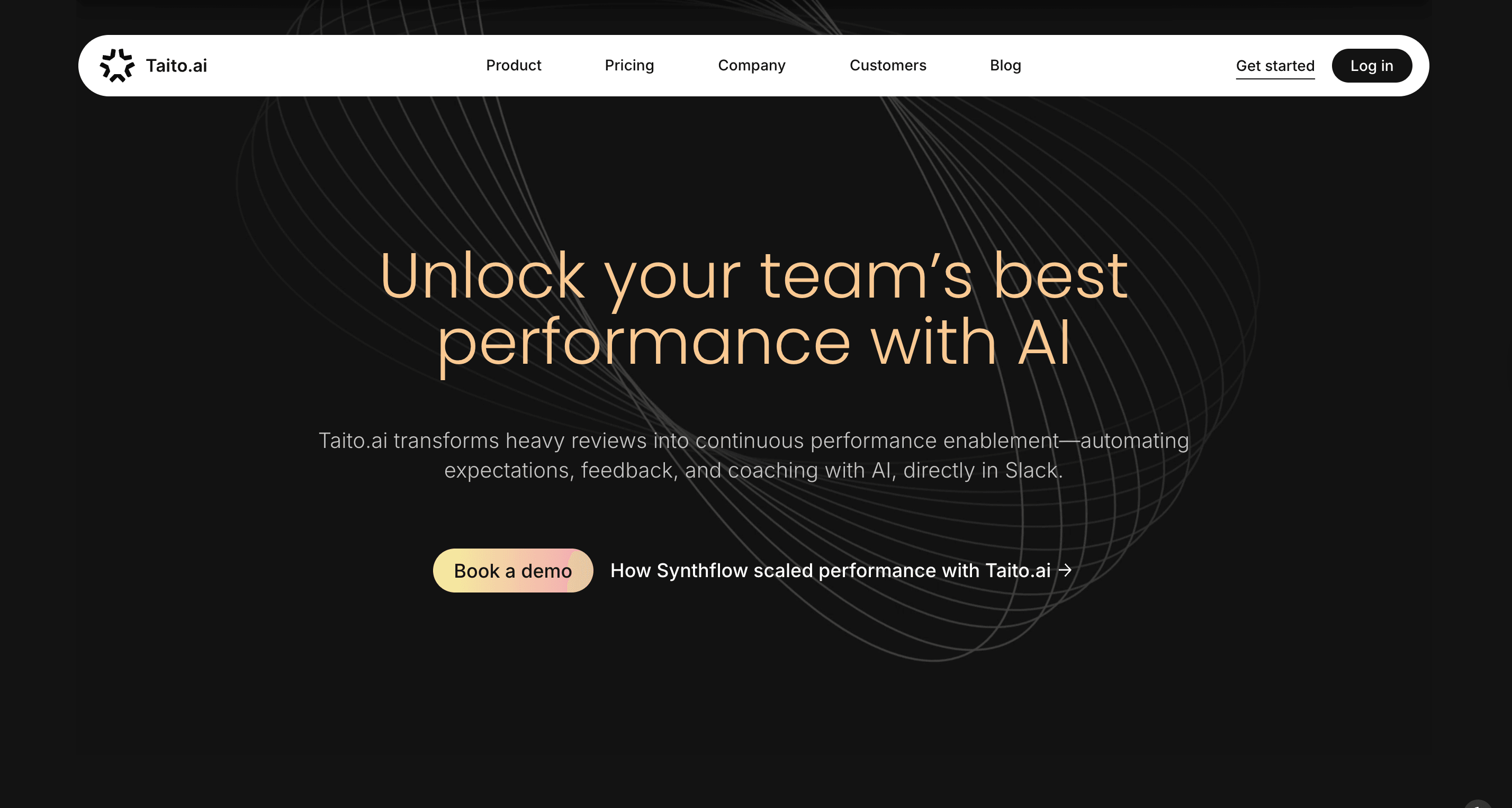
Tool 1: Taito.ai
Best for: AI-native / SaaS teams (50-250) that live in Slack/Jira/Linear and want continuous performance enablement embedded in day-to-day workflows instead of a separate HR portal.
Key Strengths:
- Continuous, AI-driven feedback loop: Replaces annual cycles with ongoing expectations, feedback collection, and AI-generated summaries of strengths and growth areas, turning raw comments into usable performance profiles.
- Workflow-native for product/engineering teams: Deep integrations with Slack, Google Calendar, Jira, Linear, and HiBob/Workday mean prompts, reflections, and summaries happen where people already work, especially valuable for remote, async SaaS teams.
- Bias-aware, structured evaluations: Uses shared criteria and AI assistance to streamline writing reviews and calibrations, aiming to reduce bias and make evaluations more consistent across teams.
Watch-outs:
- Very early on G2 (zero verified reviews): G2 lists Taito.ai with 0 reviews—no independent customer evidence on reliability, support, or long-term outcomes yet. You'd be an early reference user.
- Vendor-origin story: At least one Reddit comment indicates the product was initially built to solve its own team's pain, which is a strength for relevance but also means processes, reporting, and admin tooling may still be maturing for non-founder customers.
Integrations:
- Slack, Google Calendar, Jira, Linear, HiBob, Workday
- Positioned as operating "inside" these tools instead of as a separate portal
- Supports importing existing performance frameworks or using Taito templates
- Gap: Limited marketplace due to new platform status
Pricing Signal:
- Flat rate: €10 per employee/month
- No feature gating or tier complexity
- 14-day free trial available
- Transparent, simple pricing model vs. competitors
Sources:
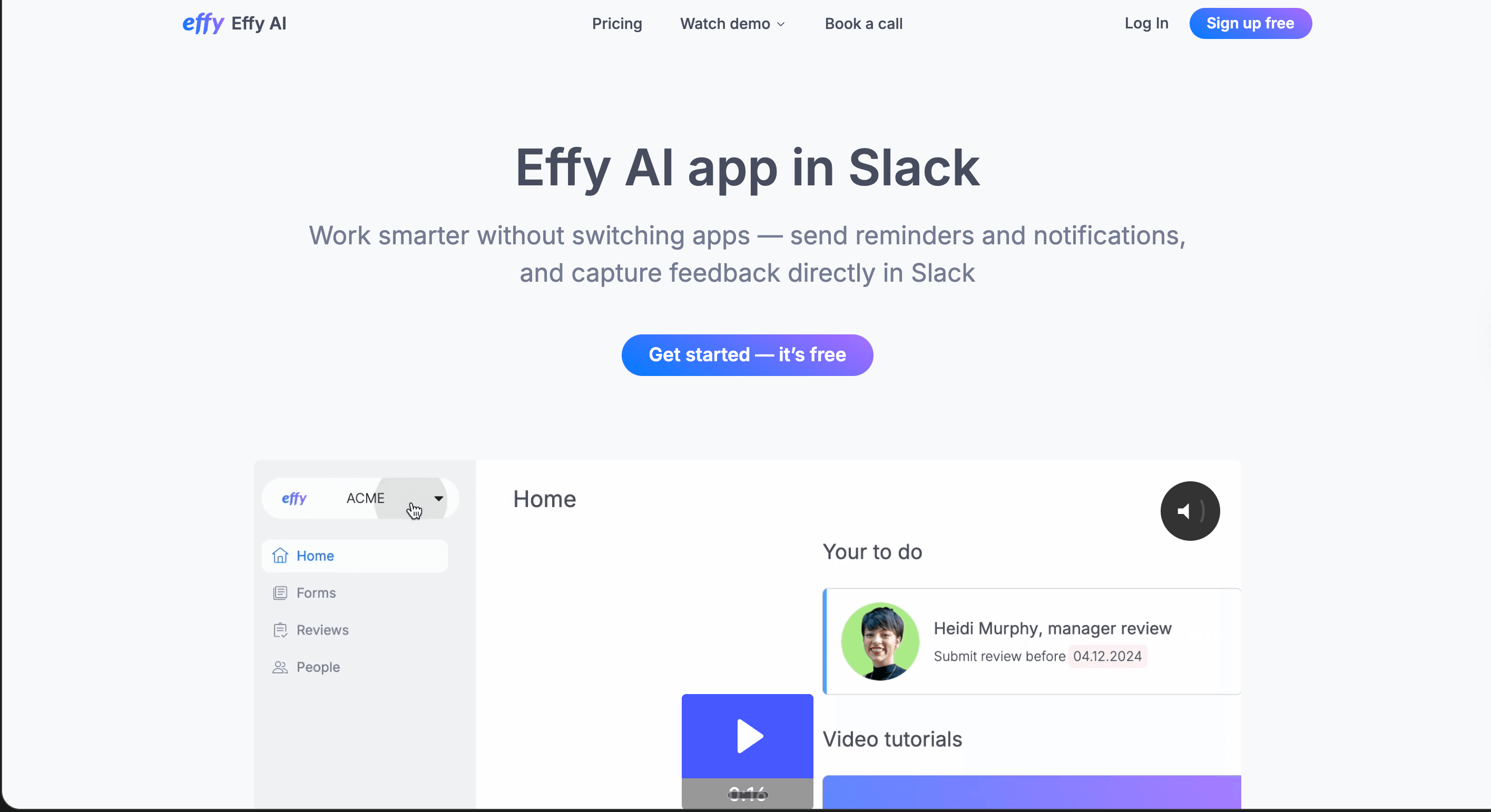
Tool 2: Effy AI
Best for: EU startups (50-150) upgrading from spreadsheets/Forms to structured 360 reviews with AI assistance; Slack-centric teams wanting a budget-friendly, fast-to-deploy performance tool.
Key Strengths:
- AI-first 360 reviews: AI generates review forms in ~90 seconds, creates summaries from free-text feedback, and detects patterns and potential bias. The vendor claims to save 40-60% of the time per review cycle compared to manual processes.
- Slack-native experience: Run entire review cycles in Slack—notifications, reminders, submissions, and AI summaries delivered where teams already work. Also supports Microsoft Teams. "Launch your first review cycle the same day you sign up" (ToolsForHumans).
- GDPR-ready, EU data residency: Privacy-by-design with AWS Frankfurt hosting for EU customer data. Explicit GDPR + CCPA compliance, granular access controls, customer-managed retention/deletion. DPA with AWS using SCCs.
- Budget-friendly: Starting from $2.50-$6 per user/month with a free tier for up to 5 people. Significantly cheaper than Lattice/Leapsome while offering AI capabilities, those tools are only beginning to roll out.
Watch-outs:
- Analytics depth limited: Users report dashboards (spider charts, heatmaps) are good for SMBs but lack the org-level calibration tools, performance distributions, and comp band analytics found in Lattice/Leapsome. Limited data export capabilities.
- Fewer HRIS integrations: No deep native integrations with Personio/HiBob/Rippling. Effy serves as a standalone PM layer with Slack/Teams, not as an embedded module within HRIS.
- May outgrow at 200-250+: Current feature set optimized for 50-150 employee range. Teams scaling to 500+ may need richer governance, analytics, and calibration features within 2-3 years.
Integrations:
- Deep: Slack (entire review workflow), Microsoft Teams (notifications + submissions)
- Limited: Calendar integrations are weak vs. bigger PM suites; there is no strong evidence of an API/webhook ecosystem yet
- Gap: Missing native HRIS connectors (Personio, BambooHR, Workday) that competitors offer
Pricing Signal:
- Free: $0/user for up to 5 people, includes all paid features
- Pro: $2.50-$6/employee/month depending on source (GetApp: $2.50/user, Stackfix: $6/user, TrustRadius: $3-$7/user range)
- Free trial available; no multi-year lock-in
- Budget assumption for 50-250: ~$3-$6/employee/month
Sources
- G2: (4.85/5, 35-37 reviews)
- GetApp: (pricing, features)
- SoftwareAdvice: (GDPR, deployment)
- Stackfix 2025 expert review
- ToolsForHumans: (implementation speed)
- TrustRadius pricing data
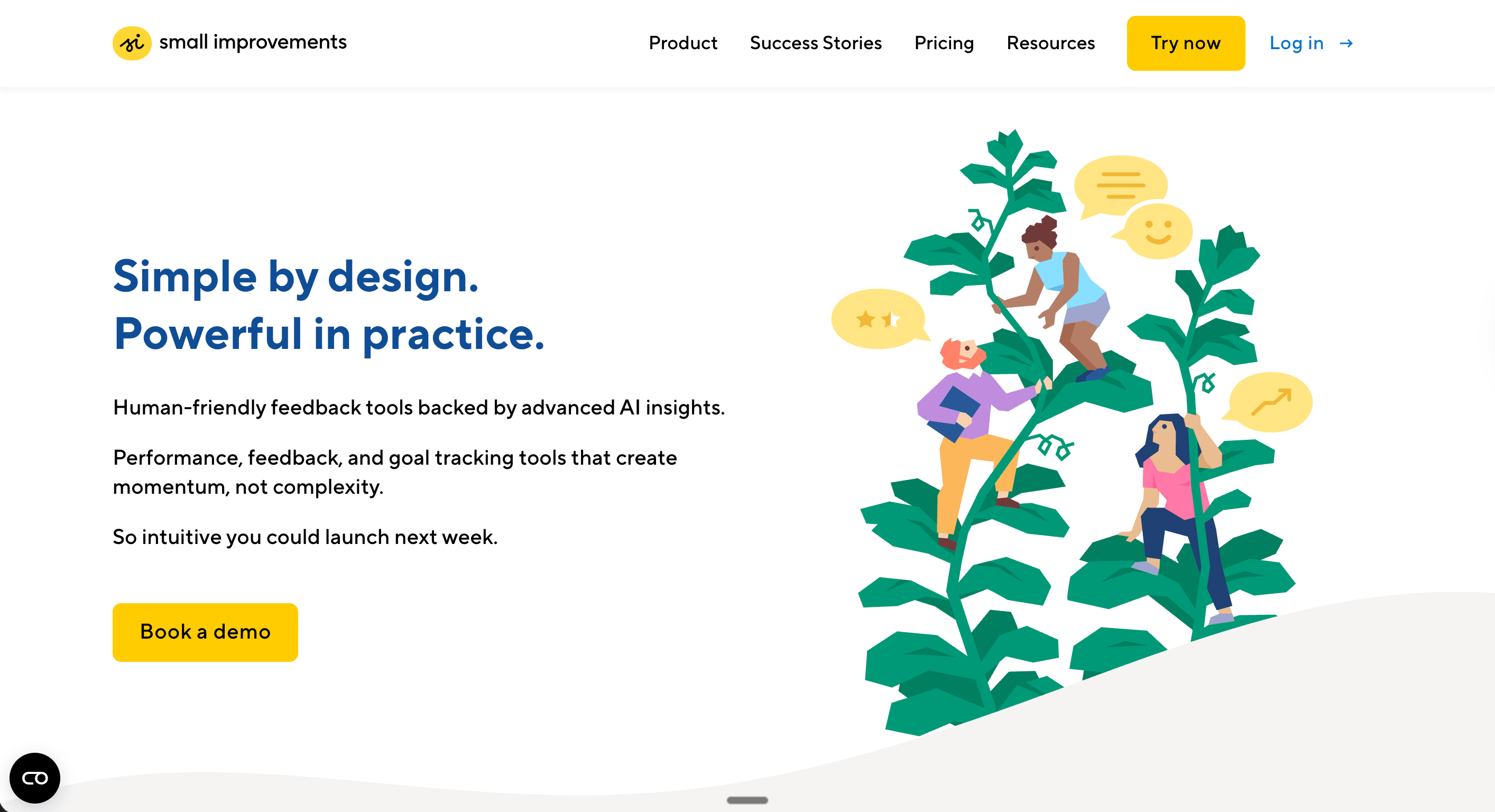
Tool 3: Small Improvements
Best for: EU startups (50-150) wanting lightweight continuous feedback without enterprise complexity or US-first tooling.
Key Strengths:
- EU-friendly positioning: Not explicitly EU-built but popular in European markets; GDPR-compliant, multilingual support.
- Focused simplicity: Continuous feedback, 1-on-1s, objectives—avoids feature bloat. Faster to implement than Lattice/15Five.
- Affordable: Lower price point than all-in-one platforms; good fit for teams that just need feedback loops, not a full performance suite.
Watch-outs:
- Limited OKR depth: Basic goal-setting vs. sophisticated OKR platforms (Lattice, Leapsome).
- Smaller ecosystem: Fewer integrations, smaller user community than US incumbents.
Integrations:
- Slack, Google Workspace, Microsoft Teams
- HRIS: BambooHR, Personio
- Gap: No native API for custom builds; fewer third-party connectors
Pricing Signal:
- Public tiers: typically €5-€8 per employee/month
- Free trial available
- Transparent pricing on website (no "contact sales")
Sources
- G2: (4.5/5, 150+ reviews estimated)
- Vendor website
Practitioner Synthesis:
- Timing matters: Consensus on Reddit: don't buy performance software until 40-50 employees. Below that, structured 1-on-1 templates in Notion/Docs suffice.
- Culture > tools: Repeated warning: "Tools won't fix bad managers." Implementation requires manager training, not just software rollout.
- OKR fatigue: Some teams report that OKR tools create bureaucracy. Preference for simple goal-setting unless the company already rigorously practices OKRs.
- Engagement survey overload: Pulse survey fatigue is real. Weekly pulses can annoy employees if not paired with visible action. Practitioners recommend bi-weekly or monthly.
- AI assistance welcome but guarded: Practitioners are open to AI to reduce admin (form generation, summaries) but wary of AI-generated feedback that's "trivial and contradictory." Need human judgment, not AI replacement.
- Slack-first vs. portal debate: Teams that live in Slack strongly prefer tools with deep integration (Taito.ai, Effy AI); it reduces friction vs. separate dashboards.
- Integration obsession: Slack/Teams integration is non-negotiable for distributed teams. Tools without native integrations see low adoption.
Implications for EU 50-250 AI/SaaS:
- Buying decision: If <75 employees, consider lightweight tools (Small Improvements, Effy AI) or delaying purchase. At 100+, choose based on workflow: Slack-native (Taito.ai/Effy) vs. structured all-in-one (moved to Engagement: Leapsome).
- Implementation: Budget 2-4 weeks for lightweight tools (Effy AI, Taito.ai), longer if adding manager training. Rollout in phases (start with reviews, add goals later).
- AI governance: If choosing AI-assisted tools (Taito.ai, Effy AI), establish clear guidelines so managers understand AI is an assistant, not a replacement for judgment.
What are the key feature differences in performance management tools?
This table highlights the most relevant features for 50-250-person teams choosing among continuous feedback, OKRs, and review automation.
| Feature Category | Taito.ai | Effy AI | Small Improvements |
|---|---|---|---|
| Continuous Feedback & Reviews | AI-driven continuous feedback loop; automated prompts in Slack/Calendar; AI-generated performance summaries from raw comments | AI-first 360 reviews; AI generates forms in 90 seconds; multi-source feedback; AI summaries from free-text responses | Lightweight continuous feedback; praise wall; private feedback; simple 1-on-1 templates |
| Goal Management (OKRs) | Performance expectations & shared criteria; imports existing frameworks or uses Taito templates; less OKR-centric than competitors | Individual goal-setting (86% of reviewers); company goals & OKRs alignment (86%); adequate but not deep OKR platform | Basic objectives tracking; goal visibility; less sophisticated than dedicated OKR platforms |
| Performance Reviews | AI-assisted review writing; bias-aware structured evaluations; calibration support; replaces annual cycles with continuous profiles | Customizable review forms (95%); review status tracking (93%); AI-generated summaries; spider charts & heatmaps for visualization | Review cycles; peer feedback; manager 1-on-1s; simple templates; no AI features |
| Analytics & Reporting | AI-generated insights; performance profile summaries; feedback trends; still maturing for non-founder customers | Dashboards (89%); historical data (91%); spider charts & heatmaps; limited depth vs. enterprise suites (no advanced people analytics) | Basic reporting; feedback frequency; goal progress; limited advanced analytics |
| Integrations | Slack, Google Calendar, Jira, Linear, HiBob, Workday; workflow-native (operates "inside" tools) | Deep Slack & Microsoft Teams integration (entire review workflow); limited HRIS integrations; no native Personio/BambooHR/Workday | Slack, Teams, BambooHR, Personio; fewer integrations than enterprise platforms |
| Learning Curve / Onboarding | 2-4 weeks estimated (G2: no data; Reddit: positive for Slack-native teams; website: free trial implies PLG ease; reasoning: AI tools require trust-building with managers) | Days to first cycle (G2: "launch your first review cycle same day you sign up"; Reddit: fast replacement for Excel/Forms; website: AI-generated forms in 90 seconds; reasoning: Slack-native + templates = minimal setup) | 2-3 weeks to productivity (G2: "easy onboarding, live in 1-2 weeks"; Reddit: praised for simplicity; website: quick setup emphasized; reasoning: focused feature set reduces configuration) |
Employee engagement - What this category is for:
Employee engagement tools help distributed EU teams (50-250) measure sentiment, identify burnout risks, and give managers actionable data to improve culture. For AI/SaaS companies with remote/hybrid setups, these tools replace annual surveys with continuous listening (pulse surveys), anonymous feedback channels, and manager dashboards that surface team health trends. GDPR compliance, anonymity thresholds, and Slack-native delivery are critical for EU adoption.
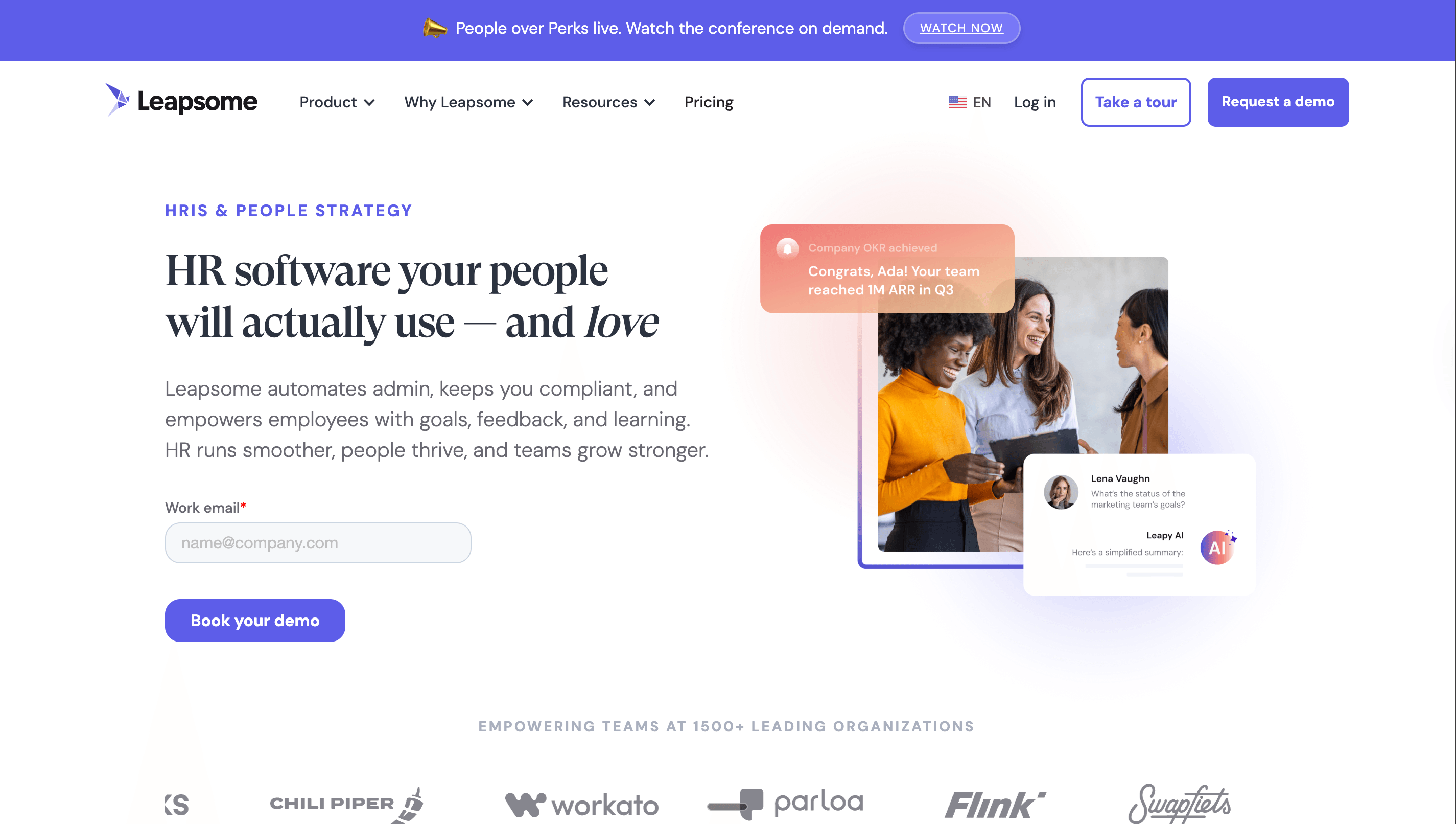
Tool 1: Leapsome
Best for: EU startups (75-250) wanting an integrated engagement + performance platform; teams consolidating 3-5 tools into one GDPR-first, German-built system.
Key Strengths:
- All-in-one engagement + performance: Combines pulse surveys, eNPS tracking, engagement analytics WITH OKRs, 360° reviews, learning paths, and 1-on-1s. Reduces tool sprawl—users report consolidating 3-5 separate tools into Leapsome.
- German origin, strong EU traction: Founded in Berlin; GDPR-native with EU data residency; multilingual (10+ languages); customers include Spotify, Mercedes-Benz, Trivago. Strong European customer base and support.
- Engagement analytics integrated with performance: Unlike standalone pulse tools, Leapsome connects engagement scores with performance data, goals, and 1-on-1 frequency. See correlations between team engagement and OKR completion, turnover risk, or manager effectiveness.
- AI-powered features: AI Review Wizard for questionnaires, AI-generated OKRs, and sentiment analysis of free-text feedback—differentiate from legacy engagement-only tools.
Watch-outs:
- Complex setup (8-12 weeks): All-in-one means feature-rich but requires dedicated People Ops time. Not plug-and-play. G2 reviews mention "initial setup can be complex."
- Pricing opacity: No public pricing; only custom quotes. Industry estimates: €8- €18/employee/month, depending on the modules enabled. "Contact sales"is frustrating for budget-conscious startups.
- Can overwhelm small teams: For 30-50 employee teams, the full feature set may feel excessive. Better fit once you're 75-100+ and actually need a consolidated platform.
Integrations:
- Slack, Microsoft Teams, Google Workspace
- HRIS: Personio, BambooHR, Workday, Rippling (30+ HRIS systems)
- SSO: Okta, Azure AD
- Gap: Some users want deeper Slack threading for feedback
Pricing Signal:
- Not publicly listed; custom quotes based on employee count + modules
- Surveys + performance: ~€8-€12/employee/month (estimated)
- All modules (surveys, OKRs, reviews, learning): ~€15-€18/employee/month (estimated)
- Transparent quoting process: demo → needs assessment → quote within 48 hours
Sources:
- G2
- Vendor website
- Third-party
- Reddit: (engagement tool comparisons)
Tool 2: Teamspective
Best for: EU startups (50-200) needing Organizational Network Analysis to identify hidden engagement risks and target interventions precisely.
Key Strengths:
- Finnish-built, EU-native: GDPR-first design; data residency in EU; strong Nordic customer base (Relex, others). Helsinki-based with €900K funding in 2024.
- Unique ONA (Organizational Network Analysis): Maps informal networks to identify isolated employees, overburdened connectors, or silos. Surfaces that need support, not just those with low survey scores.
- Reported results: Customer testimonials cite 18% average performance increase for Teamspective users—actionable insights beyond generic engagement scores.
Watch-outs:
- Smaller user base: Less G2 validation than Officevibe or major platforms (newer platform, more niche positioning).
- Feature breadth: Focused on analytics + feedback; may lack full learning modules or advanced benchmarking vs. enterprise engagement platforms.
Integrations:
- Slack, Microsoft Teams for pulse surveys
- HRIS: Personio, BambooHR (via API)
- EU whistleblower channel included
- Gap: Smaller integration marketplace than US incumbents
Pricing Signal:
- Not publicly listed; typically custom quotes
- Mid-market positioning suggests accessibility for 50-250 employee companies
- Industry patterns suggest €6-€10 per employee/month
Sources
- G2 reviews
- Customer testimonials and case studies
Tool 3: Friday Pulse
Best for: Remote-first EU startups (30-150) prioritizing privacy, simplicity, and EU data residency without enterprise complexity.
Key Strengths:
- Remote-first design: Built for distributed teams; async feedback, timezone-agnostic pulse delivery.
- Privacy-focused: Strong GDPR stance; data in EU; transparent anonymity thresholds (5+ respondents to show results).
- Norwegian origin: Nordic design philosophy (simplicity, user trust); pricing transparency.
Watch-outs:
- Smaller feature set: No learning modules, no OKRs, no performance reviews—purely engagement surveys + feedback.
- Limited integrations: Smaller marketplace than Officevibe/Peakon; fewer HRIS connectors.
Integrations:
- Slack, Microsoft Teams
- Basic HRIS via API (Personio, BambooHR)
- Gap: No Zapier; fewer third-party apps
Pricing Signal:
- Transparent tiers: typically €5-€10 per employee/month
- Free trial (14-30 days)
- No "contact sales"; self-serve signup
Sources
Practitioner Synthesis:
- Survey fatigue is real. The overwhelming theme: employees ignore surveys if no visible action follows. Practitioners recommend bi-weekly or monthly pulses, not weekly.
- Integrated vs. standalone debate: Leapsome users report higher ROI when using both engagement and performance modules than with standalone engagement tools. Argument: seeing engagement scores alongside OKR progress and 1-on-1 frequency provides actionable context.
- Network analysis intrigue: Organizational Network Analysis (Teamspective's differentiator) gets interest but also skepticism: "sounds like surveilling social graphs." Requires trust and transparency to be implemented ethically.
- Anonymity trust critical: EU teams are especially sensitive to anonymity. Tools that show results with <5 respondents damage trust. Teamspective and Friday Pulse are praised for transparency.
- Slack integration valued but not universal: Distributed teams report 50-85% response rates with Slack delivery vs. 20-40% for email surveys. However, all-in-one platforms (Leapsome) prioritize web dashboards with Slack notifications.
- Action-planning gap: Most tools collect data well; few help managers act on it. Integrated platforms that connect engagement drops with goal slippage or low 1-on-1 frequency provide clearer intervention triggers.
- Multilingual challenges: Non-English EU teams struggle with tools lacking translation. Leapsome (10+ languages) and Teamspective are strong here with an EU focus.
Implications for EU 50-250 AI/SaaS:
- Buying decision: If <100 employees, consider lightweight tools (Friday Pulse) or wait. At 100-150, choose based on integration needs: standalone engagement (Teamspective for ONA, Friday Pulse for privacy) vs. all-in-one (Leapsome if also buying performance management).
- Implementation: Pair the tool with "you said, we did" communication cadence. A survey without visible action kills engagement faster than no surveys.
- Response rate expectations: Aim for 60-70% with Slack delivery. A score below 50% indicates trust/relevance issues, not tool problems. Leapsome's web-first approach may see lower rates without strong comms.
What are the key feature differences in employee engagement tools?
This table compares pulse surveys, manager action tools, and analytics approaches for understanding and improving team sentiment.
Here's the Employee Engagement Feature Differences table in plain markdown: markdown### What are the key feature differences in employee engagement tools?
This table compares pulse surveys, manager action tools, and analytics approaches for understanding and improving team sentiment.
| Feature Category | Leapsome | Teamspective | Friday Pulse |
|---|---|---|---|
| Pulse Surveys | Customizable pulse surveys (weekly/bi-weekly/monthly); eNPS tracking; engagement heatmaps by team/department; anonymous feedback channels | Bi-weekly/monthly pulse surveys; customizable questions; ONA-integrated survey design | Weekly/bi-weekly pulses; simple question builder; timezone-agnostic delivery |
| Manager Action Tools | Action planning tied to survey results; integration with 1-on-1 frequency and goal progress; engagement drops trigger interventions | ONA insights show which managers need coaching; network bottleneck identification; targeted interventions | Basic manager dashboards; trend visibility; less prescriptive action guidance |
| Analytics & Insights | Engagement analytics integrated with performance data; see correlations between engagement, OKR completion, turnover risk, manager effectiveness | Unique: Organizational Network Analysis (ONA); identifies isolated employees, overburdened connectors, silos; 18% performance increase reported | Engagement metrics; response rates; basic benchmarking; privacy-first reporting (5+ threshold) |
| Anonymity & Privacy | Anonymous responses; GDPR-first; EU data residency; multilingual (10+ languages) | GDPR-first; EU data residency; transparent anonymity rules; whistleblower channel included | Norwegian GDPR compliance; EU data centers; strong privacy transparency; 5+ threshold |
| Integrations | Slack, Teams, Google Workspace, 30+ HRIS systems (Personio, BambooHR, Workday, Rippling), Okta, Azure AD SSO | Slack, Microsoft Teams, Personio, BambooHR (API); fewer integrations due to newer platform | Slack, Microsoft Teams, basic HRIS via API; no Zapier; smaller marketplace |
| Learning Curve / Onboarding | 8-12 weeks for full platform (G2: "complex setup, requires People Ops time"; Reddit: "don't underestimate training"; website: implementation support required; reasoning: all-in-one with engagement+performance means more modules to configure) | 3-4 weeks for ONA value (G2: "requires People Ops sophistication"; Reddit: "interpreting network data takes training"; website: implementation support offered; reasoning: unique methodology requires education) | <1 week to first pulse (G2: "simple setup"; Reddit: minimal mentions but "privacy-first tools have less bloat"; website: self-serve; reasoning: focused feature set, no complex analytics) |
Decision rules (reusable framework)
Here's a scoring and decision framework for evaluating HR/People tools for EU-based SaaS companies with 50–250 employees. Covers weighted criteria across Europe fit, security, implementation speed, integrations, and product maturity, plus bias rules favoring modern startup-native tools, minimum evidence thresholds, and tie-breaker logic.
Download the framework
Download FrameworkWhat should I read next?
- What are the top performance management software for small and mid-sized companies 2026?
- What are the top 14 HiBob talent module competitors and alternatives in 2026?
- What are the top 13 CultureAmp competitors and alternatives in 2026?
FAQ
1. When should we buy performance management tools instead of using spreadsheets?
The inflection point hits around 40-50 employees when promotion/compensation decisions carry higher stakes and managers interpret performance differently without a shared system. For groups below 40, structured 1-on-1 templates in Notion suffice; above 75, the cost of inconsistent data exceeds the €8-€15/employee/month cost of the tool. Budget 2-4 weeks for lightweight tools (Taito.ai, Effy AI), longer if adding manager training.
2. What's the difference between Taito.ai and Effy AI?
Taito.ai embeds continuous feedback in Slack/Jira workflows (€10/employee/month flat, zero G2 reviews, best for workflow-embedded performance). Effy AI focuses on AI-assisted 360 reviews ($2.50-$6/employee/month, 4.85/5 on 35-37 G2 reviews, same-day setup). Choose Taito for continuous ambient feedback; choose Effy for structured review cycles with budget-friendly pricing.
3. Should we pick one vendor for performance + engagement, or use separate tools?
Integrated approach (Leapsome): combines engagement surveys with OKRs/reviews/learning at €8-€18/employee/month, 8-12 week setup, best for 75-250 teams with People Ops capacity. Separate best-of-breed: faster implementation and lower cost for <150 employees (pair Taito.ai/Effy AI with Teamspective/Friday Pulse). Reddit consensus: separate tools win for <150 unless you need consolidated analytics.
4. How do we avoid vendor lock-in?
Verify three exit mechanisms before signing: (1) Data export in CSV/JSON format—test during trial, (2) API access for programmatic extraction, (3) Annual contracts with clear cancellation terms. ATS migration is most painful (years of candidate data); performance/engagement tools easier to swap. Dover's free ATS and Taito.ai's flat pricing reduce future lock-in risk.
5. What's the minimum team size where these tools make sense?
ATS: 20-30 employees when hiring 5+ roles/year. Performance: 40-50 employees when promotion decisions and manager consistency matter. Engagement: 30-40 employees when multiple teams need pulse surveys. Below these thresholds, invest in structured processes (scorecards, templates, check-ins) before software.
6. How important is EU data residency vs. GDPR compliance?
GDPR compliance is non-negotiable (DPA, retention automation), but EU data residency varies by risk tolerance. Conservative approach: require EU data centers and EU-headquartered vendors (Recruitee, Leapsome, Teamspective, Friday Pulse). Pragmatic approach: accept US vendors with strong GDPR compliance (Ashby, Effy AI) if features justify it. Red line: avoid vendors without clear DPAs or articulated data locations.