Events
6.3.2026
Miikka Kataja
You can't run quarterly planning cycles at AI company speed. Here's what Lovable and Tandem do instead.
Lovable uses quarterly signal reviews and micro retros. Tandem runs six-week cycles. Here's how two AI-native teams have rebuilt performance management to match the speed they operate at.
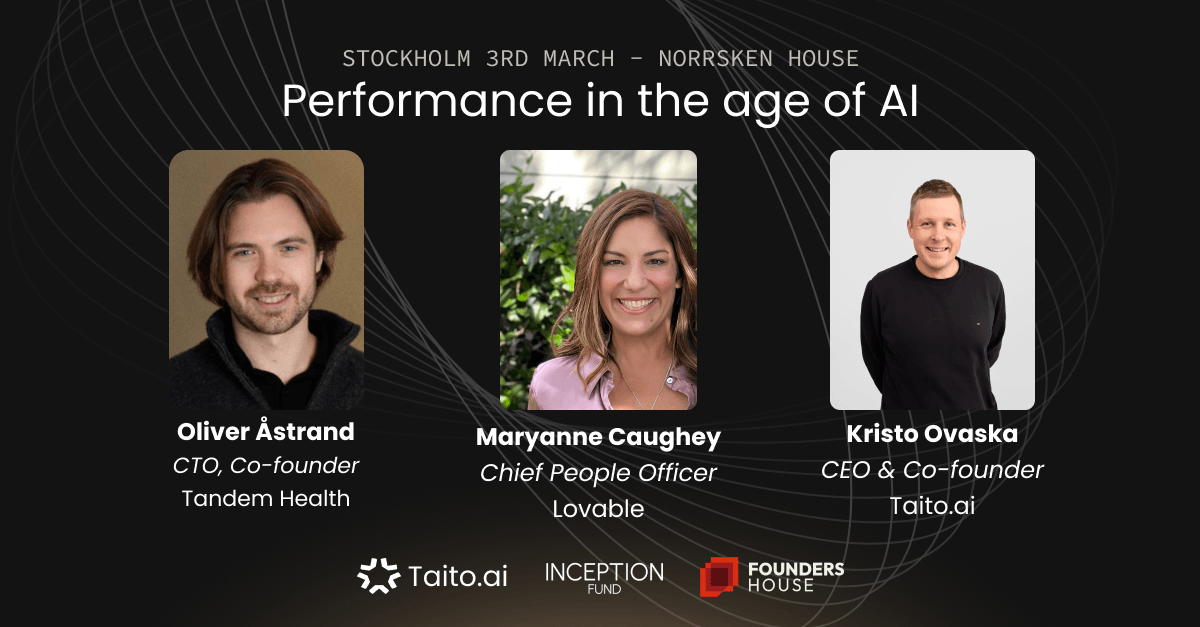
Insights from Maryanne Caughey, Chief People Officer at Lovable, and Oliver Åstrand, CTO and Co-founder at Tandem Health — shared at a Taito event in Stockholm, March 2026.
TL;DR
- Lovable runs quarterly "signal reviews" — keeper test, values alignment, outcome delivery — not personal development reviews. The goal is to identify problems and acceleration fast, not process feedback thoroughly.
- Tandem runs six-week planning cycles instead of quarters, because "quarterly plans often end with 'priorities changed'."
- Both rely on micro retros and continuous check-ins as the connective tissue between formal moments — not as a replacement for structure, but as what makes formal reviews useful when they happen.
- AI has unlocked a dataset that didn't exist before: calls, Slack history, Git commits, and meeting transcripts now give managers real context before feedback conversations.
- Lovable removed compensation from the review conversation entirely — pay is top of market, annual increases are automatic, and ratings are decoupled from pay decisions in the moment.
Who was in the conversation and why did it matter?
The discussion brought together two leaders from companies that have independently reached the same conclusion: the standard performance management playbook is too slow for how they operate.
Maryanne Caughey is Chief People Officer at Lovable, a company of around 170 people that has become one of the fastest-growing products in the AI era. Her background spans Google, Dropbox (where she led international expansion when the company had 75 people), Gusto, and Notion. She joined Lovable when everything was still being figured out — and has built a performance system deliberately designed around speed and signal, not process weight.
Oliver Åstrand is CTO and co-founder at Tandem Health, an AI medical assistant that helps clinicians prepare ahead of consultations, find the right treatment during them, and document after. Tandem is two and a half years old and rolling out across major private care providers in Europe. Oliver brought the perspective of a technical founder who has had to build performance from scratch — without a People Lead to hand it off to.
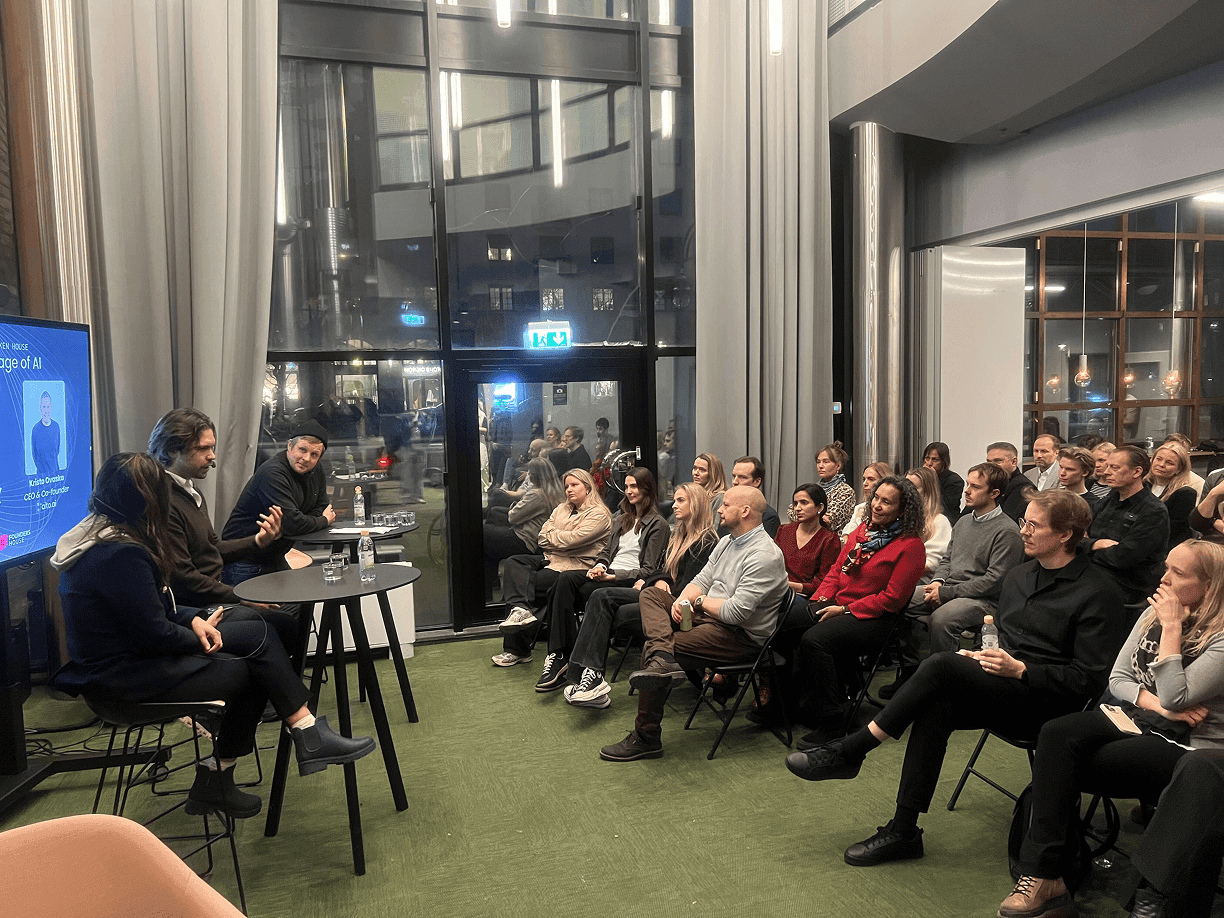
Kristo Ovaska, Taito's CEO, hosted the conversation as part of Taito's ongoing event series, held in Stockholm at Norrsken House in March 2026.
What made this conversation valuable was the contrast. Maryanne is building performance infrastructure at a company with real headcount and a clear philosophy. Oliver is doing it as a founder, close to the product. Both are doing it at AI company speed — and both have made deliberate choices to abandon process that couldn't keep up.
How does Lovable run performance without slowing down?
Lovable's approach is built around what Maryanne calls "signal reviews" — a lightweight quarterly process designed to identify problems and acceleration, not to run development conversations.
The format is simple. Each manager inputs three data points for every direct report: the keeper test (would you hire them again?), how they're stacking against Lovable's core values, and how they're delivering outcomes. The output is a two-by-two: who's on track, who's exceptional, who needs attention.
"Traditional performance reviews don't work for us because they take time and we care about speed. We have a philosophy that the market is narrow right now and we need to win."
The signal review doesn't do everything. Personal development feedback and coaching happen continuously — not in a quarterly meeting. The formal moment exists to surface patterns and flag outliers, not to trigger conversations that should have happened months earlier.
Between signal reviews, the team runs what Maryanne calls the "brilliant basics." Every week, each person publicly identifies the three most important things they'll ship or move forward. On Friday they check in: on track or off track. It's visible and creates accountability without requiring a manager to chase.
Micro retros happen constantly. At the end of every meeting, a quick 1-to-5 rating and one thing to fix. Lovable's CEO models this directly — after meetings, he asks an AI agent how he did and what to improve.
"It seeps into the culture."
Lovable also removed compensation from the performance review conversation entirely. Pay is top of market. After one year, a set increase kicks in automatically. Equity grants exist for exceptional impact. The anxiety that typically corrupts performance conversations — the gaming, the hedging, the sandbagging — doesn't exist because ratings aren't tied to pay in the moment.
How does Tandem Health think about planning cycles and performance?
Oliver's answer to the quarterly planning problem was to shrink the cycle.
Tandem runs six-week planning sprints at the team level. Company goals are set at six to twelve months, but execution happens in six-week windows. The reasoning is simple:
"Quarterly plans often end with 'priorities changed'. Six weeks creates urgency, but enough time to do meaningful things."
Formal performance reviews happen twice a year. But the content of those reviews is built continuously: retros after meetings, retros after shipping a feature, retros after incidents. The biannual review isn't where feedback starts — it's where it accumulates.
The foundation is ownership and autonomy. Tandem deliberately creates an environment where people are aligned with the mission rather than waiting for permission.
"It's not about asking permission from your manager all the time. We want people aligned enough with our mission that they can make decisions on the spot and move forward."
Where Oliver acknowledges the tension is calibration. Hiring exceptional people is a good problem to have. But you still have to distinguish a "score five" from a "score three" — and that's a genuinely hard design problem when the team is small and nearly everyone is performing.
The short cycle doesn't resolve this. It just surfaces it faster.
How is AI changing what performance information is actually available?
Both Maryanne and Oliver described the same shift: performance data that used to be invisible is now available — and managers who use it arrive at feedback conversations better prepared than they've ever been.
Oliver frames it as a visibility problem that AI has solved:
"Performance information that used to be hidden is now available. Calls are recorded and transcribed, Slack history exists, Git history exists. You can understand performance and communication patterns. It's not the full picture, but it's an additional data point."
The practical unlock for Oliver is writer's block removal. Before a performance review, he records himself talking through a person for ten minutes. Then he iterates with AI — what questions is he missing, what's he not seeing? The output is a structured, honest review built from something real, not assembled from memory.
Maryanne uses Granola at Lovable for a similar purpose. When you ask it how you've shown up against your values over the past thirty days, it's accurate. People accept the feedback precisely because it feels objective rather than personal — and some even share it voluntarily.
Lovable has built an internal AI coach integrating Slack, Granola, and Notion. It provides ongoing coaching aligned to Lovable's values and rolls up themes across the company. The next step: connecting those themes to resources and learning pathways so that feedback doesn't just surface, it leads somewhere.
Oliver's longer-term view is that management itself is changing shape:
"Management becomes management of both people and AI systems. More engineering, less 'people'. The dream is good systems for managing agents — which means: get your internal data in order, make it available, and build feedback loops so agents improve."
What is the deeper pattern for people leaders?
Neither Maryanne nor Oliver describes their performance system as finished. Both describe it as a design problem they're actively iterating — starting from a hypothesis, testing, adjusting.
The common thread is lightweight frequency over heavyweight infrequency. Signal reviews over development reviews. Six-week cycles over quarters. Micro retros after every meeting rather than a formal quarterly debrief.
What AI has changed is the feasibility calculation on continuous feedback. The preparation work that previously made feedback feel enormous — remembering what happened, structuring it, writing it — can now be handled by tooling that works where managers already are: in Slack, in meetings, in Notion.
The companies getting this right are not the ones with the most sophisticated AI stack. They are the ones who were clearest about what signal they needed and built the lightest possible process to get it.
What should you read next?
- How Lovable and ŌURA scale performance in the AI era
- What does performance look like at Linear in the age of AI?
- How can AI help you build continuous feedback loops in your organization?
FAQ
1. What is a "signal review" and how is it different from a performance review?
A signal review is a lightweight quarterly check-in focused on three inputs: keeper test (would you rehire?), values alignment, and outcome delivery. It produces a quick two-by-two view — on track, off track, or exceptional — rather than a detailed development conversation. The goal is speed and visibility, not thoroughness.
2. Why does Tandem use six-week planning cycles instead of quarters?
Quarterly plans in fast-moving companies often get invalidated before the quarter ends. Six-week cycles create urgency while leaving enough time to do meaningful work. Company-level goals still run on longer horizons (six to twelve months), but team execution happens in tighter windows that stay relevant.
3. How does Lovable use AI in its performance process?
Lovable uses Granola to transcribe meetings and provide feedback on how individuals are showing up against values over time. They've also built an internal AI coach integrating Slack, Granola, and Notion that gives ongoing coaching and rolls up themes across the company. The CEO uses an AI agent to reflect on his own performance after meetings.
4. Why did Lovable remove compensation from performance reviews?
Tying ratings to pay in the moment creates anxiety that distorts the conversation — people optimize for the rating rather than the feedback. Lovable pays top of market, gives automatic increases on the one-year anniversary, and reserves equity grants for exceptional impact. This decouples the review from the pay decision and makes feedback more honest.
5. What does it mean that "performance information used to be hidden"?
Before AI-powered transcription and search, performance data lived in people's memories — fragmented and inaccessible before feedback conversations. Now, meeting recordings, Slack threads, Git history, and call transcripts can be surfaced and synthesized. Managers arrive at reviews with actual context, not just impressions.
If you're thinking about how to run performance at AI company speed — fewer heavy processes, more continuous signal — we can walk you through how Lovable, Tandem, and other teams have approached this. See how it works.