Blog/Guides
What are the top 15 HiBob talent module competitors and alternatives in 2026?
Compare the top HiBob Talent Module competitors in 2026. Reviews, goals, feedback, 1:1s, AI features, pricing, and best use cases.
HiBob’s Talent Module serves mid-sized organizations managing performance reviews, goals, feedback, and development. Yet as performance management gravitates toward continuous enablement and AI-supported workflows, many teams seek more specialized alternatives.
This guide examines the top 15 HiBob Talent Module competitors and alternatives in 2026, emphasizing performance, feedback, goals, 1:1s, and development—excluding payroll or core HR functions.
Performance enablement platforms are advancing rapidly. While HiBob provides solid all-in-one functionality, emerging platforms deliver deeper automation, real-time insights, and AI-assisted coaching—transforming weekly performance management from periodic reviews into ongoing conversations.
What is the HiBob Talent Module?
HiBob’s Talent Module, part of its broader HR offering, encompasses:
- Performance reviews and ratings
- Goal setting and OKR tracking
- Continuous feedback and check-ins
- 1:1 meeting support
- Development plans
- Performance analytics
- Compensation process integration
Its primary advantage is convenience—performance management resides within the same system as core HR. However, the module frequently lacks the depth and automation of dedicated performance-first solutions.
Why consider HiBob Talent Module competitors?
Organizations initially adopt HiBob’s Talent Module for “good enough” functionality and tight HR integration. Over time, teams typically explore alternatives for several reasons:
- Need for advanced performance workflows beyond basic reviews
- Desire for AI-supported feedback, coaching, and goal insights
- Faster iteration and reduced administrative burden
- Emphasis on continuous enablement versus HR-centric processes
- Superior analytics for growth, skills, and performance trends
Performance management is shifting. Gartner notes that organizations are moving from cycle-based reviews toward continuous feedback, coaching, and development. McKinsey reports that companies emphasizing people’s performance are “4.2 times more likely to outperform their peers,” treating performance as ongoing conversations rather than biannual HR processes.
This evolution explains why many HiBob Talent Module users explore specialized alternatives focused on continuous enablement, automation, and AI-supported workflows.
Quick Decision Matrix
| Tool | Best for | Key strength |
|---|---|---|
| Taito.ai | Modern, fast-growing teams | AI-native performance enablement |
| Lattice | Large organizations with HR ops teams | Comprehensive performance & goals suite |
| Small Improvements | Simplicity & low cost | Easy to use, flexible feature set, starting at $3/user/mo |
| Leapsome | Structured growth organizations | OKRs, performance, and learning combined |
| Culture Amp | Data-driven HR teams | Performance insights & benchmarking analytics |
| 15Five | Remote and hybrid teams | Lightweight check-ins & continuous feedback |
| Betterworks | Large enterprises | Enterprise-grade OKR alignment |
| Peoplebox | Scaling startups | Simple, AI-assisted OKR management |
| Zavvy | Learning-driven cultures | Performance linked to development journeys |
| PerformYard | Professional services & custom workflows | Highly configurable review cycles |
| Mesh.ai | AI-forward organizations | Personalized AI feedback & insights |
| Mirro | Growing SMBs (200–5,000 employees) | Real-time feedback, OKRs & recognition |
| Engagedly | Culture-focused organizations | Engagement, recognition & performance blend |
| Synergita | Traditional HR-led organizations | Structured appraisals & goal tracking |
| Teamspective | Leadership-focused, Slack-centric teams | Real-time feedback & AI-driven leader agendas |
How were the platforms evaluated?
Each platform was assessed using five consistent criteria:
- Depth of performance workflows
- AI and automation capabilities
- Feedback and coaching quality
- Scalability across teams and roles
- Ease of adoption and integration
These factors reflect 2026 performance enablement team priorities.
Top 15 HiBob Talent Module Competitors and Alternatives
1. Taito.ai
Overview: Taito.ai is an AI-native performance enablement platform explicitly designed to replace static review cycles with continuous growth workflows.
Strengths:
- AI-generated expectations and role clarity
- Continuous feedback tied to goals and skills
- AI-supported 1:1 preparation and coaching prompts
Limitations:
- Newer category with a smaller ecosystem than legacy suites
Integration & onboarding: Slack, Google Workspace, major HRIS; onboarding in days.
Pricing range: Mid-range, scalable.
Best for: Teams want an AI-first alternative to traditional performance modules.
2. Lattice
Overview: Lattice is a comprehensive people management platform covering performance reviews, goals, continuous feedback, engagement, and compensation through modular, scalable architecture.
Strengths:
- Broad performance feature set spanning reviews, OKRs, feedback, and compensation
- Proven scalability with strong enterprise adoption
- Advanced analytics and reporting across performance and engagement data
Limitations:
- Admin-heavy configuration requiring dedicated HR operations support
- Setup and customization can become complex in large or highly tailored environments
Integration & onboarding: Native integrations with Slack, Jira, Microsoft Teams, and major HRIS platforms. Enterprise-grade APIs, SSO, and SCIM available. Onboarding typically requires multiple weeks.
Pricing range: Mid-range to premium, modular pricing. Costs scale with organization size, selected modules, and enterprise requirements. Annual contracts standard.
Best for: Large organizations with mature HR operations teams seeking a single platform combining performance, goals, and engagement.
3. Small Improvements
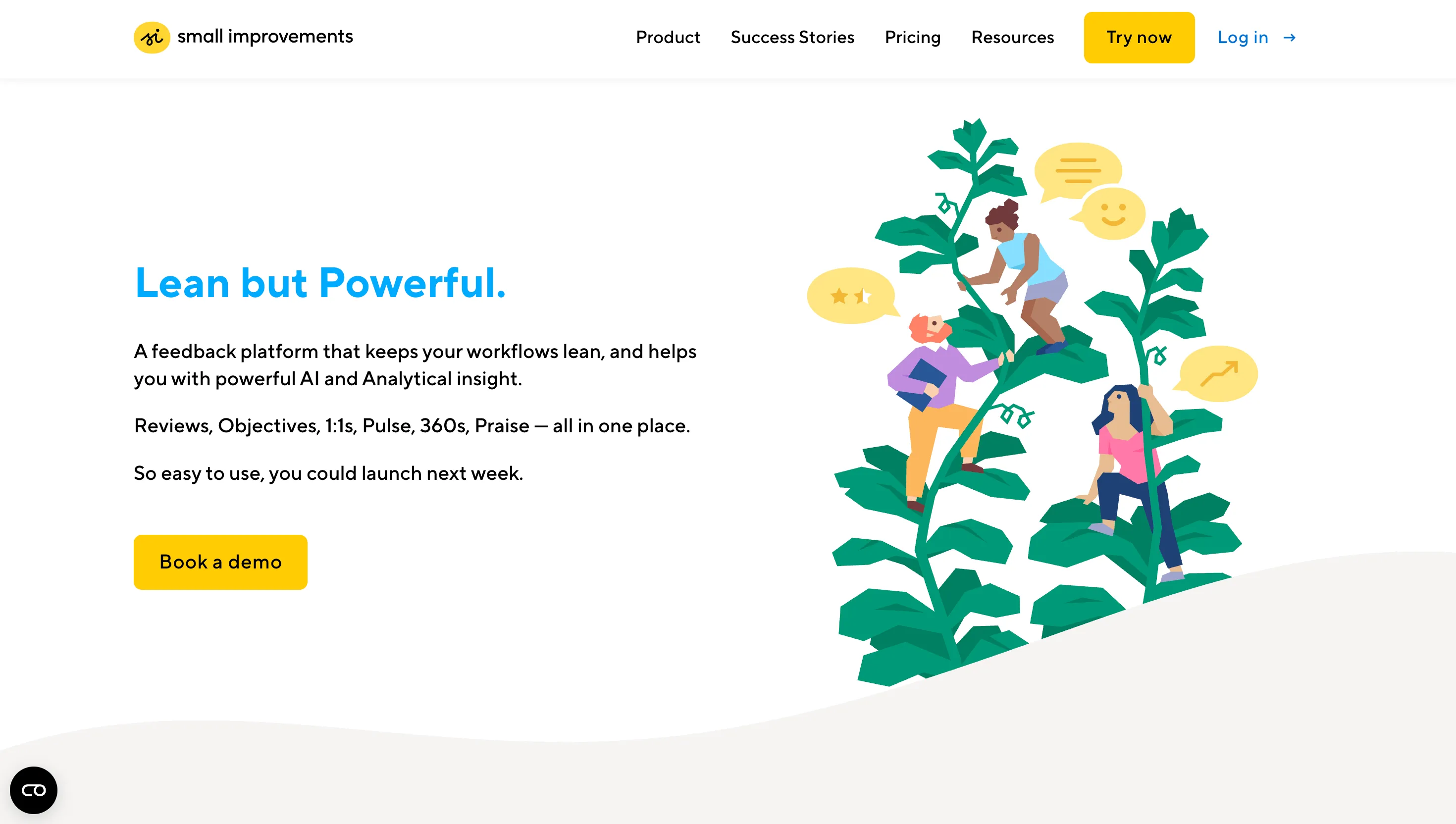
Overview: Small Improvements is a lightweight performance management platform combining reviews, 1:1s, continuous feedback, and praise — designed for teams that want a flexible, easy-to-adopt tool without enterprise overhead.
Strengths:
- Very easy to use, with little training required for both admins and employees
- A flexible set of features supports performance reviews, 1:1 meetings, continuous feedback, cascading objectives, and praise
- Continuous feedback and shared 1:1 agendas that support ongoing conversations
- New Manager Activation Scores and post-1:1 ratings help surface and support managers who may be struggling
Limitations:
- Analytics and reporting are more limited compared to enterprise-focused solutions
Integration & Onboarding: Integrates with common HRIS systems and tools like Slack and Google Workspace, with fast onboarding and no implementation overhead.
Pricing Range: Low-end pricing within the category, starting at $3 per user per month, with no seat minimums or implementation costs.
Best For: Smaller and mid-sized teams looking for a simple, affordable performance tool without sacrificing core review and feedback workflows.
4. Leapsome
Overview: Leapsome is a unified people enablement platform combining OKRs, performance reviews, feedback, and learning into a single modular system.
Strengths:
- Strong competency and OKR frameworks with deep customization
- Integrated learning and development linking performance to growth
- Modular structure allows flexible adoption by maturity level
Limitations:
- Steeper learning curve for first-time users
- Setup and customization can be time-intensive for complex organizations
Integration & onboarding: Integrates with Slack, Jira, Google Workspace, and primary HRIS tools. Supports learning integrations (LinkedIn Learning, SCORM). Guided onboarding included.
Pricing range: Mid-range, per-user pricing with modular flexibility. Scales with feature adoption and organization size. Enterprise options available.
Best for: Organizations investing in structured growth systems seeking tightly integrated performance, OKRs, and learning.
5. Culture Amp
Overview: Culture Amp is best known for engagement analytics and benchmarking, with performance management layered into a broader employee experience platform.
Strengths:
- Industry-leading benchmarks and people analytics
- Strong insights into engagement, sentiment, and performance trends
- Trusted data model for culture and retention analysis
Limitations:
- Less workflow automation compared to performance-native tools
- Entry-level plans limit integrations and configuration
- Can become expensive for smaller organizations
Integration & onboarding: Integrates with Slack, Microsoft Teams, and a wide range of HR platforms. Full implementations typically require several weeks for setup and data configuration.
Pricing range: Mid-range to high, with pricing increasing based on employee count, feature depth, and analytics access. Annual contracts standard.
Best for: HR teams that prioritize data-driven insights, benchmarking, and engagement analytics alongside performance management.
6. 15Five
Overview: 15Five is a lightweight performance and feedback tool focused on weekly check-ins, continuous feedback, and recognition.
Strengths:
- Fast adoption with intuitive, manager-friendly UX
- Strong support for remote and hybrid teams
- Weekly cadence encourages a continuous feedback culture
Limitations:
- Limited analytics depth compared to enterprise platforms
- OKR functionality is basic relative to specialized goal tools
- Fewer customization options for complex review cycles
Integration & onboarding: Integrates with Slack, Microsoft Teams, Google Calendar, and major HRIS systems. Onboarding is quick with minimal setup required.
Pricing range: Affordable, SMB-friendly pricing with tiered plans. Costs increase as advanced performance and manager enablement features are added.
Best for: Teams that want simple, frequent feedback and check-ins without enterprise complexity.
7. Betterworks
Overview: Betterworks is an enterprise-grade OKR and performance management platform designed for large-scale strategic alignment.
Strengths:
- Strong OKR alignment across complex organizations
- AI-supported goal creation and progress insights
- Enterprise-grade security, governance, and scalability
Limitations:
- Longer implementation timelines
- Higher complexity for organizations new to OKRs
- Less suitable for smaller or mid-market teams
Integration & onboarding: Integrates with Slack, Microsoft Teams, and major enterprise HRIS platforms. Vendor-led implementations with structured onboarding programs.
Pricing range: Enterprise-level pricing with custom contracts. Costs scale with organization size, deployment scope, and implementation needs.
Best for: Large enterprises running formal OKR programs requiring strong governance and strategic visibility.
8. Peoplebox
Overview: Peoplebox is a startup-focused, AI-assisted OKR and performance management platform optimized for fast-growing teams.
Strengths:
- Simple OKR setup with AI-driven recommendations
- Fast implementation without heavy configuration
- Startup-friendly product and pricing model
Limitations:
- Narrower feature set than enterprise suites
- Limited advanced analytics and reporting
- Smaller integration ecosystem
Integration & onboarding: Integrates with Slack, Jira, Google Workspace, and standard HRIS tools. Setup typically takes days.
Pricing range: Affordable, tiered pricing designed for startups and scaleups. Scales gradually with feature adoption.
Best for: Growth-stage startups seeking simple OKR and performance tracking without enterprise overhead.
9. Zavvy
Overview: Zavvy focuses on performance management through learning and development journeys, connecting feedback directly to growth.
Strengths:
- Strong linkage between feedback, reviews, and development plans
- Integrated onboarding, training, and career frameworks
- Customizable 360-degree feedback workflows
Limitations:
- Smaller integration and partner ecosystem
- Less advanced analytics than specialist platforms
- Limited OKR depth
Integration & onboarding: Integrates with Slack, Google Workspace, and common HRIS platforms. Guided onboarding typically completed within weeks.
Pricing range: Mid-range pricing, often bundled with broader learning or people enablement offerings.
Best for: Learning-driven cultures wanting performance management tightly embedded with development.
10. PerformYard
Overview: PerformYard is a flexible performance review platform designed for organizations with particular workflow requirements.
Strengths:
- Highly customizable review templates and cycles
- Strong reporting without technical configuration
- Dedicated customer success support included
Limitations:
- Less emphasis on continuous feedback automation
- Limited OKR and goal-management capabilities
- More review-cycle focused than real-time enablement tools
Integration & onboarding: Integrates with major HRIS platforms, Slack, Microsoft Teams, and SSO. Guided onboarding included.
Pricing range: Mid-range, transparent pricing that scales by feature set rather than usage complexity.
Best for: Professional services firms and teams needing tailored review workflows.
11. Mesh.ai
Overview: Mesh.ai is an AI-powered performance platform delivering personalized insights and automated feedback.
Strengths:
- AI-driven recommendations for managers and employees
- Continuous performance automation reducing admin work
- Predictive insights into performance trends
Limitations:
- Smaller ecosystem than legacy platforms
- Fewer enterprise-grade reporting and compliance features
- Newer product with a smaller customer base
Integration & onboarding: Integrates with Google Workspace, Microsoft tools, Jira, and calendars. Fast implementation with optional premium onboarding.
Pricing range: Affordable to mid-range pricing with clear differentiation between core and advanced AI features.
Best for: AI-forward organizations prioritizing automation and personalized performance insights.
12. Mirro
Overview: Mirro combines real-time feedback, OKRs, and recognition into a single platform designed for growing organizations.
Strengths:
- Simple UX driving high participation
- Real-time feedback and OKR dashboards
- Built-in recognition that encourages engagement
Limitations:
- Limited automation for complex review cycles
- OKR depth below specialist platforms
- Smaller integration ecosystem
Integration & onboarding: API-based integrations with Slack and other tools. Includes onboarding support, workshops, and ongoing enablement.
Pricing range: Mid-range, custom pricing based on organization size and deployment scope.
Best for: Mid-sized companies seeking feedback, OKRs, and recognition in a single lightweight platform.
13. Engagedly
Overview: Engagedly combines performance management with engagement and recognition, using gamification to drive adoption.
Strengths:
- Strong recognition and social feedback features
- Gamification encouraging participation
- Integrated goal-setting and performance reviews
Limitations:
- Heavier interface than lightweight alternatives
- Less emphasis on continuous feedback workflows
- Limited depth in advanced OKR management
Integration & onboarding: Integrates with standard HR systems. Multiple onboarding models available, from self-serve to fully managed.
Pricing range: Mid-range, modular pricing with bundled discounts for larger deployments.
Best for: Culture-focused organizations emphasizing engagement and recognition alongside performance.
14. Synergita
Overview: Synergita is a cloud-based performance management platform focused on structured appraisals, goal tracking, and employee development, commonly used by traditional HR teams modernizing their performance processes.
Strengths:
- Strong support for structured performance appraisals and rating cycles
- Goal tracking and competency frameworks suitable for hierarchical organizations
- Automation for performance reviews and employee development plans
Limitations:
- User interface feels dated compared to newer platforms
- Limited flexibility for continuous, real-time feedback workflows
- Analytics and reporting depth is more basic than AI-native tools
Integration & onboarding: Integrates with standard HRIS systems and offers API access for custom integrations. Onboarding typically follows a guided, process-driven implementation approach.
Pricing range: Affordable to mid-range pricing, typically positioned below enterprise suites. Costs scale with employee count and selected performance modules, with annual contracts as default.
Best for: Traditional HR teams and established organizations seeking to digitize appraisal-driven performance management without adopting fully AI-native or continuous enablement models.
15. Teamspective
Overview: Teamspective is a leadership enablement platform turning people data into actionable insights through real-time feedback and AI-driven agendas.
Strengths:
- Real-time Slack-based insights and meeting agendas
- AI agent supporting leadership decision-making
- Modular approach across feedback, engagement, and network analysis
Limitations:
- Smaller customer reference base
- Limited customization compared to mature suites
- OKR functionality is less developed than dedicated tools
Integration & onboarding: Native Slack integration with HRIS support. API, SSO, and enterprise integrations available.
Pricing range: Affordable, modular pricing with free entry tiers and scalable paid options.
Best for: Organizations prioritizing leadership enablement and real-time performance conversations inside Slack.
Recap: Which alternative is best?
- Best AI-native alternative: Taito.ai
- Best for structured enterprises: Lattice
- Best for OKRs + development: Leapsome
- Best lightweight option: 15Five
- Best HR-suite replacement: HiBob (when HR + performance must live together)
Closing Summary
HiBob’s Talent Module works well for teams wanting performance management tightly coupled with HR operations. Yet as organizations move toward “continuous, AI-enabled performance enablement,” many are choosing more specialized tools that automate feedback, clarify expectations, and support real-time growth.
The right alternative depends on whether performance is treated as an HR process or as a “weekly operating system for growth.”
FAQs
Is HiBob’s Talent Module enough for performance management? For many teams, yes—especially when HR integration is the priority. For deeper enablement, alternatives offer more automation.
Which tools go deeper than HiBob for performance? Taito.ai, Leapsome, and Lattice provide more advanced performance workflows.
Which HiBob alternatives use AI most effectively? Taito.ai and Mesh.ai lead in AI-supported feedback and coaching.
What’s the easiest alternative to implement? 15Five, Peoplebox, and Taito.ai offer fast onboarding.
Which is best for continuous feedback cultures? Taito.ai, 15Five, and Leapsome focus strongly on ongoing feedback loops.