Blog/Guides
Rippling alternatives: the 9 best competitors compared for 2026
Nine Rippling alternatives compared on published pricing, setup effort and company size, for teams that use Rippling mostly for people operations.

TL;DR
- What decides it: how much of Rippling you use. Replacing its people operations layer is one project. Replacing payroll, benefits, and device management as well is three.
- Least setup: Taito.ai, a people operations system for teams of 30 to 300, set up in under 30 minutes and run from Slack, with one tier and every module included.
- Most readable pricing for a small team: Charlie HR, which publishes flat monthly bands by headcount instead of a per-seat rate.
- Best published per-employee rate card: BambooHR at $10, $17, and $25 per employee per month across Core, Pro, and Elite.
- Lowest per-user rate for an all-round tool: Factorial, from $8 per user per month.
- Best for performance programs: Lattice, with Foundations at $13 per seat per month and a $4,000 annual minimum.
- Best for hiring abroad: Deel, at $599 per employee per month to employ people in countries where you have no local company.
- Hardest to budget: HiBob and Humaans, neither of which publishes rates.
What is Rippling?
Rippling is a workforce management platform that unifies HR, finance, and IT in one system. Employee records, payroll, benefits, time and attendance, expense management, corporate cards, device management, and identity and access share one platform, with workflow automation and reporting across all of it. Rippling sells each product individually. Its pricing FAQ states that every HR, finance, and IT product is purchased alongside the core, required Rippling Platform. Most products are billed per employee per month, and some carry a monthly base fee.
Rippling’s strength follows from that architecture. When an employee joins, one record drives payroll enrollment, benefit election, a provisioned laptop, and application access, without four systems being reconciled by hand. For a company that wants those four things to move together, few other products do it in one platform.
Why consider Rippling competitors?
Scope you may not need. A 40-person company that needs employee records, time off, documents, and a review cycle is buying a platform designed to replace its payroll provider, its expense tool, and its device management as well. The required platform charge in Rippling’s pricing FAQ applies whether you buy one module or six.
Pricing that arrives by quote. Rippling’s pricing page has no rate card, only a quote request form. The FAQ confirms per-product billing on top of the required platform. BambooHR, Factorial, Charlie HR, Lattice, and Deel all publish figures you can read before talking to anyone.
Setup that scales with module count. Every module needs its permissions, approval chains, policies, and workflows decided before the first employee uses it. Each module you add is another set of those decisions, and all of them go to whoever owns operations. A company without that person has to find the time somewhere else.
Quick decision matrix
When you compare tools in this category, weigh the total price once platform fees, modules, and minimums are added. Then weigh the setup effort before first use, and whether anyone at your company will own the configuration.
| Tool | Best for | Key strength |
|---|---|---|
| Taito.ai | Teams that want people operations to run itself | Set up in under 30 minutes, runs in Slack, one tier at €10 per seat |
| BambooHR | Teams wanting a readable per-employee rate card | Published Core, Pro, and Elite rates with a flat small-team price |
| Factorial | Budget-conscious European small businesses | Published entry price from $8 per user per month |
| Charlie HR | UK small businesses under 100 people | Flat monthly bands by headcount, plus a 7-day trial |
| Humaans | Employee records for scaling teams | Onboarding automation and API access on its Growth plan |
| HiBob | Larger companies with an HR operations owner | Broad records coverage and a large integration marketplace |
| Lattice | Performance and goal programs | Per-module pricing published per seat |
| Leapsome | People enablement across reviews and learning | One framework across reviews, goals, surveys, and learning |
| Deel | Global hiring and employer of record | Published rates per hiring type across 130+ countries |
Source: each vendor’s pricing page, checked September 2026. Prices are the entry rate on the cheapest published tier. Taito.ai has one tier.
The top 9 Rippling competitors and alternatives in 2026
1. Taito.ai
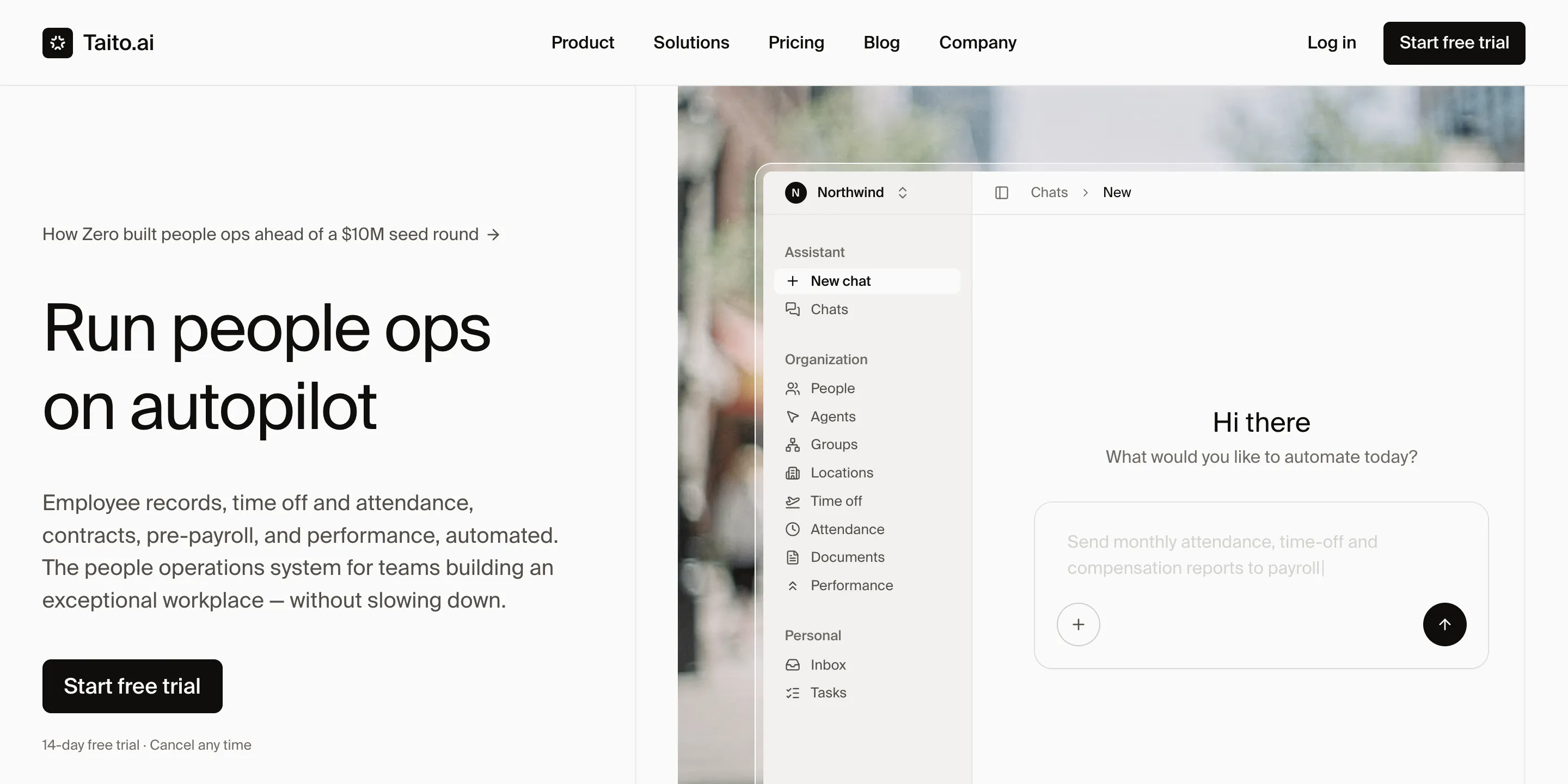
Overview: Taito.ai is a people operations system where ready-made agents run the process on top of the records. Review cycles run themselves once participants, prompts, and cadence are set. Feedback is collected in Slack, where the team already works, so nobody has to remember to open another system.
Strengths:
- Set up in under 30 minutes, with defaults that work from day one
- Review cycles that run end to end, including reminders and calibration prep: the context managers need for the meeting where they compare ratings across teams
- One tier at €10 per seat per month, or €8 on annual billing, with every module included
Limitations: No payroll, no device management, no expense management. It replaces Rippling’s people layer and nothing else. Analytics and enterprise reporting are still expanding.
Integration and onboarding: Slack and Google Workspace, payroll providers including Xero, Fortnox, and Netvisor, and applicant tracking systems including Ashby and Teamtailor. It also works from Claude.
Pricing: €10 per seat per month, €8 on annual billing. One tier.
Best for: Companies of roughly 30 to 300 people in the Nordics and Europe that want the cycle to run without someone owning it full time.
2. BambooHR
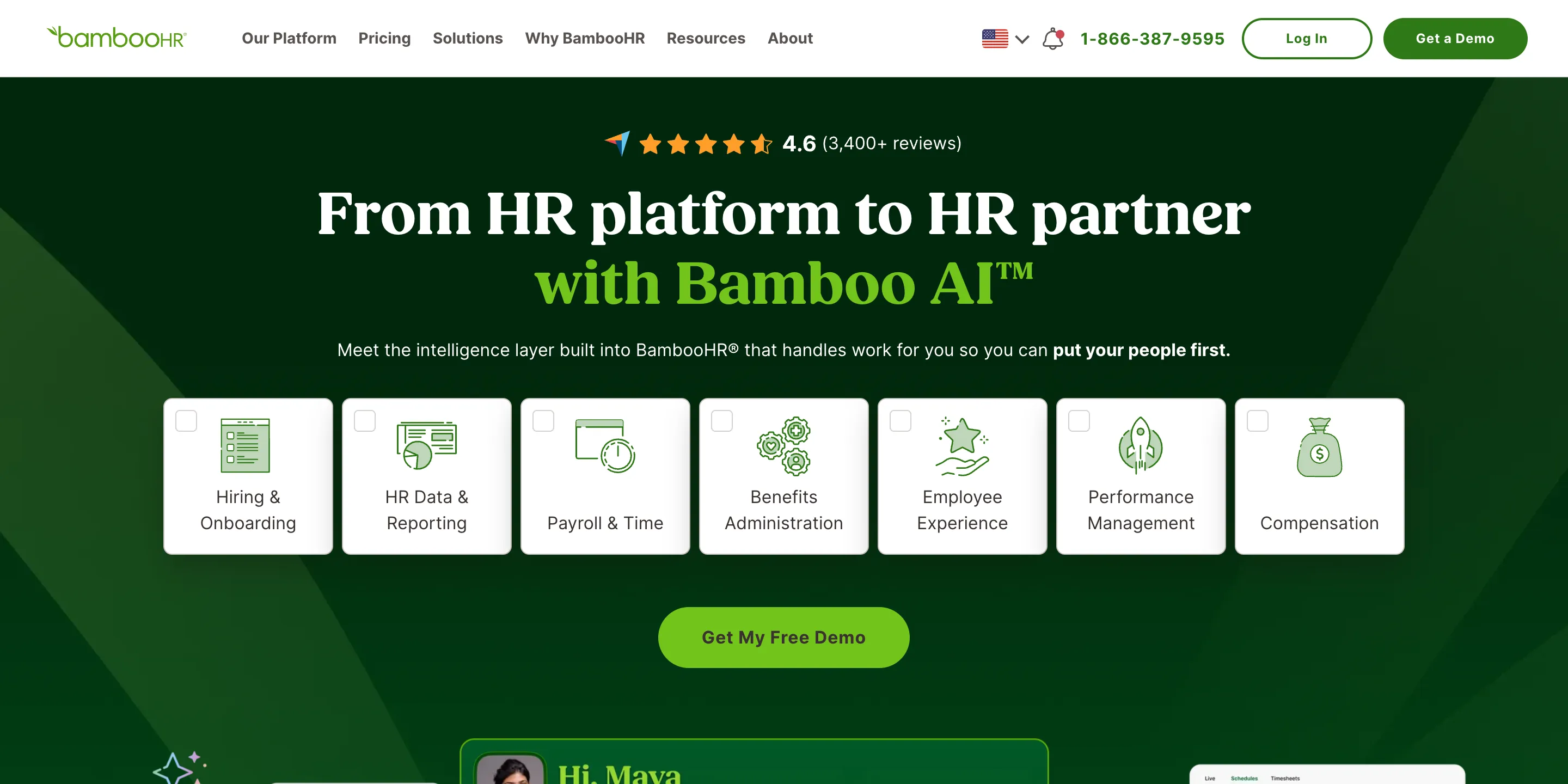
Overview: BambooHR is the established starter system for employee records, time off, and onboarding, and it has the clearest rate card in this comparison. Pricing is published at $10 per employee per month for Core, $17 for Pro, and $25 for Elite. Companies of 25 employees or fewer pay a flat monthly rate starting at $250.
Strengths:
- Published per-employee rates across three tiers, with month-to-month or extended terms
- Records, time off, and onboarding in one product, with a price you can read before a demo
Limitations: Minimum fee does not favor small teams: a 10-person company on the $250 monthly minimum pays $25 per employee per month.
Integration and onboarding: Self-serve signup, a large marketplace integration catalog, and implementation support bundled by tier.
Pricing: $10 / $17 / $25 per employee per month; from $250 per month flat at 25 employees or fewer.
Best for: Teams of 25 to 100 that want records and time off handled at a price they can plan against.
3. Factorial
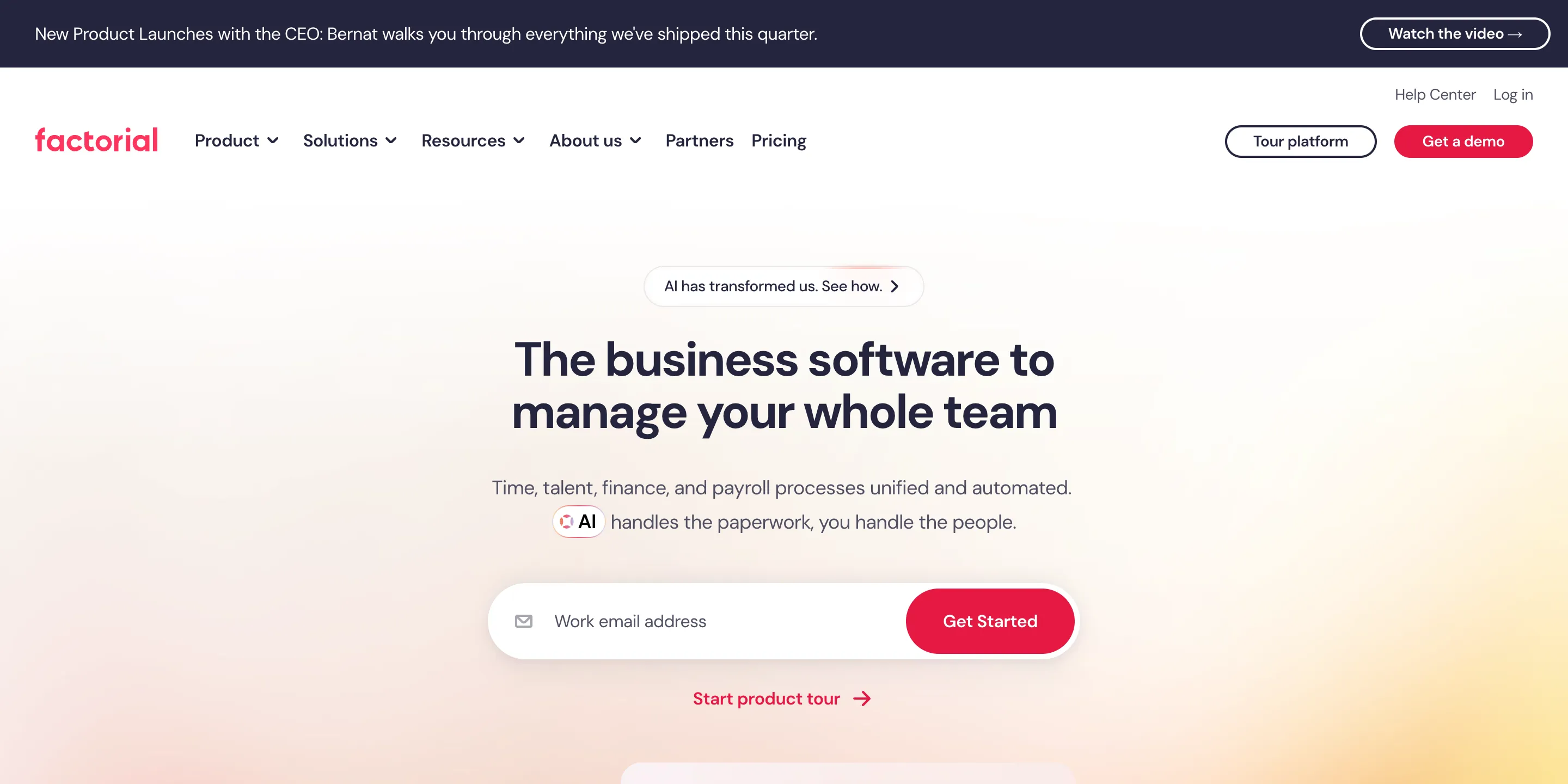
Overview: Factorial is a European people management platform covering records, time tracking, documents, and expenses, aimed at small and mid-sized companies on the continent. Its pricing page publishes an entry figure of $8 per user per month, the lowest per-user rate in this comparison for a tool with that breadth. For a company that wants a tool built around European practice, it is a natural shortlist entry.
Strengths:
- Lowest published per-user entry rate among the all-round tools here
- Broad functional coverage for the price, including time tracking, documents, and expenses
Limitations: The pricing page publishes one entry figure and routes the rest to a quote, so the price of the configuration you need is not readable in advance.
Integration and onboarding: Self-serve trial, published integration catalog, and guided onboarding on paid plans.
Pricing: From $8 per user per month.
Best for: European companies under 100 people that want wide coverage at a low published entry price.
4. Charlie HR
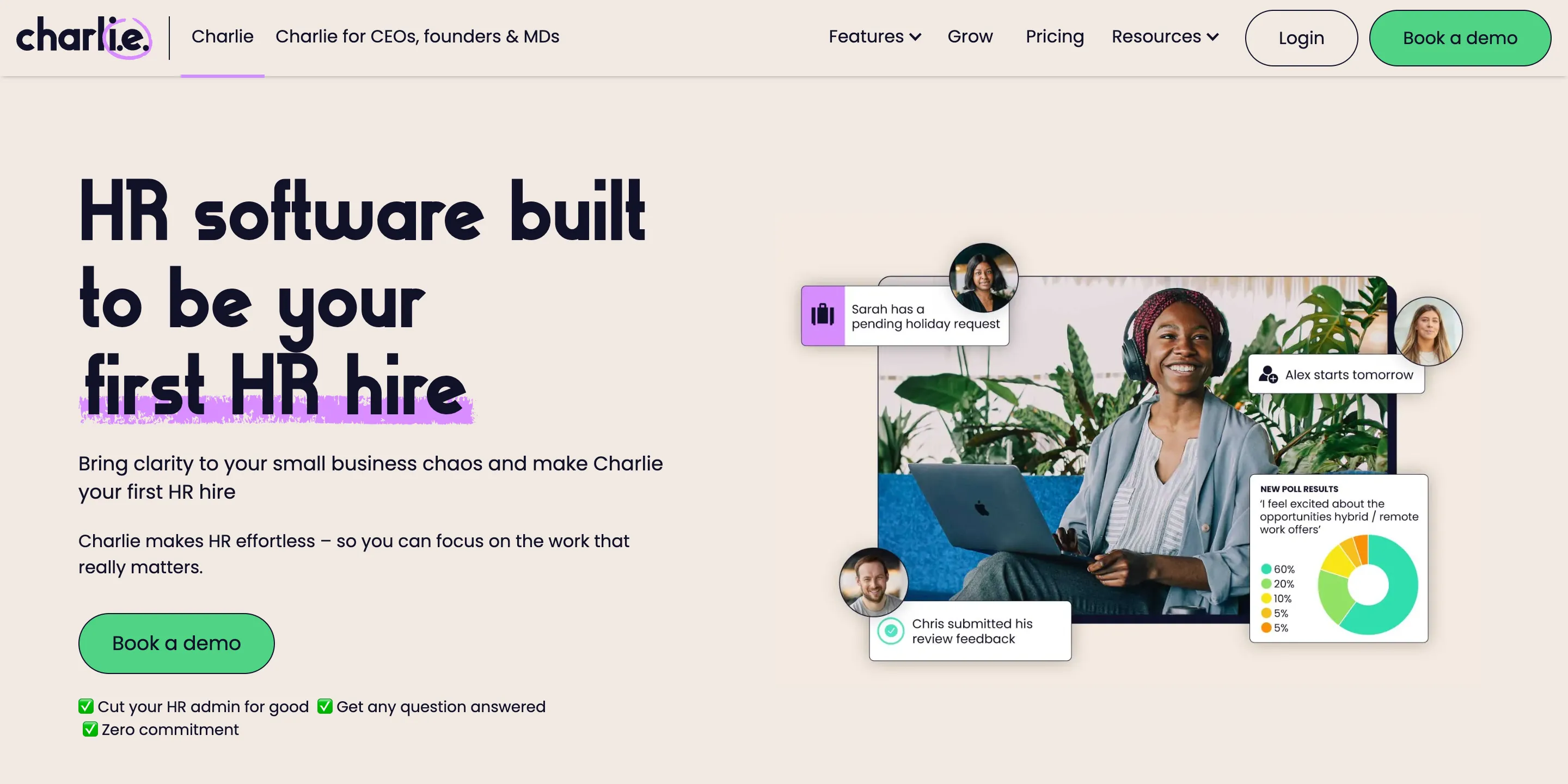
Overview: Charlie HR is built for UK small businesses, and it prices in a way few others in this comparison do: flat monthly bands by headcount, not a per-seat rate. It offers a 7-day free trial with no credit card required. A 12-person company can read its exact monthly bill off a public page.
Strengths:
- Flat monthly bands, published in full, so cost per employee falls as the team grows
- Self-serve from signup, with a 7-day trial
Limitations: Add-ons are priced separately, and they are expensive next to the core plan. The recruitment module starts at £55 per month and the advisory plan at £200. At 150 to 199 people the advisory tier reaches £1,038 per month, well above the core plan at that headcount.
Integration and onboarding: Self-serve signup, 7-day trial, UK-focused integration set.
Pricing: Flat monthly bands for the core plan, with add-ons priced separately:
- £47 per month at 5 to 14 employees
- £108 at 15 to 29
- £185 at 30 to 49
- £323 at 50 to 99
- up to £754 at 250 or more
Best for: UK companies under 100 people that want a readable monthly bill and no sales call.
5. Humaans

Overview: Humaans is an employee records system for scaling companies. Its Growth plan covers the people directory, documents, absence, timesheets, onboarding and offboarding automation, analytics, and integrations with API access. Enterprise adds single sign-on, unlimited custom fields and permission roles, audit log export, and a dedicated sandbox, a copy of the system for testing changes. Both plans route to sales with no figure attached.
Strengths:
- Onboarding and offboarding automation included on the Growth plan
- API access and integrations from the Growth plan up
Limitations: No published price on either plan, so budgeting requires a sales conversation, the same obstacle that sends people looking past Rippling. Single sign-on is available only on Enterprise.
Integration and onboarding: Integrations and API on Growth. Single sign-on through Okta or Microsoft Entra ID, and a dedicated sandbox, on Enterprise.
Pricing: Not published. Growth and Enterprise are both quoted by sales.
Best for: Companies of 100 to 300 people that want a clean records system and can accept a quoted price.
6. HiBob
Overview: HiBob is an employee records and people management platform aimed at mid-sized and larger companies, with a large integration marketplace and partner network. For a company of 300 or more people with a dedicated HR operations owner, it is a credible place to consolidate records.
Strengths:
- Records, time off, onboarding, and performance in one product
- Large integration marketplace and a mature partner network
Limitations: HiBob publishes no rates at all. Its pricing page redirects to a demo request with no figures on it. That is a harder starting point than Rippling’s, where at least the billing structure is described.
Integration and onboarding: Sales-led onboarding, broad marketplace integration catalog.
Pricing: Not published.
Best for: Companies of 300 or more people with a dedicated HR operations owner and budget for a sales-led buying process.
7. Lattice
Overview: Lattice is a performance and goals platform, and it publishes its seat rates openly. Foundations is a package at $13 per seat per month, and each base product can also be bought on its own. If you are leaving Rippling because you want more depth in performance reviews, this is the specialist replacement with a public price.
Strengths:
- Per-seat rates published for every base product and add-on, which is rare in this category
- Performance reviews, goals, calibration, and succession planning in one product
Limitations: The published minimum annual agreement is $4,000, so a small team pays the minimum whatever its seat count. At the $13 Foundations rate that minimum covers about 26 seats for a year, and a 12-person company pays roughly double what its headcount implies.
Integration and onboarding: Self-serve entry on the published package, Salesforce and Jira integrations on the goals product, and enterprise quotes for larger deployments.
Pricing: $4,000 annual minimum, and per seat per month:
- Foundations package: $13
- Base products: Performance $10, Goals and OKRs (objectives and key results) $8, Engagement $4
- Add-ons: Compensation $6, Grow $4
Best for: Companies of 100 or more that want a performance program as the center of the system.
8. Leapsome
Overview: Leapsome is a people enablement platform spanning reviews, goals, surveys, learning, and compensation, built for companies that want those programs to share one framework. It is deliberately configurable. That is a strength with an operations owner and a weakness without one. Customer success services go to customers on an annual contract of €6,000 or US$6,000 or more, and email support and the success center are available to everyone.
Strengths:
- One framework across reviews, goals, surveys, and learning
- Highly configurable competency and review structures
Limitations: Below the €6,000 annual contract threshold there are no customer success services, so a smaller team configures the platform itself, and configuration is the part that stalls. Module-based pricing is quoted, not published.
Integration and onboarding: Sales-led, with implementation support tied to the contract threshold above.
Pricing: Quoted. Customer success services from €6,000 or US$6,000 annual contract value.
Best for: Companies of 100 to 300 people with someone who owns HR operations and wants programs to share a framework.
9. Deel
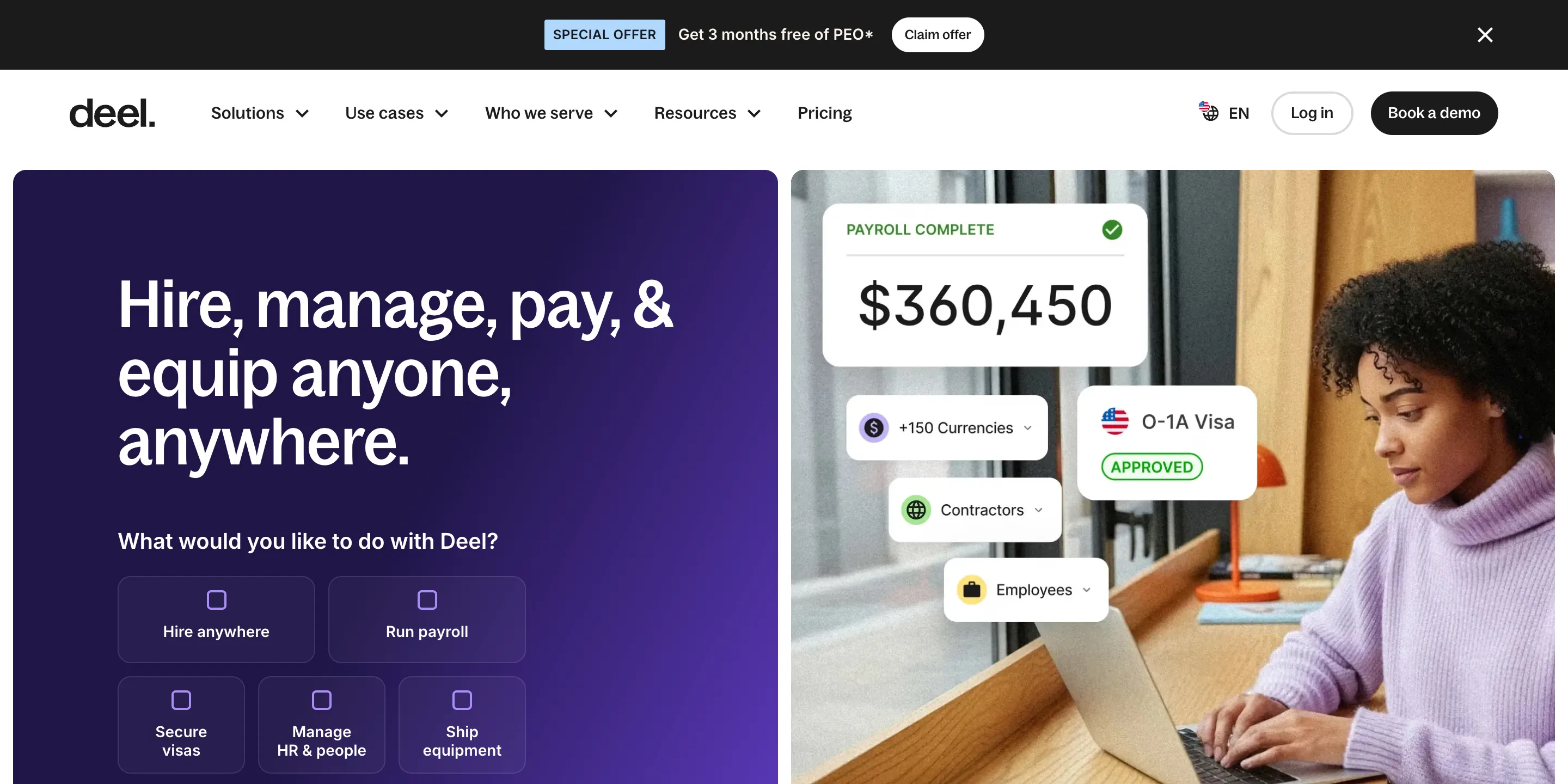
Overview: Deel is a global hiring platform covering 130 or more countries. Its published rates are organized by hiring type. If the part of Rippling you rely on is global employment, this is the direct comparison.
Strengths:
- Published rates for every hiring type, which is unusual in global employment
- Employer of record coverage in 130 or more countries, with payroll and compliance handled
Limitations: The pricing is built around employment structures, so a domestic company that wants records and a review cycle is buying a global employment product for a local problem.
Integration and onboarding: Sales-led for employer of record and PEO. Published integration catalog and API.
Pricing: Per person per month, by hiring type:
- Hiring product: $14 per worker
- Contractors: $49 per contractor
- Contractor of record, where Deel engages the contractor on your behalf: $325
- US PEO (professional employer organization), where Deel co-employs your US staff and runs their payroll and benefits: $125 per employee
- Employer of record, where Deel is the legal employer in a country where you have no company: $599 per employee
Best for: Companies hiring across borders without local entities, at any size.
Which Rippling alternative fits your company size?
| Company size | Strongest fit | Why |
|---|---|---|
| Under 25 | Charlie HR, Factorial | Flat bands and published entry rates, with no seat minimum to grow into |
| 25 to 100 | Taito.ai, BambooHR, Charlie HR, Factorial | Defaults that work without an operations owner, or a price you can read |
| 100 to 300 | Taito.ai, Humaans, Lattice, Leapsome | Program depth becomes worth configuring, and performance often decides |
| 300 and above | HiBob, Lattice, Rippling itself | Consolidation starts to justify its setup overhead |
| Hiring abroad | Deel | Employer of record and contractor compliance, priced per hiring type |
The size bands matter less than the ownership question underneath them. A configurable platform only delivers what it promises if somebody owns it, and below roughly 100 people that person usually does not exist. The test is to name the person who will define your review cycle, your permission model, and your approval chains. If you cannot, buy defaults, not flexibility.
The second question is how much of Rippling you run. Replacing its people layer is one project with one owner, and it usually takes two to four weeks. Replacing payroll, benefits, and device management at the same time is three projects, each with its own deadline. Payroll needs a clean tax-period boundary, benefits need an enrollment window, and every laptop has to be enrolled in a new device management tool.
How do you replace Rippling?
- List the Rippling modules you use, and mark each one as people operations, payroll, finance, or IT.
- Export everything before you cancel anything: employee records, documents, time-off balances, review history, and payroll reports.
- Pick a replacement per category, not one replacement for everything, unless you want another consolidated platform.
- Choose a cutover boundary. The start of a month works for people operations. Payroll needs the start of a quarter or a tax year.
- Run one cycle in parallel for anything with a deadline attached, payroll first among them.
- Keep the Rippling export as the read-only record for everything that closed before the switch.
- Cancel only once the first full cycle has closed cleanly in the new system.
How does Taito.ai compare to Rippling?
Rippling’s argument is consolidation: one platform for HR, finance, and IT, configured until it fits. Taito.ai’s argument is that people operations should run itself. The review cycle sends its own reminders, feedback arrives in Slack where the team already talks, and nobody logs into a new system to keep the process moving. Taito.ai is one tier at €10 per seat per month, or €8 on annual billing, with every module included and no setup fee. At 100 people that is about €12,000 a year, against more than €100,000 for a fully loaded people operations hire. It is set up in under 30 minutes. See how Taito.ai handles performance reviews, and join the waitlist to get access.