Blog/Guides
Culture Amp alternatives: 10 best competitors compared for 2026
Ten Culture Amp alternatives compared on published price, contract minimums, setup effort and company size, for teams replacing engagement surveys and reviews.
TL;DR
- What decides it: whether anyone at your company owns the system full time, and the total price once modules and contract minimums are added. Culture Amp’s engagement surveys are strong, so survey features alone rarely decide the switch.
- Cheapest to start: FeedbackPulse, free for up to 10 people, then $4 per employee per month billed annually.
- Lowest published per-seat rate: Small Improvements at $3 per user per month, though a 20-user minimum puts the real floor near $60 a month.
- Least setup: Taito.ai, a people operations system for teams of 30 to 300, and 15Five. Both come with working defaults.
- Most predictable total: Taito.ai at €10 per seat per month, or €8 on annual billing, with every module included and no implementation fee.
- Deepest enterprise analytics: Workday Peakon, if you already run Workday.
- Check the minimum: Lattice’s $13 seat price sits on a $4,000 minimum annual agreement.
- Quote first: Culture Amp, Leapsome, HiBob, CultureMonkey and Workday Peakon publish no per-seat price.
What is Culture Amp?
Culture Amp describes itself as an employee experience platform. It sells three products. Engage runs engagement surveys, which are regular, usually anonymous questionnaires on how employees feel about their work, their manager and the company. It also turns survey results into action plans. Perform covers performance reviews, continuous feedback, 1:1s and goals. Develop covers employee development plans. AI Coach works inside Engage and Perform.
Its main strength is benchmarking. You can read your scores against other companies’ scores, drawn from what Culture Amp calls the world’s biggest collection of employee insights. It says more than 6,000 companies use it. Its pricing page sorts buyers into three bands: under 200 employees, 200 to 999, and 1,000 or more. Price depends on employee count, products and service tier, and all products are billed annually.
Why consider Culture Amp competitors?
Teams look elsewhere for three reasons: what the product covers, quote-only pricing, and the setup needed before anything runs.
- Functional gaps: Culture Amp is an engagement and performance product. Employee records, onboarding, time off and the data payroll needs still run in a separate system, so a growing company operates two. A people operations system such as Taito.ai covers that operational work and performance in one place, continuous feedback included.
- Procurement gaps: Quote-only pricing means you cannot compare a Culture Amp total with anything until sales produces one. Alternatives that publish a number can be compared without a call: $3 at Small Improvements, $4 at FeedbackPulse and 15Five Engage, $13 at Lattice Foundations, €10 at Taito.ai.
- Setup weight: The flexibility that makes Culture Amp powerful at 1,000 people is overhead at 150. Survey cadence, question sets, permissions and action-planning templates all need a decision before the first result. Companies without a dedicated people operations person stall there.
Quick decision matrix
When you compare engagement and performance tools, weigh the total price once minimums are added, the setup effort before the first cycle, integration coverage, the depth of insights, and whether feedback runs all year or only inside a cycle.
| Tool | Best for | Key strength | Published entry price |
|---|---|---|---|
| Taito.ai | 30 to 300 people in Europe, no full-time HR owner | AI performance cycles on your existing data | €10 / seat / month, €8 annual. One tier, no minimum |
| Small Improvements | Small teams that want a working review rhythm | Lowest published per-seat rate | $3 / user / month annual. 20-user minimum (30 on Elevate) |
| CultureMonkey | Multilingual and frontline workforces | Surveys over mobile and QR codes | Not published. Over 1,000 employees quoted individually |
| FeedbackPulse | Teams under 25 starting to measure engagement | Free tier and published benchmarks | Free up to 10 people, then $4 / employee / month annual |
| Lattice | Several HR programs with one owner to run them | Every module rate published | $13 / seat / month (Foundations). $4,000 annual minimum |
| Leapsome | Goals, feedback and learning in one place | Competency frameworks | Not published. One-year minimum term |
| 15Five | Remote teams that want a weekly rhythm | Weekly check-ins | $4 / user / month annual (Engage) |
| Workday Peakon | Large organizations already on Workday | Predictive engagement analytics | Not published. Enterprise quote |
| Workleap (formerly Officevibe) | 50 to 250 people who want one annual package | Reviews and goals included in Standard | From $4,999 / year (Standard). Custom over 250 employees |
| HiBob | Moving HR tools into one platform | Records, time off and engagement in one system | Not published |
| Culture Amp (for reference) | Engagement and performance in one product | Benchmark dataset | Not published. Billed annually |
Source: each vendor’s pricing page, checked September 2026. Entry price is the cheapest tier that includes engagement surveys or reviews.
The top 10 Culture Amp competitors and alternatives in 2026
1. Taito.ai
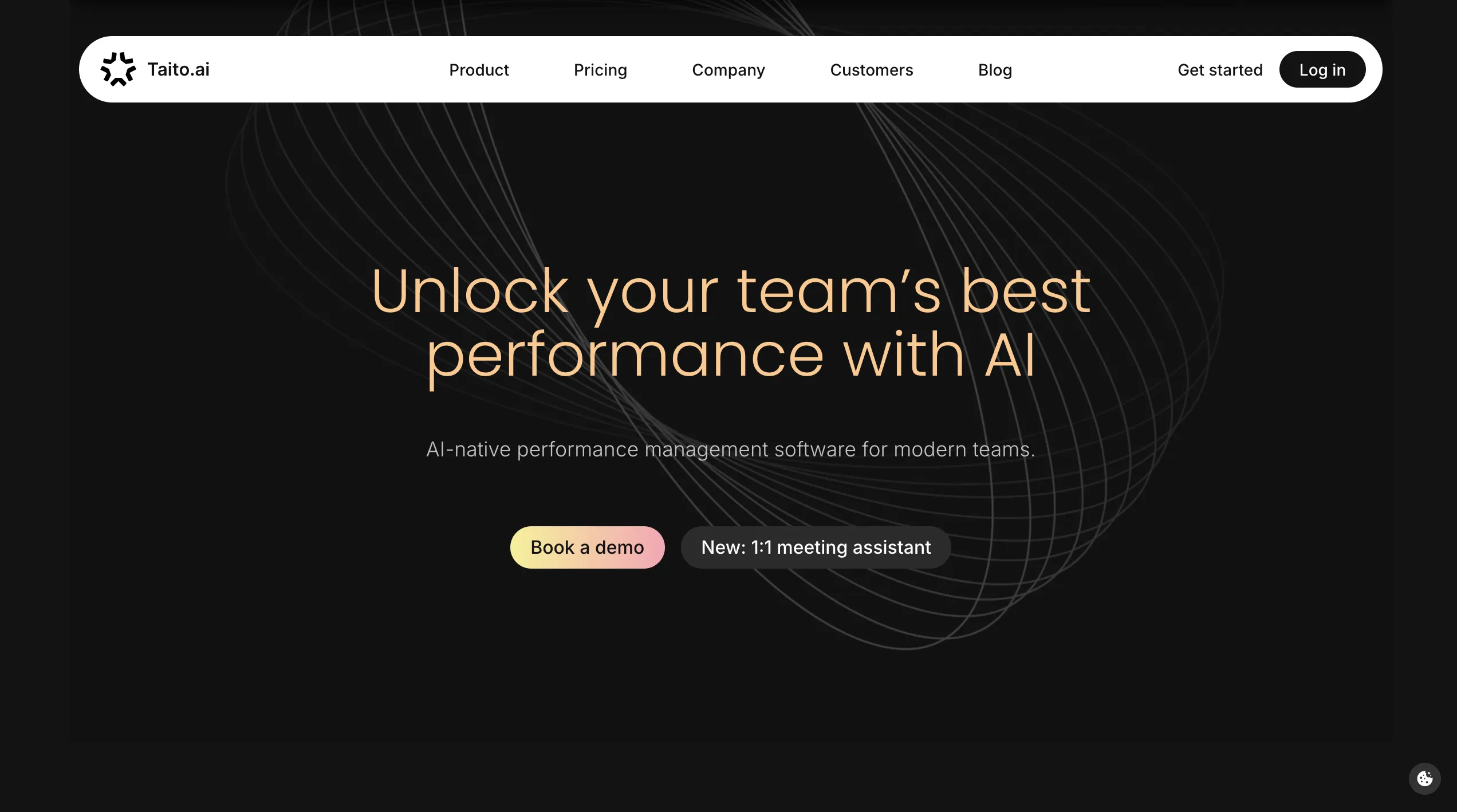
Overview: Taito.ai is a people operations system for companies of 30 to 300 people across the Nordics and Europe. Ready-made agents, software that carries a task from start to finish, run onboarding, time off, attendance, documents and performance from Slack, and hand a person only the decisions that need one.
Strengths:
- AI-run performance cycles on top of your existing people data and workflows, also in Slack
- Continuous feedback collected in Slack
- Reminders and review drafts handled by the agents, so the cycle finishes without a full-time owner
- Employment-law coverage for Finland, Sweden, Norway, Denmark, the UK and DACH (Germany, Austria and Switzerland), as of September 2026
- ISO 27001 information security certification, compliance with GDPR (the EU’s data protection law), and data stored in the EU
Limitations:
- No benchmark dataset to read your engagement score against other companies’ scores
Integration & onboarding: Set up in under 30 minutes, in Slack, with no implementation fee.
Pricing range: €10 per seat per month, or €8 on annual billing. One tier, every module and AI included.
Best For: Companies of 30 to 300 people in the Nordics and Europe that want the operational work to run itself.
2. Small Improvements
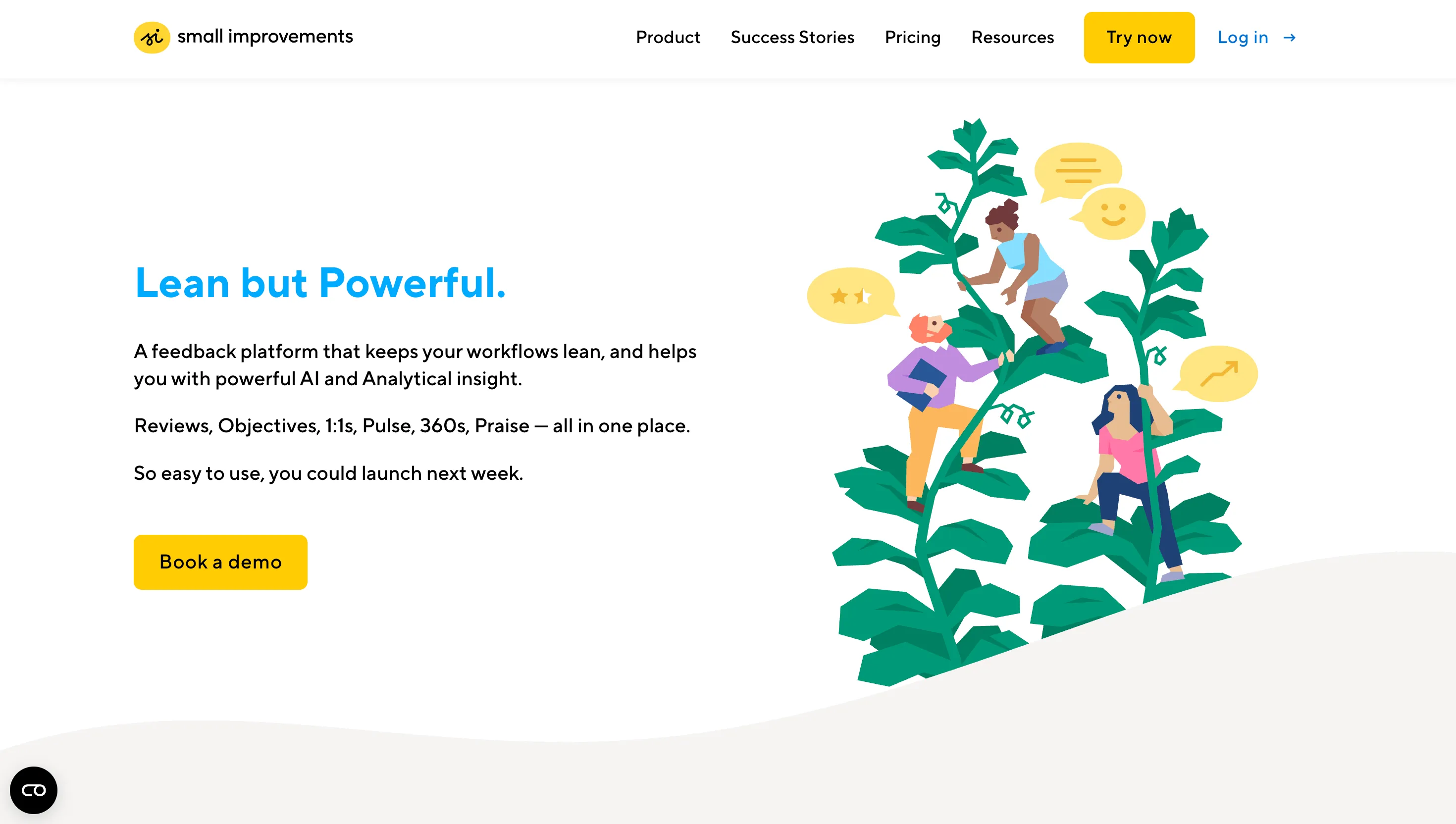
Overview: Small Improvements is a lightweight performance tool covering reviews, 1:1s (regular one-to-one meetings between a manager and an employee), continuous feedback, objectives and praise. It is deliberately narrow and leaves engagement analytics to other tools. Its Manager Activation Score and the ratings employees give after each 1:1 flag managers who are struggling.
Strengths:
- Lowest published per-seat rate among established performance tools
- Cascading objectives, meaning company goals broken down into team and individual goals
- Three published tiers, so the upgrade path is visible in advance
Limitations:
- Seat minimums of 20 users on Launch and Grow and 30 on Elevate put the real floor at about $60 a month
- No engagement benchmark dataset
Integration & onboarding: Self-serve setup, with connections to common HRIS platforms (HR information systems, where employee records live), Slack and Google Workspace.
Pricing range: $3, $6 and $9 per user per month, billed annually.
Best For: Small teams that want a cheap, working performance cycle and will measure engagement elsewhere.
3. CultureMonkey
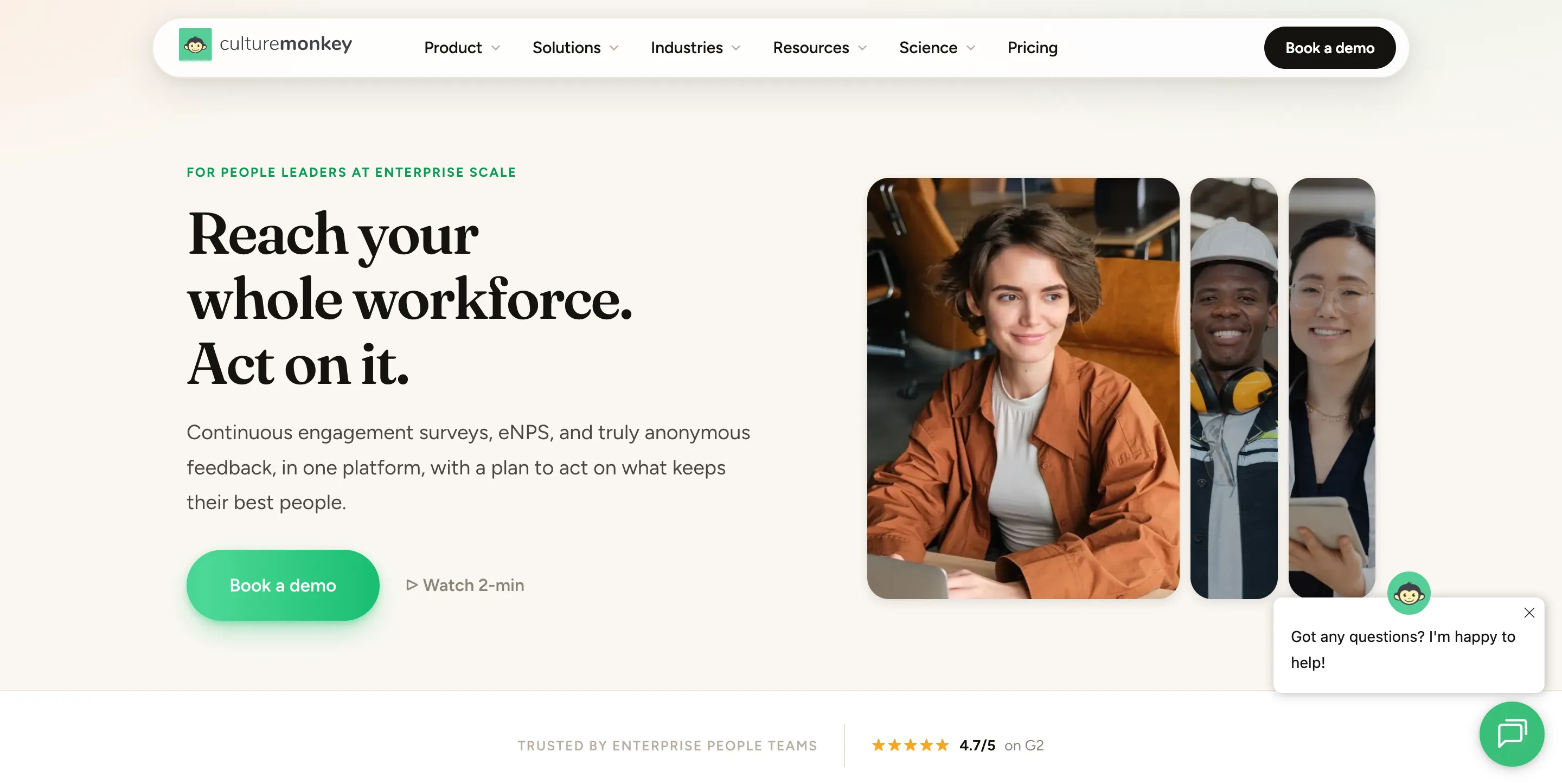
Overview: CultureMonkey runs anonymous surveys for distributed and multilingual workforces, delivered over mobile, email and QR codes. That reaches frontline and shift-based employees who rarely sit at a desk to read email. Heatmaps, color-coded tables of scores, break results down by role and location.
Strengths:
- Surveys in multiple languages, with mobile and QR delivery as well as email
- Segmentation by role and location
- One plan with a single paid add-on, per its pricing page, instead of a grid of modules
Limitations:
- Pricing is not published, so even a short evaluation starts with sales
- Engagement measurement only, so reviews and goals live in another tool
Integration & onboarding: Connects with ADP, Workday, BambooHR and other major HRIS platforms. Guided onboarding typically finishes inside five weeks.
Pricing range: Not published. Quoted on employee count, and individually above 1,000 employees.
Best For: Multilingual and frontline-heavy organizations where survey reach matters most.
4. FeedbackPulse
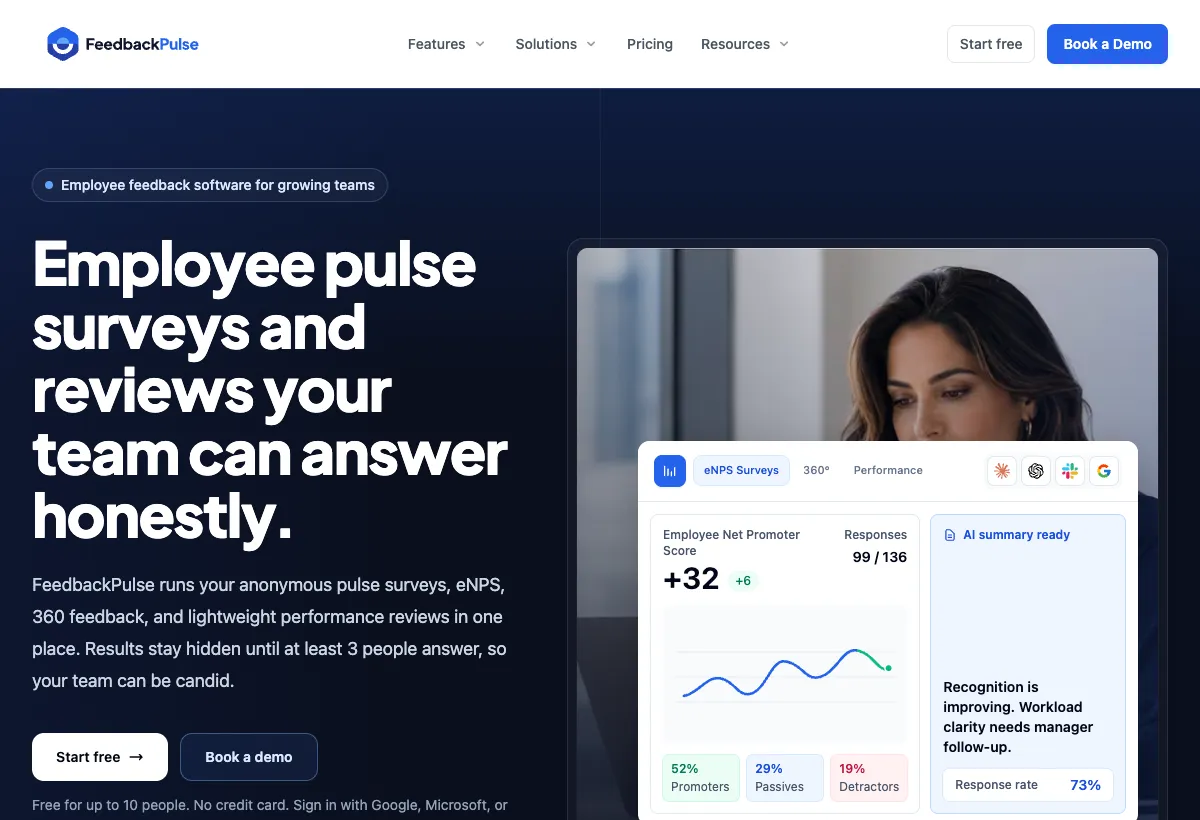
Overview: FeedbackPulse is an engagement and feedback tool for small and growing teams. It runs pulse surveys (short surveys repeated every few weeks), eNPS (employee Net Promoter Score) surveys, anonymous feedback, 360 peer reviews and performance reviews on one dataset. eNPS asks how likely employees are to recommend the company as a place to work.
Strengths:
- Free for teams up to 10 people, with no time limit
- Automatic eNPS scoring, with trends between survey rounds
- Free published eNPS benchmarks across 18 industries and 65 countries and regions, in its January 2026 snapshot
- Claude, ChatGPT and Microsoft Copilot can query results directly
Limitations:
- Not a system of record: no payroll, benefits administration or employee records
- Built for 10 to 500 people, so custom service-level agreements and complex permissions sit on the sales-led plan
Integration & onboarding: Self-serve setup in minutes, with connections to common HRIS platforms.
Pricing range: Free up to 10 people. Pro at $4 per employee per month billed annually ($5 monthly), Max at $8 billed annually, enterprise on quote.
Best For: Small teams that want surveys and eNPS at a published price, usually alongside a people operations system.
5. Lattice
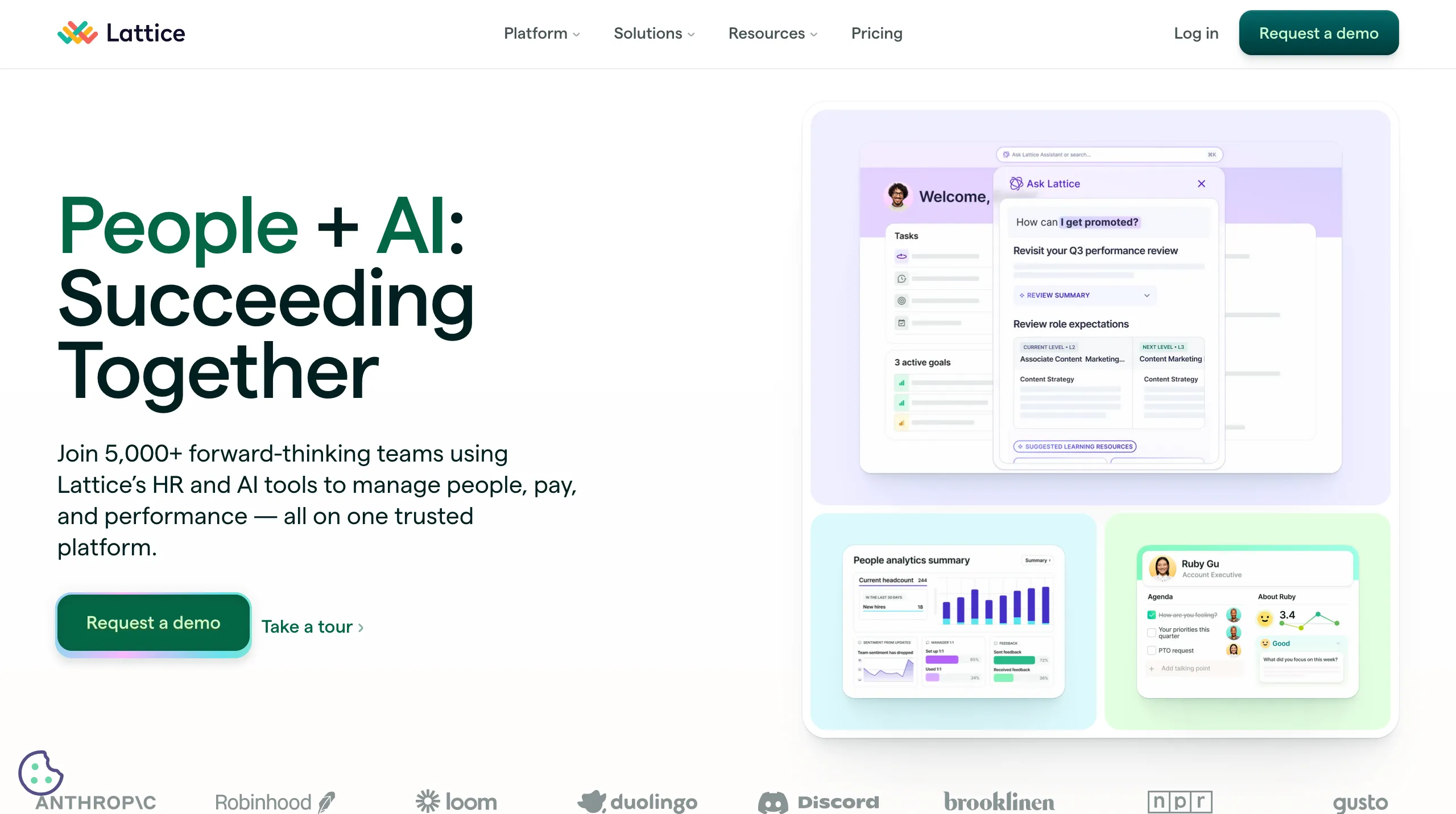
Overview: Lattice sells performance, goals, engagement, compensation and career growth as separate products on top of a Foundations package. It is the closest like-for-like replacement when Culture Amp runs your reviews as well as your surveys. Every module rate is on its pricing page, so the total is easy to rebuild.
Strengths:
- Published module rates: Foundations $13 per seat per month, Performance $10, Goals & OKRs (objectives and key results) $8, Engagement $4, Compensation $6, Grow $4
- 1:1s, Updates and Feedback included with Performance, Goals or Engagement
- No extra implementation fee for performance management, per its pricing FAQ
Limitations:
- A $4,000 minimum annual agreement, so a team under about 26 people pays for seats it does not have
- A working setup is usually several products: Foundations, Performance and Engagement together come to $27 per seat per month
Integration & onboarding: Single sign-on (SSO) providers, Slack, Microsoft Teams, Jira and major HRIS platforms. Lattice sells structured rollout support.
Pricing range: From $13 per seat per month plus modules, with a $4,000 annual minimum.
Best For: Organizations running several HR programs at once, with a people operations owner to configure them.
6. Leapsome
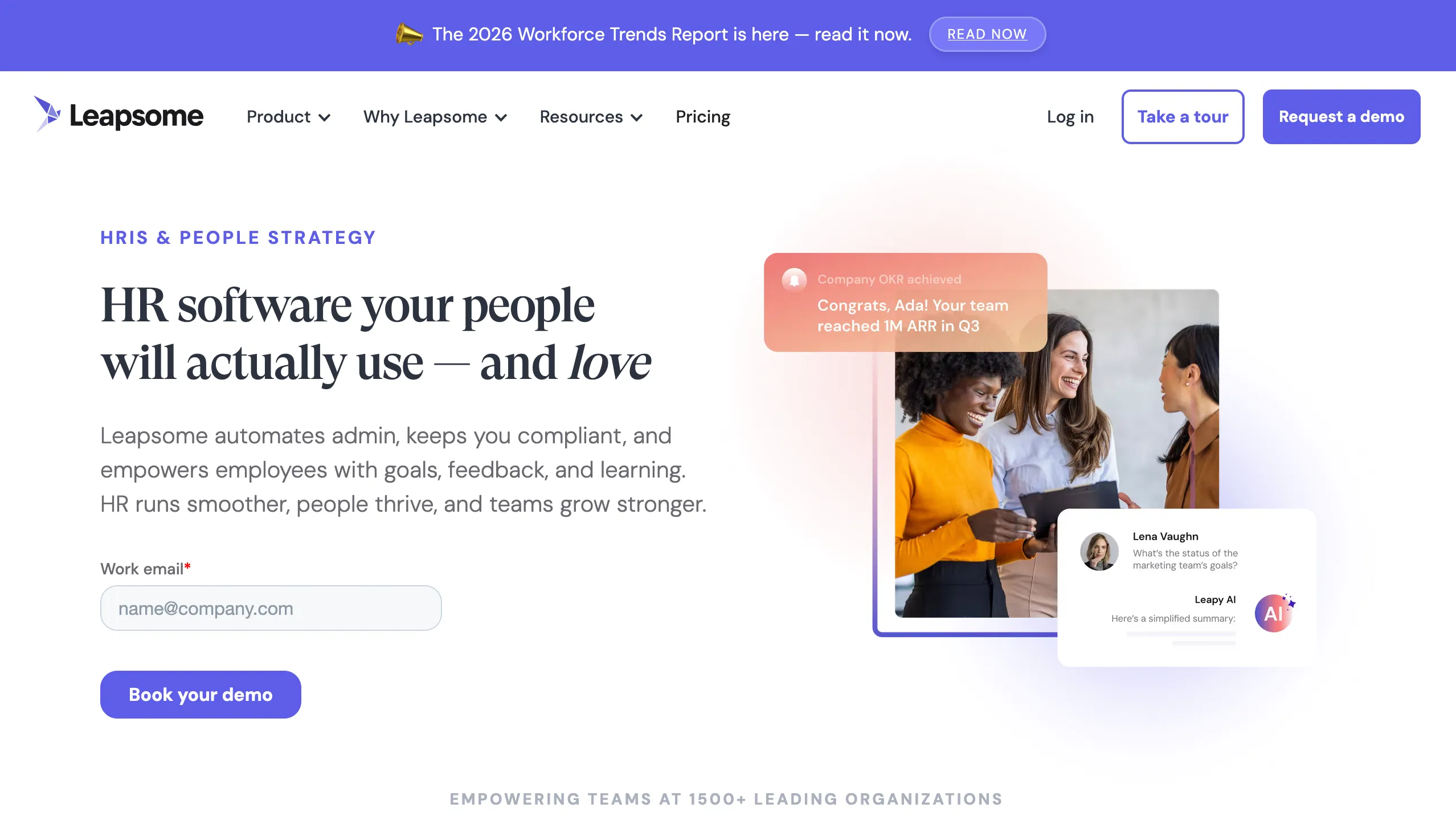
Overview: Leapsome connects performance management with learning and development. It is the strongest choice here when competency frameworks matter more than survey benchmarks. A competency framework is a written description of the skills expected at each level of a role. Leapsome’s flexibility is why it wins evaluations and why it takes work to roll out: review templates, competencies, goal structures and permissions all need decisions before the first cycle.
Strengths:
- Customizable competency frameworks and development paths
- Goal and OKR alignment across teams
- Learning, feedback and reviews on one platform instead of three
Limitations:
- No published per-seat price, and its pricing page states a one-year minimum contract term
- Customer success services are available only on annual contracts of €6,000 or US$6,000 and above, so smaller customers get email support
Integration & onboarding: Works with Slack, Jira and common HRIS platforms. Rollout typically takes two to four weeks.
Pricing range: Not published. Quoted on headcount, contract length and modules.
Best For: Teams with a people operations owner who will do the configuration work.
7. 15Five
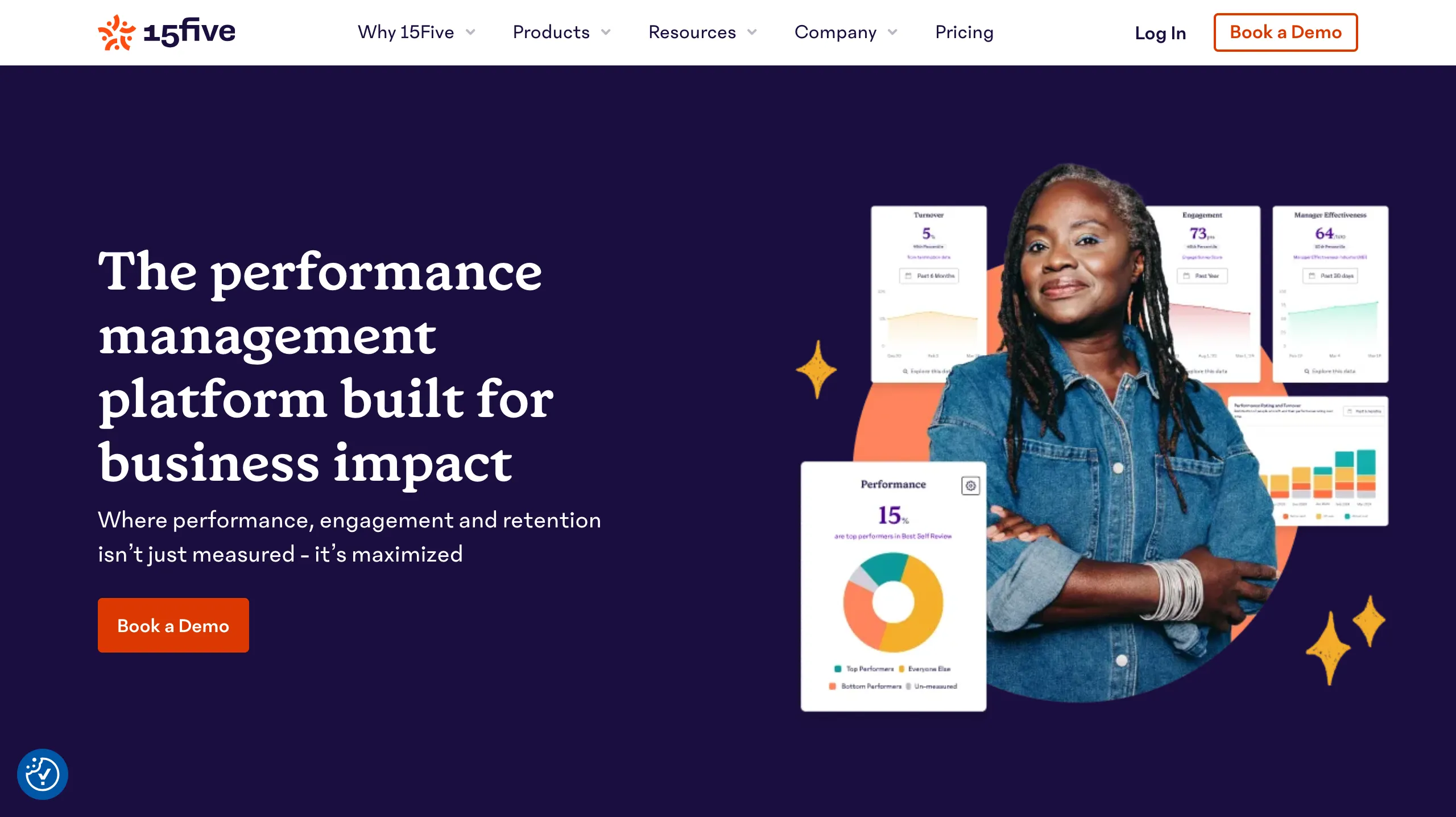
Overview: 15Five is built around a weekly rhythm of check-ins, feedback and recognition, instead of an annual measurement event. A check-in is a short written update from each employee to their manager on progress and blockers. It suits a team whose complaint about Culture Amp is that engagement only gets attention twice a year.
Strengths:
- Three published tiers
- Weekly check-ins that give managers a steady read on each employee between reviews
- Recognition and manager coaching tools built in
Limitations:
- Engagement surveys and performance reviews sit on separate tiers, so covering both takes the $16 Total Platform rate, four times the Engage price
Integration & onboarding: Slack and HRIS integrations, self-serve setup, no implementation project.
Pricing range: $4 per user per month for Engage, $11 for Perform, $16 for Total Platform, billed annually.
Best For: Remote and hybrid teams that want a weekly feedback rhythm at a published price.
8. Workday Peakon
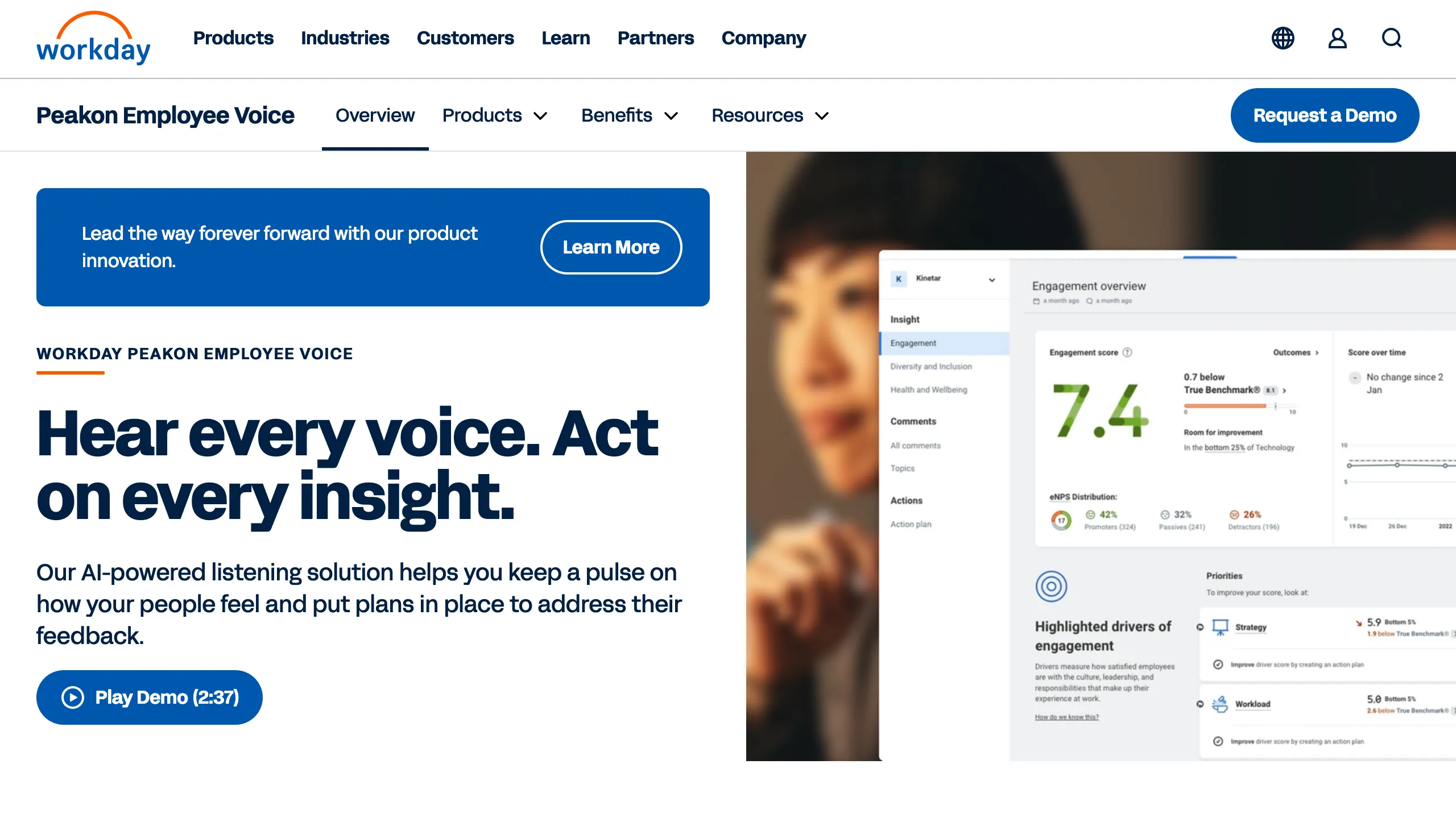
Overview: Peakon is now sold as Workday Peakon Employee Voice, and its own domain redirects to Workday’s product pages. It competes with Culture Amp directly at the top of the market. It offers continuous listening, meaning frequent short surveys instead of one annual survey, with predictive analytics on which teams may lose people.
Strengths:
- Real-time engagement analytics with predictive signals
- Scales to large organizations with many legal entities
- Native to Workday, so employee data needs no second integration
Limitations:
- No published pricing, and enterprise agreements are negotiated
- The case for it depends on already running Workday. As a standalone survey tool it competes with cheaper options
Integration & onboarding: Native to Workday. Rollout is an enterprise implementation project.
Pricing range: Not published. Enterprise quote only.
Best For: Large organizations already on Workday that want engagement analytics in the same system.
9. Workleap (formerly Officevibe)
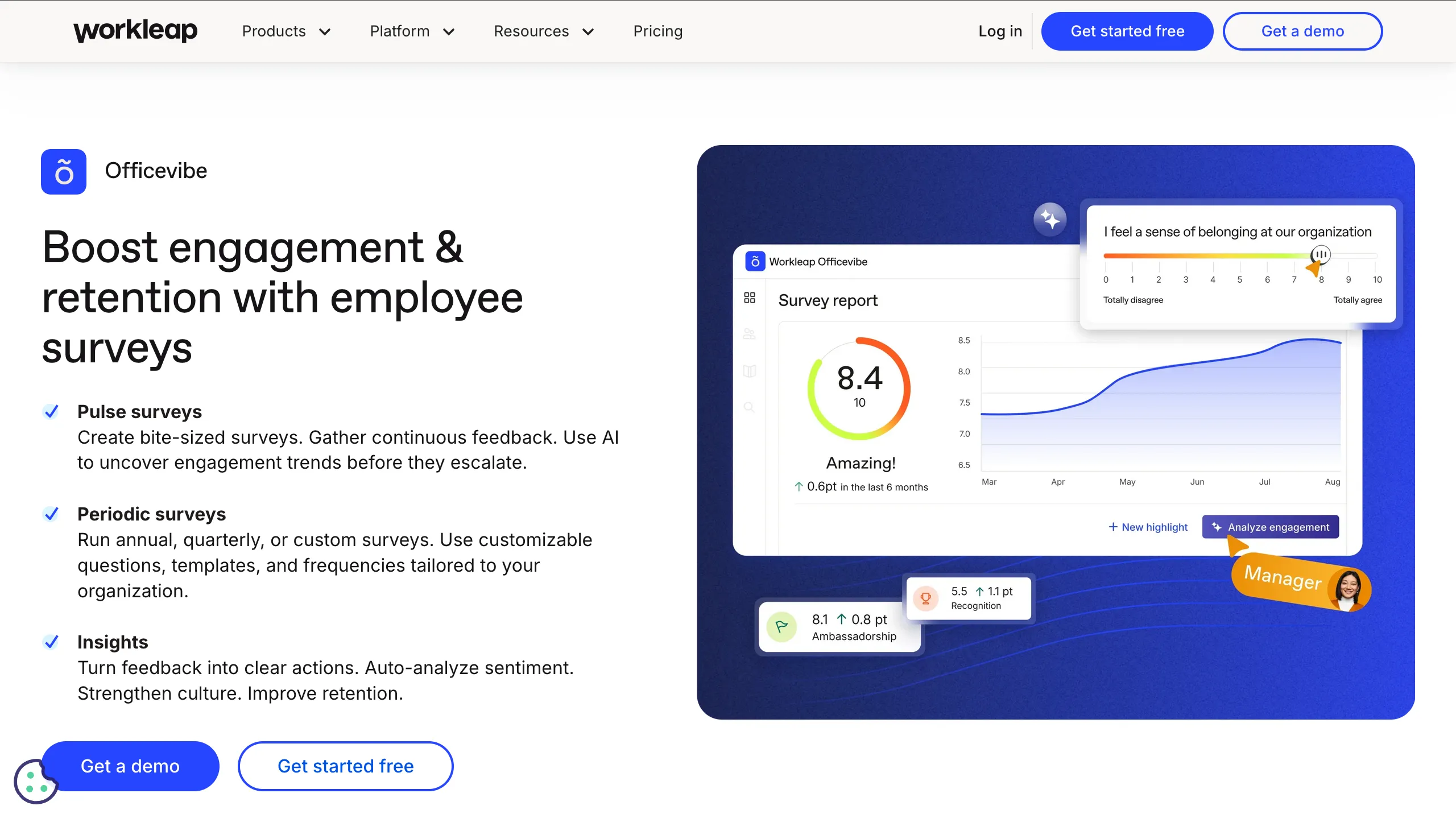
Overview: Officevibe is now Workleap, part of a wider suite covering team health, performance reviews and an org directory. Workleap publishes annual package prices instead of a per-user rate. At $4,999 a year, Standard works out to about $4 per person per month at 100 people and about $21 at 20.
Strengths:
- Published annual package prices
- Performance reviews, goals, recognition and an org chart included in Standard
- Accounts created automatically from HRIS, Slack, Office 365 and Google Workspace
Limitations:
- Package pricing means no low entry point for small teams
- Organizations over 250 employees move to custom pricing, so the published rates cover only the middle of the market
Integration & onboarding: Slack, Microsoft Teams, Office 365 and Google Workspace, with self-serve onboarding.
Pricing range: Standard from $4,999 and Pro from $11,999 per year, billed annually. Custom above 250 employees.
Best For: Companies of roughly 50 to 250 people that want engagement and reviews in one annual package.
10. HiBob
Overview: HiBob is an HR platform with engagement and performance modules inside it. It fits when employee records, time off and engagement live in three places. Its surveys and reviews come as modules of that platform, so you buy one system instead of three.
Strengths:
- Employee records, time off, engagement and performance in one system
- Integrations include Greenhouse for recruiting, Deel for international hiring, and Slack
- Reporting built for mid-sized organizations
Limitations:
- No published pricing: its pricing page leads to a guided quote form
Integration & onboarding: Connects with Greenhouse, Deel, Slack and common payroll providers. Rollout typically takes two to three weeks.
Pricing range: Not published. Quote only.
Best For: Mid-sized organizations moving people operations and engagement into one platform.
Which Culture Amp alternative fits your company size?
| Company size | Usual best fit | Why |
|---|---|---|
| Under 25 people | FeedbackPulse | Free to 10 people, then $4 per employee per month, no minimum |
| 25 to 100 people | Taito.ai, Small Improvements, 15Five | Working defaults, published rates, no implementation project |
| 100 to 300 people | Taito.ai, 15Five, Workleap | The cycle has to run without a full-time owner |
| 300 to 1,000 people | Lattice, Leapsome, HiBob | Configurability pays off once someone owns it |
| Over 1,000 people | Workday Peakon, CultureMonkey | Scale and multilingual reach matter more than setup speed |
Below about 100 people, the scarce resource is attention. Nobody owns the system full time, so a platform that needs configuring before it does anything will sit unused. The cheapest tool that runs a cycle beats the most capable one that does not.
Between 100 and 300 people, ownership decides. If you have hired a people operations person, the configurability of Lattice or Leapsome turns into processes that fit you better. If you have not, buy for the cycle you will run in the next six months, not for the company you expect at 800 people.
Nordic and European companies have a third question: employment-law coverage and where the data is stored. Taito.ai covers the Nordics, the UK and DACH as of September 2026, with data stored in the EU. Eletive in Sweden and Teamspective in Finland are the two Nordic-headquartered survey platforms that come up in the same evaluations. Neither publishes a per-seat price.
How do you replace Culture Amp?
- Export your engagement history, survey questions, benchmark reports and review records before the contract ends. Access ends with the contract, and the historical trend line is the part teams miss most.
- Decide what you are replacing. Engagement measurement, performance reviews and action planning are three jobs. Culture Amp does all three, and most alternatives do one or two.
- Get quotes for the total, not the rate. Add modules, seat or contract minimums and implementation fees before you compare anything with a published per-seat price.
- Pick the next survey or performance cycle as the cutover point. Do not switch mid-cycle.
- Run one cycle in parallel if the calendar allows. Keep the Culture Amp export as the record for anything that closed before the move.
- Allow two to four weeks between signing and the first cycle. Plan manager communication as the larger half of the work.
How does Taito.ai compare to Culture Amp?
Culture Amp covers engagement and performance. Taito.ai covers people operations as a whole: onboarding, time off, attendance, documents and performance, with continuous feedback collected in Slack. See how Taito.ai runs performance: end-to-end performance cycles with AI, and one tier at €10 per seat per month, or €8 on annual billing, with every module included and no implementation fee. Get access by joining the waitlist.
Sources
All pages checked September 2026.
- 15Five (n.d.) 15Five pricing.
- Culture Amp (n.d.) The market-leading employee experience platform.
- Culture Amp (n.d.) Pricing.
- CultureMonkey (n.d.) Employee engagement software pricing.
- FeedbackPulse (2026) eNPS benchmarks 2026.
- FeedbackPulse (n.d.) Pricing and plans.
- HiBob (n.d.) Pricing.
- Lattice (n.d.) Pricing.
- Leapsome (n.d.) Pricing.
- Small Improvements (n.d.) Pricing.
- Workday (n.d.) Workday Peakon Employee Voice.
- Workleap (n.d.) Pricing and costs.